What to Know Before Taking Magnesium Glycinate Long Term
For long-term use, the key questions are how much elemental magnesium you take, why you take it, and whether your kidneys or medicines change the picture.
Magnesium glycinate doesn’t have a separate long-term intake limit in NIH guidance. Check the “Magnesium” amount on Supplement Facts: that’s the elemental magnesium to count, not the weight of the glycinate compound. For adults, the upper limit from supplements and medicines is 350 mg a day; it doesn’t include magnesium from food. Kidney problems and certain medicines call for extra review. 1
Magnesium glycinate is one form of magnesium, but its name alone doesn’t tell you how much magnesium you’re taking or establish that it’s safer for long-term use. A useful review starts with the reason you take it, the elemental amount on the label, and any health conditions or medicines that could affect your magnesium balance.
Start with the amount that counts
Look at the Supplement Facts panel for the line that says Magnesium. That amount is elemental magnesium. It isn’t the total weight of magnesium glycinate in the capsule or powder. For example, if a label lists “Magnesium 120 mg (as magnesium glycinate),” count 120 mg toward your supplemental magnesium total, not the weight of the whole compound. 1
Add together elemental magnesium from all supplements and magnesium-containing medicines, including some antacids and laxatives. The adult upper limit is 350 mg per day from supplements and medicines combined. It does not include magnesium naturally found in foods and drinks. This limit is a ceiling set for intake unlikely to cause adverse effects, not a recommended target or a line that guarantees safety below it. 1
Food still matters when you’re considering whether your overall intake meets your needs. Adult women’s recommended daily intake is 310 mg through age 30 and 320 mg from ages 31 onward. Those recommendations include food, drinks, supplements, and medicines. The upper limit, by contrast, counts only supplements and medicines. 1
Match the supplement to the reason you take it
A supplement can be worth continuing when there’s a clear reason for it, but evidence depends on the intended use. For migraine prevention, a professional guideline summarized by NIH considers magnesium probably effective; the amounts commonly used in migraine studies can exceed the 350 mg upper limit, so this is a use to manage with a health care provider rather than self-escalate. For blood pressure, trials found only small average reductions over weeks to months. And NIH reports insufficient evidence to recommend magnesium routinely to improve blood sugar control in people with diabetes. 1
These findings aren’t proof that magnesium glycinate specifically produces those effects. They also don’t establish that taking it indefinitely is useful for someone whose goal or health situation differs from the groups studied. Revisit the reason for use if it’s unclear, if it hasn’t helped, or if you’re adding magnesium from another product.
What long-term safety evidence can and can’t tell you
The NIH guidance sets magnesium limits by the amount of elemental magnesium, not by glycinate versus another form. It doesn’t establish a special long-term safety advantage for glycinate. One 12-month randomized trial described in an abstract studied 224 adults in India with low magnesium and asthma or COPD. It reported no serious adverse events, but that finding in a particular group doesn’t settle long-term safety for everyone taking glycinate, and the abstract doesn’t clarify whether its stated 440 mg daily was elemental magnesium. 12
For supplements and magnesium-containing medicines, common effects of excessive intake include diarrhea, nausea, and abdominal cramping. The kidneys help remove excess magnesium, so the risk of toxicity rises when kidney function is impaired. If you have kidney disease or reduced kidney function, get the amount reviewed before continuing rather than assuming a usual supplement dose is appropriate. 1
Check pregnancy, breastfeeding, and medicines separately
Pregnancy and breastfeeding change the recommended total intake, but not the adult upper limit for magnesium from supplements and medicines. For women ages 19 to 30, the recommended intake is 350 mg daily during pregnancy and 310 mg during breastfeeding; for ages 31 to 50, it is 360 mg during pregnancy and 320 mg during breastfeeding. The adult supplemental-and-medicine upper limit remains 350 mg daily. Count magnesium in a prenatal vitamin and any other products, and review a separate magnesium supplement with the clinician overseeing your pregnancy or postpartum care. 1
Magnesium can reduce absorption of oral bisphosphonates such as alendronate and can bind with tetracycline and quinolone antibiotics, including doxycycline and ciprofloxacin. NIH guidance gives separation intervals to reduce these interactions: magnesium at least two hours before or after an oral bisphosphonate; for the listed antibiotics, take the antibiotic at least two hours before or four to six hours after magnesium. Follow your prescription instructions and ask a pharmacist if the timing is hard to coordinate. 1
Some medicines affect magnesium status rather than simply interacting with a supplement. Long-term proton pump inhibitor use can be associated with low magnesium, while loop and thiazide diuretics can increase magnesium loss in urine. Potassium-sparing diuretics can reduce that loss. These are reasons to review your full medication list and situation, not to add or increase magnesium on your own. 1
A quick continuation check
Before continuing, make sure you can answer three questions: What am I taking it for? How much elemental magnesium comes from all my supplements and magnesium-containing medicines? Do kidney problems, pregnancy or breastfeeding, or any of my medicines change the plan? If the answer to the last question is yes or uncertain, take the product label and medication list to a pharmacist or the clinician who manages that issue.
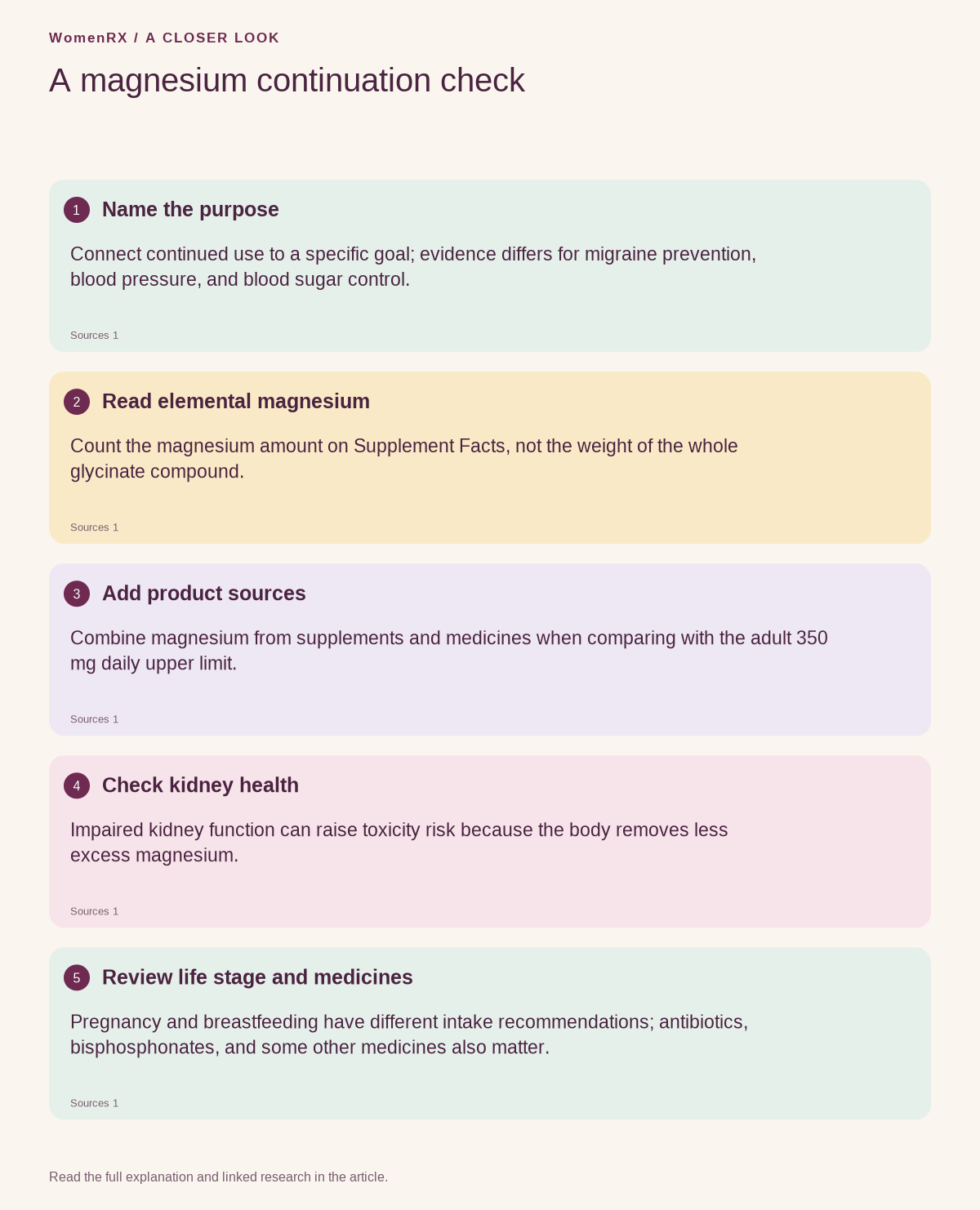
A magnesium continuation check
Name the purpose: Connect continued use to a specific goal; evidence differs for migraine prevention, blood pressure, and blood sugar control.1
Read elemental magnesium: Count the magnesium amount on Supplement Facts, not the weight of the whole glycinate compound.1
Add product sources: Combine magnesium from supplements and medicines when comparing with the adult 350 mg daily upper limit.1
Check kidney health: Impaired kidney function can raise toxicity risk because the body removes less excess magnesium.1
Review life stage and medicines: Pregnancy and breastfeeding have different intake recommendations; antibiotics, bisphosphonates, and some other medicines also matter.1
Read the figure as text
Use these checks when deciding whether your current magnesium glycinate still fits your needs.- Name the purpose: Connect continued use to a specific goal; evidence differs for migraine prevention, blood pressure, and blood sugar control.1
- Read elemental magnesium: Count the magnesium amount on Supplement Facts, not the weight of the whole glycinate compound.1
- Add product sources: Combine magnesium from supplements and medicines when comparing with the adult 350 mg daily upper limit.1
- Check kidney health: Impaired kidney function can raise toxicity risk because the body removes less excess magnesium.1
- Review life stage and medicines: Pregnancy and breastfeeding have different intake recommendations; antibiotics, bisphosphonates, and some other medicines also matter.1
More questions, answered
Does the 350 mg upper limit include magnesium from food?
No. The adult upper limit applies to magnesium from supplements and medicines, including some antacids and laxatives. Magnesium from food and drinks is not included. The recommended daily intake, in contrast, counts magnesium from all sources. 1
Is magnesium glycinate proven safer than other forms for long-term use?
NIH guidance sets the upper limit using elemental magnesium rather than a separate limit for glycinate. It does not establish a special long-term safety advantage for this form. 1
Sources you can check
- Magnesium - Health Professional Fact SheetAccessed 2026-09-25Return to first citation
- Efficacy and safety of magnesium glycinate as add on therapy in hypomagnesemic asthma and chronic obstructive pulmonary disease patients: A randomised controlled study assessing inflammatory biomarkers.Maddirevula MK, Rajanandh MG, Wesley B. · Pulmonary pharmacology & therapeutics · 2026Return to first citation