Magnesium Glycinate: Check the Dose, Side Effects, and Interactions
The magnesium amount on the label, your kidney health, and your medicines matter more to a safety check than the word “glycinate.”
Magnesium glycinate can still cause magnesium-related side effects and interactions. Start with the elemental magnesium amount in Supplement Facts, then count magnesium in other supplements and medicines. For adults, the upper limit is 350 mg a day from those sources, not food. Kidney disease raises the risk of magnesium toxicity, and certain antibiotics and osteoporosis medicines need careful timing around magnesium. 1
Read the dose the label actually gives you
On a magnesium glycinate bottle, the number to look for is “Magnesium” in the Supplement Facts panel. That is the amount of elemental magnesium, not the weight of the whole magnesium glycinate compound. Check the serving size too: a listed amount may cover more than one capsule. 1
Next, count your other sources. A multivitamin or second mineral supplement may add magnesium, and some antacids and laxatives contain it as a medicine ingredient. For adults, the tolerable upper intake level is 350 mg a day from supplements and magnesium-containing medicines combined. Magnesium naturally present in food and drinks does not count toward that limit. It’s a safety benchmark, not a suggested dose or a promise that a lower amount won’t bother your stomach. 1
That distinction matters if you’re comparing the upper limit with a recommended daily intake. Recommended intakes describe magnesium from all sources, including food. The 350 mg upper limit applies only to supplements and medicines. 1
What side effects can magnesium glycinate cause?
Higher amounts of magnesium from supplements or medicines can cause diarrhea, nausea, and abdominal cramping. Magnesium left unabsorbed in the gut can draw water into the bowel, which helps explain loose stools. The NIH identifies several other magnesium forms commonly reported to cause diarrhea, but that does not establish that glycinate is free of digestive effects. 1
Very high magnesium exposure can cause more serious toxicity. Warning signs can include vomiting, marked weakness, difficulty breathing, and an irregular heartbeat. If you develop difficulty breathing, severe weakness, or an irregular heartbeat after taking magnesium, seek urgent medical care. 1
Your kidneys usually help remove excess magnesium. When kidney function is impaired, magnesium can build up more readily. If you have kidney disease or have been told your kidney function is reduced, review a new supplement or dose increase with the clinician managing that condition. Don’t use how you feel as a kidney-function test: chronic kidney disease can have no symptoms in its early stages and is identified with blood and urine tests. 12
Check medicines for two different kinds of interaction
With some medicines, taking magnesium close to the medicine can reduce how much of that medicine is absorbed. With others, the medicine changes your magnesium balance over time. Separating pills addresses the first problem, not necessarily the second.
- Oral osteoporosis medicines called bisphosphonates, such as alendronate, can be absorbed less well alongside magnesium. NIH guidance says at least two hours of separation can minimize this interaction. Check the directions for your particular prescription before fitting a supplement into that schedule. 1
- Tetracycline antibiotics, such as doxycycline, and quinolone antibiotics, such as ciprofloxacin or levofloxacin, can bind magnesium in the gut and be absorbed less well. NIH guidance gives these antibiotics a different interval: at least two hours before or four to six hours after a magnesium-containing supplement. If your prescription schedule makes that difficult, ask a pharmacist how to handle the combination rather than guessing. 1
- Diuretics affect magnesium balance in different directions. Loop and thiazide diuretics can increase magnesium loss in urine, while potassium-sparing diuretics can reduce magnesium excretion. Moving your supplement to another time of day does not resolve those effects. 13
- Proton pump inhibitors (PPIs) used for a long time can be associated with low magnesium. A supplement does not always correct that problem, so it’s worth reviewing the medicine and your magnesium status together rather than assuming more magnesium is the answer. 13
This is a focused interaction check, not a complete list of every medicine. Bring the exact supplement label and your medicine list to a pharmacist if you’re unsure about a combination.
Include pregnancy or breastfeeding in the review
Magnesium needs vary by life stage, but the adult 350 mg daily upper limit from supplements and medicines is also listed for pregnancy and breastfeeding. It does not include magnesium from food. If you take a prenatal vitamin, antacid, or another supplement, include it when you total your sources. 1
Keep a clinician-directed magnesium plan separate from a supplement you choose for yourself. A clinician may recommend magnesium for a specific reason and assess it in the context of your health and other medicines; the upper limit alone cannot tell you whether that plan or a self-selected product is right for you. If you’re pregnant or breastfeeding, check the product and your combined intake with your prenatal or postpartum care team before adding it. 1
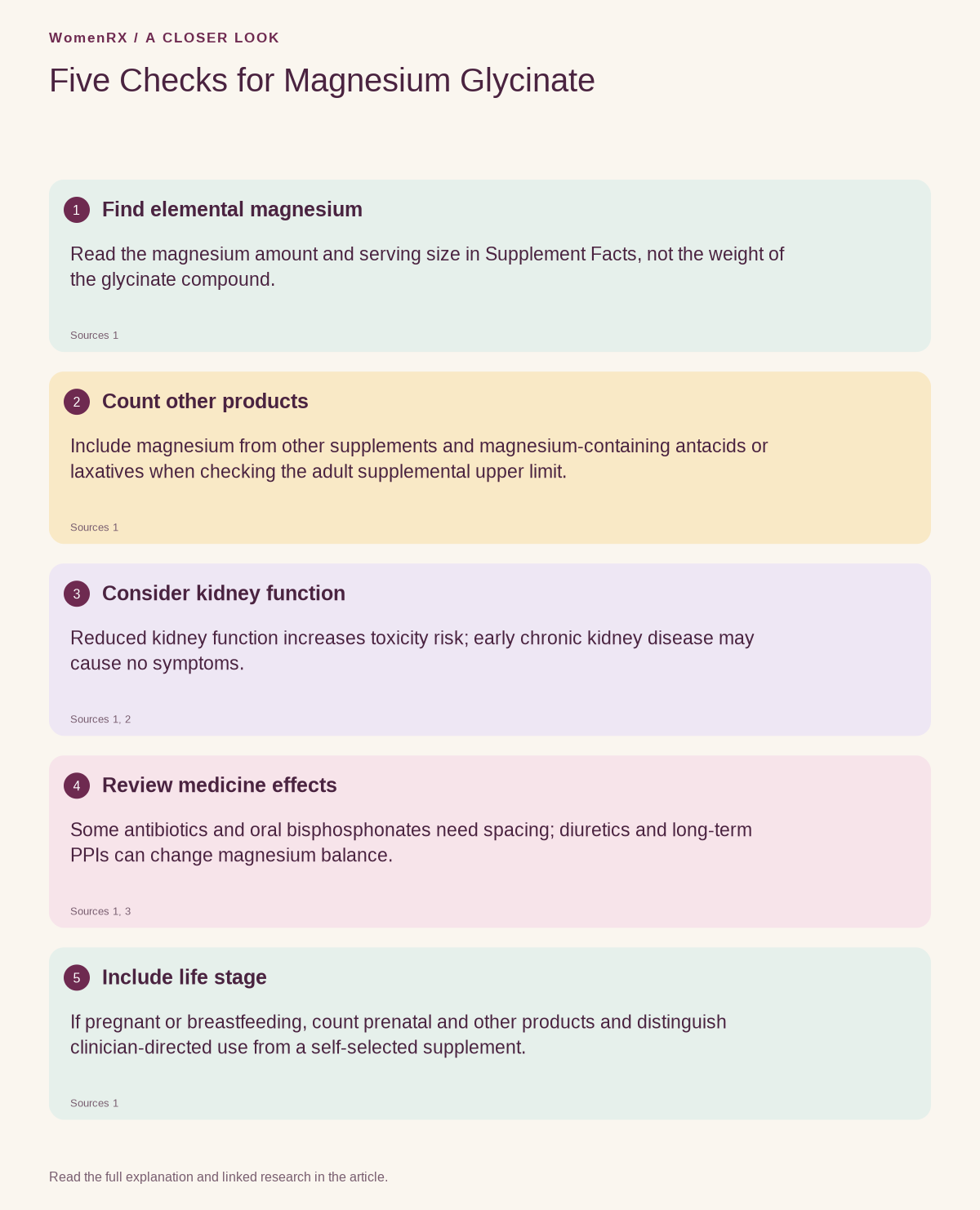
Five Checks for Magnesium Glycinate
Find elemental magnesium: Read the magnesium amount and serving size in Supplement Facts, not the weight of the glycinate compound.1
Count other products: Include magnesium from other supplements and magnesium-containing antacids or laxatives when checking the adult supplemental upper limit.1
Consider kidney function: Reduced kidney function increases toxicity risk; early chronic kidney disease may cause no symptoms.12
Review medicine effects: Some antibiotics and oral bisphosphonates need spacing; diuretics and long-term PPIs can change magnesium balance.13
Include life stage: If pregnant or breastfeeding, count prenatal and other products and distinguish clinician-directed use from a self-selected supplement.1
Read the figure as text
Use these checks to review a specific bottle alongside your other products, medicines, and health history.- Find elemental magnesium: Read the magnesium amount and serving size in Supplement Facts, not the weight of the glycinate compound.1
- Count other products: Include magnesium from other supplements and magnesium-containing antacids or laxatives when checking the adult supplemental upper limit.1
- Consider kidney function: Reduced kidney function increases toxicity risk; early chronic kidney disease may cause no symptoms.12
- Review medicine effects: Some antibiotics and oral bisphosphonates need spacing; diuretics and long-term PPIs can change magnesium balance.13
- Include life stage: If pregnant or breastfeeding, count prenatal and other products and distinguish clinician-directed use from a self-selected supplement.1
More questions, answered
Is magnesium glycinate gentler than other forms?
Magnesium forms differ, and the NIH identifies several forms commonly reported to cause diarrhea. That does not show that glycinate cannot cause diarrhea or that it has a different safety limit. Judge the product by its elemental magnesium amount and how you respond to it, not the form name alone. 1
Sources you can check
- Magnesium - Health Professional Fact SheetAccessed 2026-09-25Return to first citation
- Chronic Kidney Disease | Kidney Disease | CKD | MedlineplusAccessed 2026-09-25Return to first citation
- Magnesium and Drugs.Gröber U. · International journal of molecular sciences · 2019Return to first citation