Magnesium for Menopause: What the Evidence Actually Shows
A placebo-controlled trial did not find fewer hot flashes with magnesium, while sleep findings from combination supplements can’t show magnesium was the helpful ingredient.
The clearest direct test here is a placebo-controlled trial in postmenopausal breast cancer survivors: magnesium oxide did not reduce hot flashes more than placebo, and diarrhea was more common in the magnesium groups. A smaller earlier study found improvement but had no placebo group. One menopause-specific sleep trial described here tested a blend containing magnesium, so it can’t establish magnesium’s effect by itself. 3 4 2
Hot flashes: a promising pilot, then a stronger test
A small pilot study followed 25 women with breast cancer who had completed four weeks of magnesium treatment. Their reported hot-flash frequency and hot-flash score fell from the start of the study, but there was no placebo group. Without that comparison, the changes could reflect the treatment, natural symptom variation, or other factors. 4
A later, larger randomized, placebo-controlled trial tested magnesium oxide in 289 postmenopausal women with a history of breast cancer and bothersome hot flashes. Hot-flash frequency and hot-flash scores changed similarly in the magnesium and placebo groups. Diarrhea was more common in the magnesium groups. For this specific population and treatment, the controlled result does not support magnesium as a hot-flash remedy. It does not answer whether every formulation or every group of menopausal women would respond the same way. 3
Sleep: don’t credit one ingredient in a blend
A randomized trial in perimenopausal and postmenopausal women with sleep disturbance and few hot flashes found improvements with a supplement containing magnesium along with several other active ingredients. Because the ingredients were given together, the result cannot show whether magnesium helped, or whether the benefit came from another ingredient or the combination. 2
Research on magnesium alone for sleep in adults is also uncertain. A systematic review of randomized trials found inconsistent results and rated the evidence low to very low certainty; it concluded that magnesium is not supported as a routine insomnia treatment. That review covered adults generally, not a menopause-specific group, so it can’t settle whether some women during the menopause transition might benefit. 5
Bone health is a different question from symptom relief
Magnesium contributes to bone health, but that doesn’t mean a supplement has been shown to prevent fractures or treat osteoporosis in postmenopausal women. The NIH Office of Dietary Supplements describes a short study in 20 postmenopausal women with osteoporosis that found a change in a bone-turnover marker after magnesium. A marker is not the same as evidence that people had fewer fractures or better long-term bone health. 1
A practical check before buying
- Match the claim to the outcome. A study of a bone marker, sleep, or hot flashes answers a different question. A menopause study of a multi-ingredient blend doesn’t prove magnesium itself works. 1 2
- Read the elemental magnesium amount. The Supplement Facts panel lists elemental magnesium, not the weight of the whole magnesium compound. Magnesium also appears in some antacids and laxatives, so check those labels too. 1
- Count supplements and medicines together. For adults, the upper limit of 350 mg per day applies to magnesium from supplements and medications, not magnesium naturally present in food. It is a safety limit, not a target or a menopause-treatment dose. 1
- Check medicines and kidney health. Magnesium can interfere with absorption of oral bisphosphonates and certain antibiotics, including tetracyclines and quinolones. Long-term use of proton pump inhibitors and some diuretics can also affect magnesium status. Reduced kidney function raises the risk of excess magnesium building up. A pharmacist can check your specific products and medication timing. 1
High supplemental or medication amounts can cause diarrhea, nausea, and abdominal cramping; kidney impairment increases the risk of more serious toxicity. If your goal is to address a menopause symptom, weigh that uncertain benefit against the product’s ingredients, your other magnesium sources, and the side effects or interactions that matter for you. 1 3
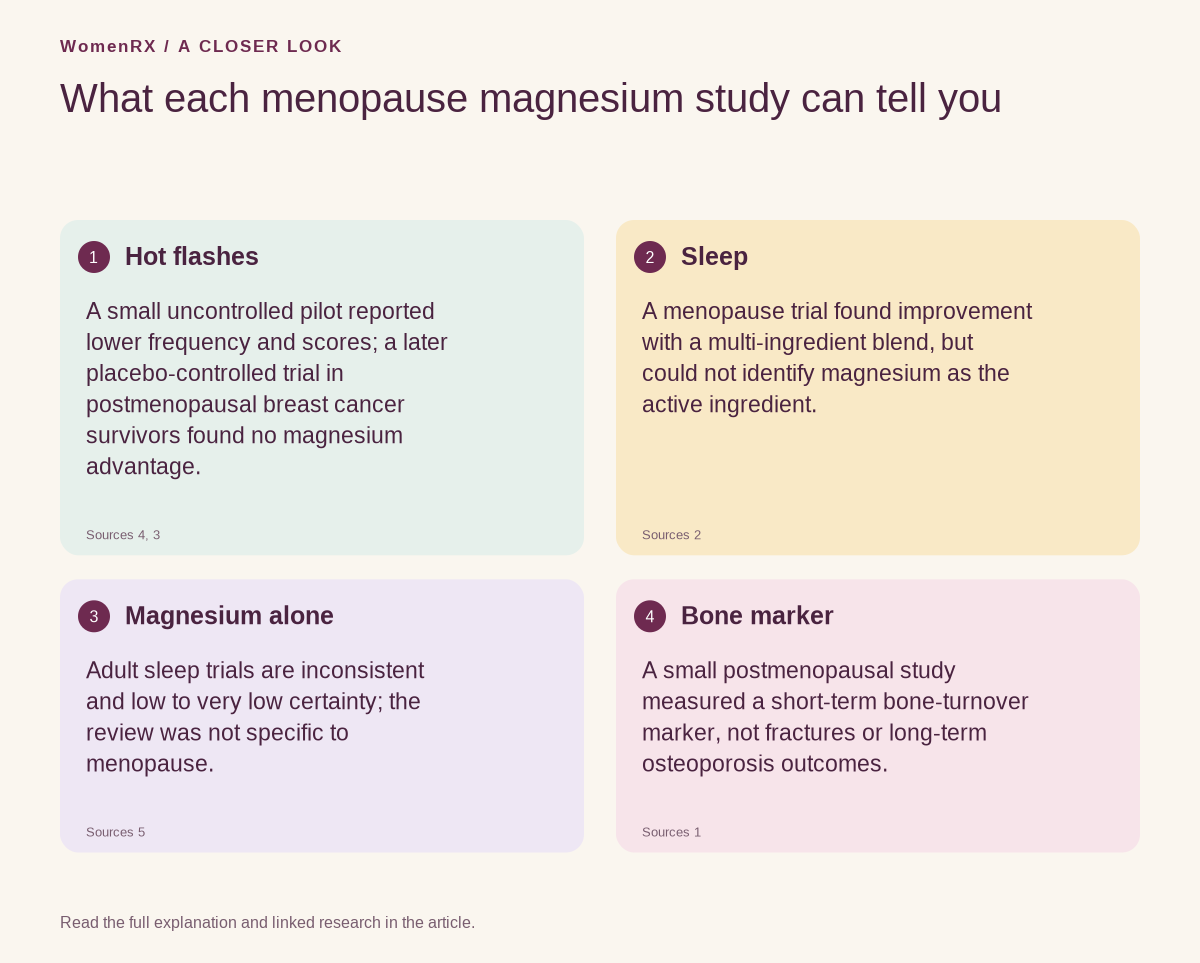
What each menopause magnesium study can tell you
Hot flashes: A small uncontrolled pilot reported lower frequency and scores; a later placebo-controlled trial in postmenopausal breast cancer survivors found no magnesium advantage.43
Sleep: A menopause trial found improvement with a multi-ingredient blend, but could not identify magnesium as the active ingredient.2
Magnesium alone: Adult sleep trials are inconsistent and low to very low certainty; the review was not specific to menopause.5
Bone marker: A small postmenopausal study measured a short-term bone-turnover marker, not fractures or long-term osteoporosis outcomes.1
Read the figure as text
The outcome and study design matter: a symptom trial, a supplement blend, and a bone marker answer different questions.- Hot flashes: A small uncontrolled pilot reported lower frequency and scores; a later placebo-controlled trial in postmenopausal breast cancer survivors found no magnesium advantage.43
- Sleep: A menopause trial found improvement with a multi-ingredient blend, but could not identify magnesium as the active ingredient.2
- Magnesium alone: Adult sleep trials are inconsistent and low to very low certainty; the review was not specific to menopause.5
- Bone marker: A small postmenopausal study measured a short-term bone-turnover marker, not fractures or long-term osteoporosis outcomes.1
More questions, answered
Does a menopause sleep supplement containing magnesium prove magnesium helps sleep?
No. A trial of a blend containing magnesium and several other active ingredients can show whether the blend performed differently from placebo, but it cannot identify magnesium as the cause. 2
Is magnesium from food included in the 350 mg upper limit?
No. The adult upper limit applies to magnesium from supplements and medications. It does not include magnesium naturally present in food. 1
Sources you can check
- Magnesium - Health Professional Fact SheetAccessed 2026-09-25Return to first citation
- Nonsedating neurotransmitter-modulating supplement for nonvasomotor sleep disturbance in menopause.Carbonneau S, Mysliwiec V, Doyle AL, Stratton M, Dweck A, Tartar J, Alesi M, Mason L, Komorowski J, VanDusseldorp TA. · Menopause (New York, N.Y.) · 2026Return to first citation
- North Central Cancer Treatment Group N10C2 (Alliance): a double-blind placebo-controlled study of magnesium supplements to reduce menopausal hot flashes.Park H, Qin R, Smith TJ, Atherton PJ, Barton DL, Sturtz K, Dakhil SR, Anderson DM, Flynn K, Puttabasavaiah S, Le-Lindqwister NA, Padula GD, Loprinzi CL. · Menopause (New York, N.Y.) · 2015Return to first citation
- A pilot phase II trial of magnesium supplements to reduce menopausal hot flashes in breast cancer patients.Park H, Parker GL, Boardman CH, Morris MM, Smith TJ. · Supportive care in cancer : official journal of the Multinational Association of Supportive Care in Cancer · 2011Return to first citation
- Magnesium Supplementation for Sleep in Adults: A Systematic Review of Randomized Controlled Trials.Lopresti AL, Smith SJ, Drummond PD. · Journal of dietary supplements · 2026Return to first citation