Menopause Cramps: What Timing and Bleeding Can Tell You
Cramps near a period can be menstrual, but new pain after periods have stopped deserves a different kind of attention, especially if there’s bleeding.
In perimenopause, cramps that arrive just before or with a period may come from the uterus contracting, though new, worsening, or persistent pain can have other causes. After menopause, cramps aren’t explained by a current period, so ongoing or recurring pelvic pain merits assessment. Any vaginal bleeding after menopause should be checked promptly; severe sudden pain, fainting, or heavy bleeding calls for urgent care. 1235
First, notice whether a period is still part of the pattern
During the menstrual transition, periods can change, and cramps may still follow a menstrual pattern: pain in the lower abdomen shortly before or around bleeding, sometimes spreading to the back or thighs. Menstrual cramps happen as the uterus tightens. Chemicals called prostaglandins help trigger those contractions. 14
That familiar timing can be a useful clue, but it doesn’t prove the pain is only menstrual. A change in the usual pattern matters. Period-related pain that starts later in life, gets worse over time, continues after bleeding ends, or happens when you aren’t having a period can be linked to conditions such as fibroids or endometriosis. 1
For example, cramps that reliably begin with bleeding and ease as the period passes fit a different pattern from pain that keeps returning between periods. That distinction is worth mentioning when you seek care, along with whether the pain is new or getting stronger.
After menopause, don’t assume cramps are hormonal
Once periods have stopped, there’s no current menstrual cycle to explain cramps. Pelvic pain can come from different parts of the body, including reproductive, urinary, or digestive organs; infection is another possible cause. A symptom’s location alone may not identify its source. 2
Recurring pain, pain that doesn’t go away, or pain that interferes with daily life deserves assessment. Sudden severe pain needs more urgent attention. Pain can be serious even if it feels mild, and severe pain doesn’t always mean a serious condition, so severity alone isn’t a reliable way to work out the cause. 23
Bleeding after menopause changes the next step
Any vaginal bleeding after menopause should be assessed promptly, even if the amount seems small or it happens only once. Bleeding after menopause is a common presentation of endometrial cancer, but bleeding by itself does not tell you the cause. Evaluation may include a transvaginal ultrasound, sampling of the uterine lining, or both; the appropriate approach depends on the clinical assessment and current guidance. 56
The key distinction is that bleeding after menopause isn’t a period returning and shouldn’t be written off as a normal menopause symptom. Contact a clinician promptly to arrange assessment. If bleeding is heavy, or you also feel faint or pass out, seek urgent care rather than waiting for a routine appointment. 2
Match the response to the pattern
Cramps around a period: If the pain is familiar and limited to the days around bleeding, menstrual contractions may be the explanation. Heat on the lower abdomen is one self-care option for period pain. If the pain is new, worsening, severe, keeps you from usual activities, or happens outside your period, arrange an assessment. 14
Pain after periods have stopped: If it keeps coming back or doesn’t go away, contact a clinician. Mention whether you also have unusual vaginal bleeding or discharge, pain when urinating, or changes in bowel or bladder habits, since these can help clarify what may be causing pelvic pain. 2
Sudden or severe symptoms: Get urgent medical help for sudden, sharp abdominal pain. Heavy vaginal bleeding, fainting, or feeling lightheaded alongside pelvic pain also calls for urgent attention. 23
It may help to describe when the cramps occur, whether bleeding is present, how long the pain lasts, and whether it’s changing. These details don’t diagnose the cause, but they make the difference between period-linked pain and pain outside that pattern easier to assess.
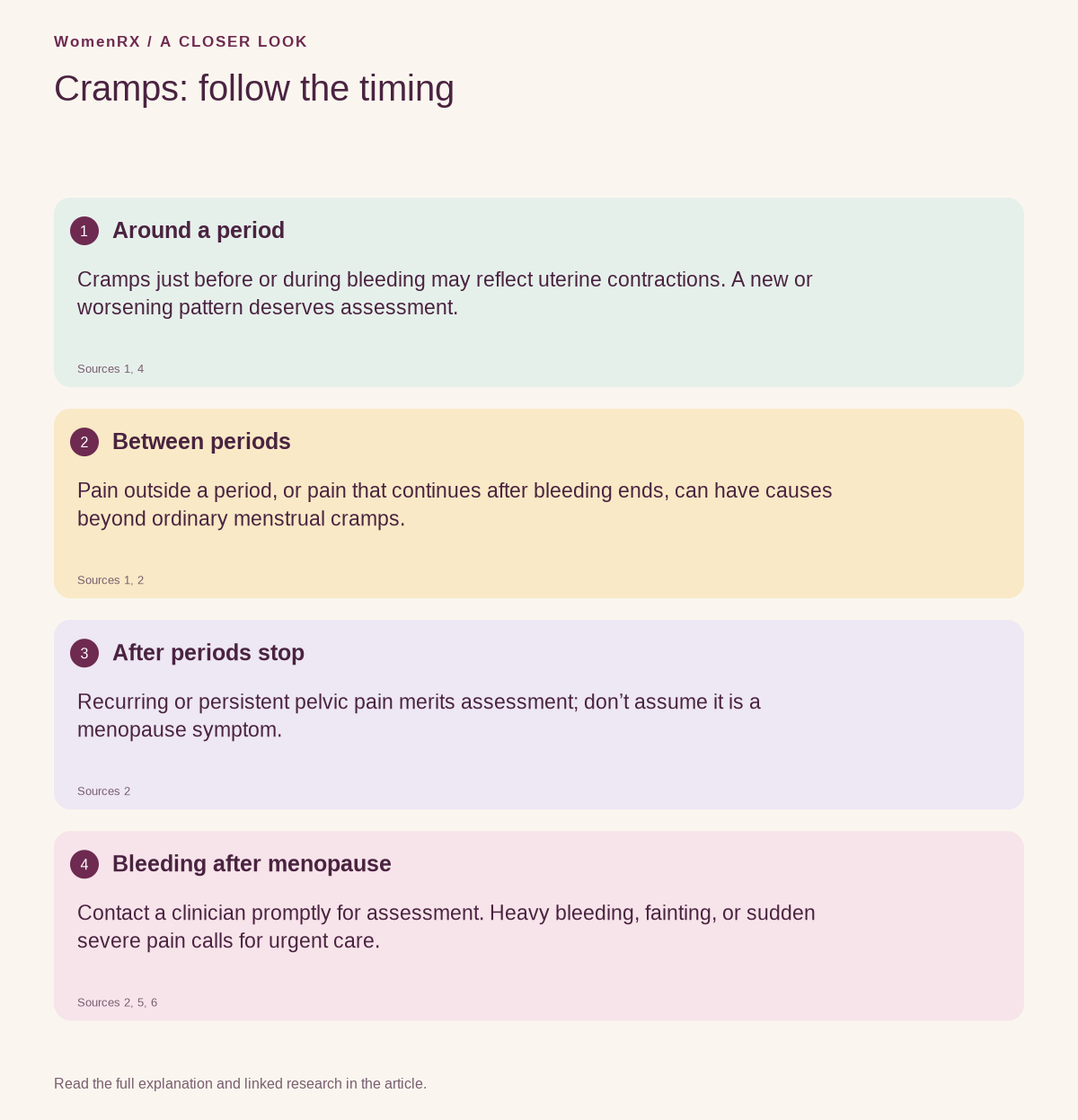
Cramps: follow the timing
Around a period: Cramps just before or during bleeding may reflect uterine contractions. A new or worsening pattern deserves assessment.14
Between periods: Pain outside a period, or pain that continues after bleeding ends, can have causes beyond ordinary menstrual cramps.12
After periods stop: Recurring or persistent pelvic pain merits assessment; don’t assume it is a menopause symptom.2
Bleeding after menopause: Contact a clinician promptly for assessment. Heavy bleeding, fainting, or sudden severe pain calls for urgent care.256
Read the figure as text
Use the relationship between cramps, periods, bleeding, and symptom severity to choose a sensible next step. This is a guide to attention, not a diagnosis.- Around a period: Cramps just before or during bleeding may reflect uterine contractions. A new or worsening pattern deserves assessment.14
- Between periods: Pain outside a period, or pain that continues after bleeding ends, can have causes beyond ordinary menstrual cramps.12
- After periods stop: Recurring or persistent pelvic pain merits assessment; don’t assume it is a menopause symptom.2
- Bleeding after menopause: Contact a clinician promptly for assessment. Heavy bleeding, fainting, or sudden severe pain calls for urgent care.256
More questions, answered
Can cramps happen without bleeding during perimenopause?
Yes. Pain that happens when you aren’t having a period is a reason to consider causes beyond ordinary menstrual cramps. If it recurs, persists, or worsens, arrange an assessment rather than assuming it’s part of menopause. 12
Sources you can check
- Period Pain | Menstrual Cramps | MedlinePlusAccessed 2026-09-25Return to first citation
- Pelvic pain - NHSAccessed 2026-09-25Return to first citation
- Abdominal Pain | MedlinePlusAccessed 2026-09-25Return to first citation
- Period pain - NHSAccessed 2026-09-25Return to first citation
- Updated Guidance Regarding The Role of Transvaginal Ultrasonography in Evaluating the Endometrium of Individuals With Postmenopausal Bleeding.American College of Obstetricians & Gynecologists. · Obstetrics and gynecology · 2026Return to first citation
- Analysis of Timely Follow-Up in the Evaluation of Postmenopausal Bleeding.Atkins S, Nolin A, Unnithan S, Myers ER, Kruse DE, Erkanli A, Havrilesky LJ. · O&G open · 2025Return to first citation