Tinnitus Around Menopause: What the Timing Can Tell You
Ringing that starts during perimenopause deserves attention to your hearing and other clues, not an automatic hormone explanation.
Tinnitus can begin during perimenopause, but the timing alone doesn’t show that hormonal changes caused it. The cited midlife study did not follow tinnitus over time, so it cannot predict how long the sound will last. A general duration for menopause symptoms is not a tinnitus countdown. Hearing loss, loud noise and certain medicines are other possibilities. If the sound beats with your pulse, or comes with sudden hearing loss, the next step is prompt assessment rather than waiting for menopause to pass. 123
Why the timing isn’t the whole answer
If ringing or buzzing appeared around the time your periods began changing, it’s reasonable to wonder whether the two are connected. But a new sound and perimenopause can happen at the same time without one explaining the other. Tinnitus can sound like ringing, hissing, clicking or roaring; it may come and go or be present all the time. Hearing loss, loud-noise exposure and certain medicines are established possibilities worth considering. 12
Research in midlife women offers a clue, not a cause-and-effect answer. In a cross-sectional study of 93 women ages 40 to 65 seen at a specialist clinic for recurrent dizziness without hearing loss, many also reported tinnitus. Menopause-symptom scores were associated with dizziness-related handicap. The study did not establish that menopause caused the tinnitus or follow women to see how long it lasted. The abstract does not report a comparison of tinnitus across menopause stages. Its findings also may not apply to someone whose main concern is ringing without dizziness. 3
That distinction matters if you’re trying to put an end date on the noise. General tinnitus guidance says it may improve by itself, but doesn’t give a reliable personal timeline. The often-quoted duration of menopause symptoms describes menopause symptoms broadly; it isn’t a countdown for tinnitus. 26
Notice the sound, then look beyond it
The pattern of the sound can point toward a more useful next step than its start date. For example, if you’ve also noticed that conversation is harder to follow, hearing deserves attention. A clinician can look for a treatable ear problem, such as wax buildup or infection, and check for hearing loss. Tinnitus is often linked to some form of hearing loss, even though its cause isn’t always clear. 2
Think, too, about recent loud-noise exposure and changes in medicines. Tinnitus can be a side effect of some antibiotics, chemotherapy medicines, nonsteroidal anti-inflammatory drugs (NSAIDs) and aspirin. That doesn’t mean a medicine is responsible in your case, but the name and timing are useful details to bring to an assessment. 12
If the noise is regular or constant, getting worse, or disrupting sleep or concentration, arrange a medical assessment. You don’t have to prove that it’s connected to menopause before asking someone to check your ears and hearing. 2
When the pattern changes the urgency
A whooshing or throbbing that beats in time with your pulse calls for a prompt medical appointment. Pulsatile tinnitus is assessed differently from ordinary ringing; a tinnitus guideline recommends imaging when tinnitus is pulsatile or hearing loss is asymmetric. That’s a decision for the evaluating clinician, not a reason to assume a particular diagnosis. 24
Seek immediate medical care if tinnitus starts after a head injury or occurs with sudden hearing loss, facial weakness or a spinning sensation (vertigo). In particular, don’t wait to see whether sudden hearing loss clears as other perimenopause symptoms come and go. 2
What may help once the cause is checked
Treatment depends partly on what an assessment finds. If hearing loss is present, hearing aids may help. If the sound persists, approaches such as cognitive behavioral therapy and sound therapy aim to reduce how much tinnitus interferes with daily life, rather than promise to erase the sound. For example, soft background sound at bedtime may be less intrusive than trying to sleep in total silence. 124
Hormone therapy has established uses for bothersome hot flashes and night sweats and for genitourinary symptoms of menopause. That doesn’t make it a proven tinnitus treatment. If you’re weighing hormone therapy for other symptoms, keep the ringing on your list as a separate concern to assess. 5
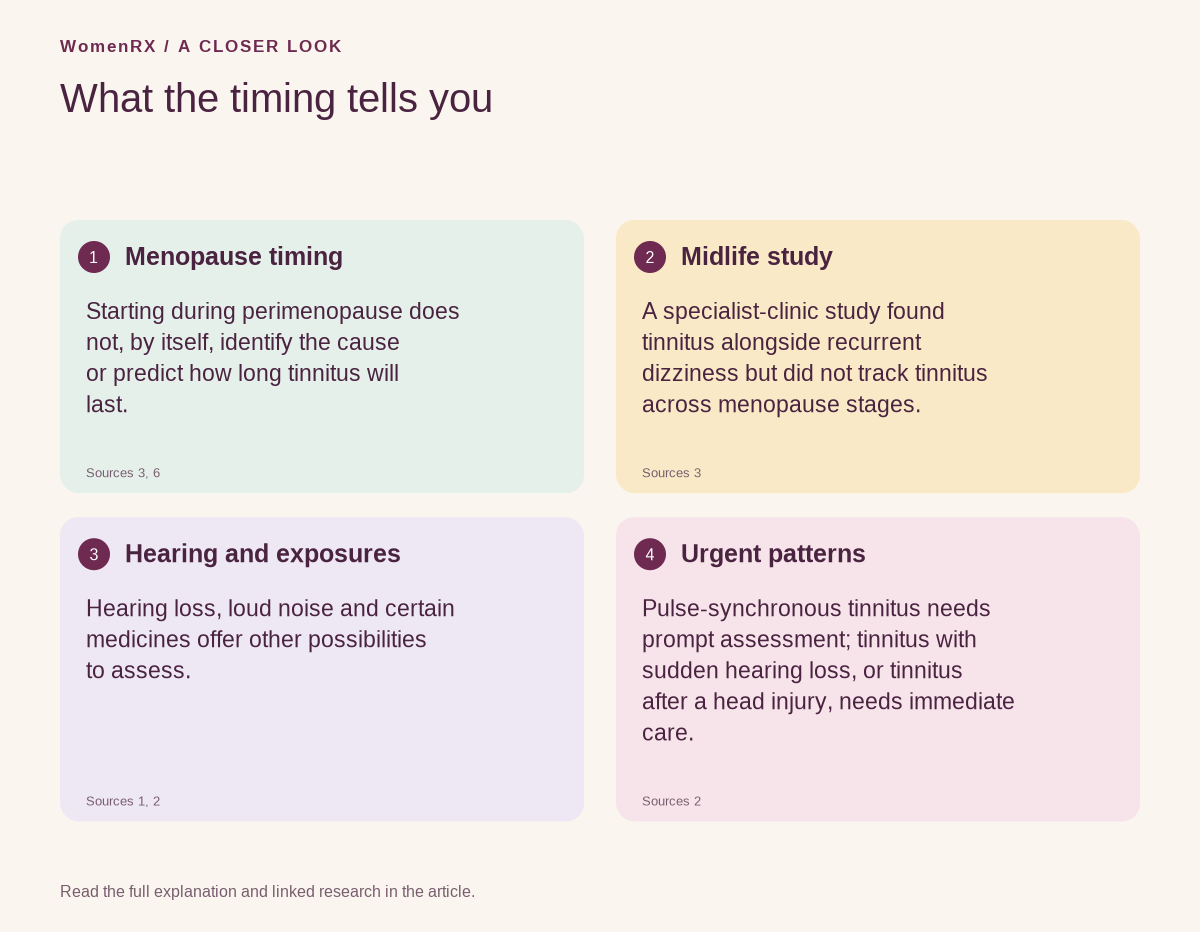
What the timing tells you
Menopause timing: Starting during perimenopause does not, by itself, identify the cause or predict how long tinnitus will last.36
Midlife study: A specialist-clinic study found tinnitus alongside recurrent dizziness but did not track tinnitus across menopause stages.3
Hearing and exposures: Hearing loss, loud noise and certain medicines offer other possibilities to assess.12
Urgent patterns: Pulse-synchronous tinnitus needs prompt assessment; tinnitus with sudden hearing loss, or tinnitus after a head injury, needs immediate care.2
Read the figure as text
Use the coincidence with perimenopause as context, while giving greater weight to the sound pattern and accompanying symptoms.- Menopause timing: Starting during perimenopause does not, by itself, identify the cause or predict how long tinnitus will last.36
- Midlife study: A specialist-clinic study found tinnitus alongside recurrent dizziness but did not track tinnitus across menopause stages.3
- Hearing and exposures: Hearing loss, loud noise and certain medicines offer other possibilities to assess.12
- Urgent patterns: Pulse-synchronous tinnitus needs prompt assessment; tinnitus with sudden hearing loss, or tinnitus after a head injury, needs immediate care.2
More questions, answered
Does tinnitus stop when perimenopause ends?
The cited midlife study did not follow tinnitus over time, so it cannot tell us whether ringing stops when perimenopause ends. The duration of menopause symptoms generally cannot predict how long tinnitus will last. Tinnitus may improve on its own, but symptoms that persist, worsen or affect your daily life are worth assessing rather than waiting for a change in menstrual stage. 236
Should I mention ringing if I haven’t noticed hearing loss?
Yes. An assessment can include a look inside your ears and a hearing check. Tell the clinician whether the sound is in one or both ears, whether it matches your pulse, and whether it began around a medicine change or loud-noise exposure. 12
Sources you can check
- Tinnitus | Tinnitus Treatment | MedlinePlusAccessed 2026-09-25Return to first citation
- Tinnitus - NHSAccessed 2026-09-25Return to first citation
- Clinical Features of Midlife Women With Isolated Episodic Vestibular Syndrome and Their Relationship With Migraine and Menopause Transition.Mangia LRL, Bittar RSM. · Otology & neurotology : official publication of the American Otological Society, American Neurotology Society [and] European Academy of Otology and Neurotology · 2026Return to first citation
- Clinical Practice Guideline for the Diagnosis and Management of Tinnitus in Korea.Park E, Lee HY, Kim HJ, Lee JM, An YH, Cho AR, Han W, Chung JH, Han JS, Jung DJ, Lee KY. · Clinical and experimental otorhinolaryngology · 2026Return to first citation
- The 2022 hormone therapy position statement of The North American Menopause Society.“The 2022 Hormone Therapy Position Statement of The North American Menopause Society” Advisory Panel. · Menopause (New York, N.Y.) · 2022Return to first citation
- Symptoms of menopause and perimenopause - NHSAccessed 2026-09-25Return to first citation