Tinnitus Around Menopause: What to Check First
Ringing or buzzing can have several causes, so new tinnitus is a reason to consider hearing and ear health, not assume menopause is to blame.
Tinnitus can begin around menopause, but the timing alone doesn’t show that menopause caused it. Hearing changes, loud-noise exposure, some medicines, and treatable ear problems are possible contributors. Sudden hearing loss, tinnitus that beats with your pulse, or tinnitus with facial weakness, vertigo, or a head injury needs urgent attention; otherwise, a hearing check can help guide next steps. 12
Ringing, buzzing, hissing, or roaring can be distracting, especially when you’re trying to sleep or focus. If it starts during menopause, the timing may feel like a clue. But it doesn’t, by itself, identify the cause. Tinnitus has several possible contributors, including hearing loss, loud-noise exposure, some medicines, and ear conditions such as infection or wax buildup. 12
A practical first step is to separate two questions: Could something need prompt care? And would a hearing or ear assessment help explain the sound?
First, look for changes that need urgent care
Seek urgent medical care if tinnitus comes with sudden hearing loss, facial weakness, or a spinning sensation. Tinnitus after a head injury also needs prompt attention. A sound that beats in time with your pulse should be assessed urgently, too. 2
If your hearing has suddenly changed, don’t wait to see whether the tinnitus fades before getting help. 2
Tinnitus and hearing loss aren’t the same thing
Tinnitus is hearing a sound that doesn’t come from an outside source. It may occur in one ear or both, and it can be intermittent or constant. Hearing loss is a separate change in how well you hear. The two can occur together, but one doesn’t automatically prove the other. 12
A hearing check can help identify hearing loss, while an ear examination may find a treatable contributor such as wax buildup or infection. If hearing loss is present, hearing aids may be recommended; they’re an option tied to that finding, not a universal tinnitus treatment. 12
If the sound is getting worse, or affecting sleep, concentration, or mood, make an appointment for an assessment even if there’s no sudden change. Those effects are valid reasons to seek help. 2
Where menopause fits, and where it doesn’t
Tinnitus that begins around menopause may be happening during a time of other changes, but the overlap doesn’t establish that menopause caused the sound. Keep other possible contributors in view: hearing changes, past or ongoing loud-noise exposure, ear problems, and medicine side effects. Some antibiotics, chemotherapy medicines, NSAIDs, and aspirin are listed as possible contributors. 12
If you’ve noticed a medication change around the same time, include that timing in the information you share during an assessment. The timing can help put the symptom in context, but it can’t establish cause on its own. 2
Choose support based on what’s bothering you
If hearing loss is found, hearing aids may be considered. Sound therapy or a sound-masking device may also be options; soft music or other sounds can distract from tinnitus for some people. The aim is to make the sound easier to live with, not to promise that it will disappear. 12
When tinnitus is causing distress, cognitive behavioral therapy (CBT) or tinnitus counseling can focus on coping and its effect on daily life. A recent review of four randomized trials and one cohort study found that combined CBT and sound therapy reduced tinnitus-related handicap more than sound therapy alone, but did not show a significant difference in perceived loudness. The review authors described the findings as preliminary, so this is a possible support option, not a guaranteed result. 24
A useful way to describe what’s happening
Before an assessment, notice whether the sound is in one ear or both, whether it pulses with your heartbeat, and whether your hearing changed suddenly or gradually. Also note when it began, whether it’s worsening, and any recent noise exposure or medication changes. These details help distinguish a symptom that needs urgent attention from one that can be evaluated through a planned hearing and ear check. 12
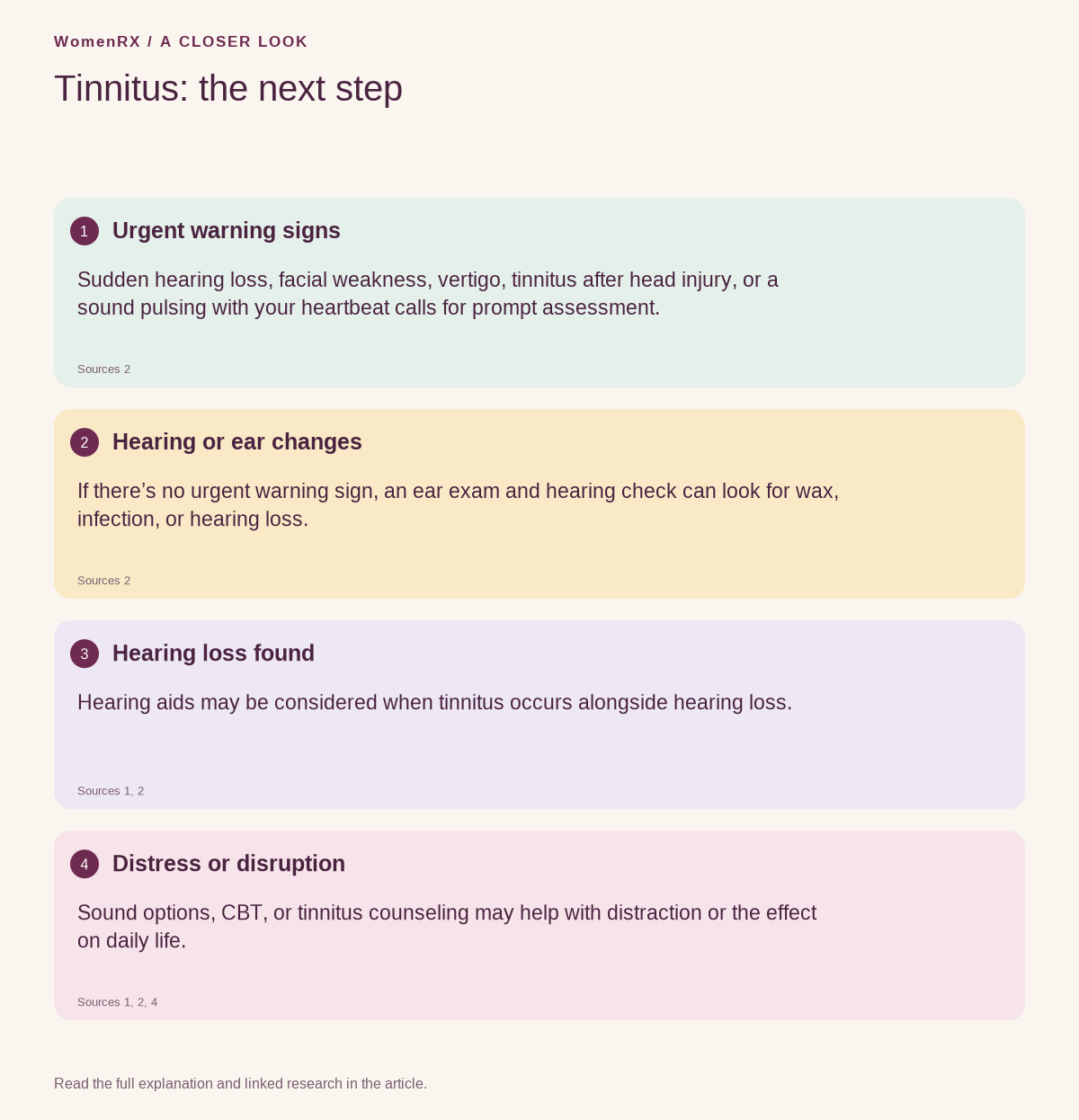
Tinnitus: the next step
Urgent warning signs: Sudden hearing loss, facial weakness, vertigo, tinnitus after head injury, or a sound pulsing with your heartbeat calls for prompt assessment.2
Hearing or ear changes: If there’s no urgent warning sign, an ear exam and hearing check can look for wax, infection, or hearing loss.2
Hearing loss found: Hearing aids may be considered when tinnitus occurs alongside hearing loss.12
Distress or disruption: Sound options, CBT, or tinnitus counseling may help with distraction or the effect on daily life.124
Read the figure as text
Use the sound’s accompanying changes to decide whether to seek urgent care, arrange a hearing check, or explore coping support.- Urgent warning signs: Sudden hearing loss, facial weakness, vertigo, tinnitus after head injury, or a sound pulsing with your heartbeat calls for prompt assessment.2
- Hearing or ear changes: If there’s no urgent warning sign, an ear exam and hearing check can look for wax, infection, or hearing loss.2
- Hearing loss found: Hearing aids may be considered when tinnitus occurs alongside hearing loss.12
- Distress or disruption: Sound options, CBT, or tinnitus counseling may help with distraction or the effect on daily life.124
More questions, answered
Can tinnitus be a sign of hearing loss?
It can occur alongside hearing loss, but tinnitus and hearing loss are not the same symptom. A hearing check can help establish whether hearing has changed. 12
Do supplements cure tinnitus?
Don’t count on a supplement as a cure. A Korean adult tinnitus guideline recommends against routine zinc and vitamin supplements for tinnitus improvement; that recommendation doesn’t establish what caused an individual person’s tinnitus. 3
Sources you can check
- Tinnitus | Tinnitus Treatment | MedlinePlusAccessed 2026-09-25Return to first citation
- Tinnitus - NHSAccessed 2026-09-25Return to first citation
- Clinical Practice Guideline for the Diagnosis and Management of Tinnitus in Korea.Park E, Lee HY, Kim HJ, Lee JM, An YH, Cho AR, Han W, Chung JH, Han JS, Jung DJ, Lee KY. · Clinical and experimental otorhinolaryngology · 2026Return to first citation
- Combined cognitive behavioral therapy and sound therapy for chronic tinnitus: a systematic review and meta-analysis.Albannai N, Alraqum FF, Aladwani AN, Alkandari AM, Almutairi RA, Altahow R, Dashti A, Owayed Y, Alharran AM, Albazee E. · European archives of oto-rhino-laryngology : official journal of the European Federation of Oto-Rhino-Laryngological Societies (EUFOS) : affiliated with the German Society for Oto-Rhino-Laryngology - Head and Neck Surgery · 2026Return to first citation