Can CBT or Lifestyle Changes Help Menopause Symptoms?
CBT can ease how disruptive hot flashes feel, while sleep-focused CBT targets insomnia; exercise and many popular lifestyle fixes aren’t established hot-flash treatments.
Yes, but the approach matters. Menopause-focused CBT is best supported for reducing hot-flash distress and interference, not reliably stopping the flashes themselves. Sleep-focused CBT may help when insomnia is the main problem. Weight loss has some support for vasomotor symptoms, but exercise, yoga, and dietary changes aren’t recommended as hot-flash treatments in current menopause guidance. 2 3 4
Match the approach to the symptom
A useful first distinction is whether the main problem is how often hot flashes happen, how much they disrupt your day, or whether you can sleep. These are related, but research doesn’t always measure them as the same outcome. An approach may improve distress or insomnia without reducing hot-flash frequency.
Menopause-focused CBT: less disruption, not necessarily fewer flashes
Cognitive behavioral therapy (CBT) for menopause is a structured psychological treatment. Research reviews describe its most consistent role as reducing the distress and day-to-day interference associated with hot flashes. Sleep, mood, and quality of life may improve too. Traditional menopause-focused CBT isn’t necessarily designed to lower how often flashes occur, so it shouldn’t be treated as a nonhormonal equivalent to hormone therapy. 3
That distinction can still matter a lot. If a flash triggers worry, frustration, or difficulty getting back to what you were doing, reducing its impact may be a worthwhile result even if flashes continue. The North American Menopause Society includes CBT among evidence-supported nonhormonal options for vasomotor symptoms. 2
There are promising findings beyond distress, but they need context. In a small, non-blinded randomized trial of 50 postmenopausal Korean women, group CBT improved reported hot-flash frequency, distress, and interference compared with a wait-list control. That finding is encouraging, but one small trial doesn’t establish that CBT reliably reduces frequency for everyone, or that results will be the same in other groups. 5
Sleep-focused CBT: choose it when insomnia is the sticking point
If you’re lying awake, waking repeatedly, or worrying that another hot flash will ruin the night, ask whether the main issue has become insomnia. CBT adapted for menopausal insomnia targets sleep problems as well as hot-flash interference; its goal is not simply to eliminate night sweats.
In a pilot randomized trial, 43 perimenopausal or postmenopausal women with insomnia and nighttime hot flashes received this adapted CBT or menopause education. The CBT group had greater improvement in insomnia severity and hot-flash interference after treatment, with some benefits still present at follow-up. It was a small pilot, so it’s a promising signal rather than a guarantee. 4
A systematic review and meta-analysis of randomized trials in peri- and postmenopausal women with chronic insomnia also found benefits from non-drug approaches on sleep-quality and insomnia-severity measures. The review identified CBT for insomnia among the more robust options, while noting limitations in the evidence. 6
Exercise and other lifestyle changes: don’t expect a hot-flash cure
Exercise may be worthwhile for reasons beyond hot flashes, but current menopause guidance does not recommend exercise as a treatment for vasomotor symptoms. The same guidance does not recommend yoga, mindfulness-based interventions, or dietary modification specifically to reduce hot flashes. That doesn’t mean these activities have no value in other parts of life; it means they shouldn’t be sold as reliable ways to stop flashes. 2
Weight loss is different: the guidance lists it as a possible option for vasomotor symptoms, but the recommendation rests on more limited evidence than its Level I options, such as CBT. It’s an option to weigh in the context of your own health and preferences, not a requirement or a promise that flashes will go away. 2
A practical way to choose
- Hot flashes are upsetting or interrupting your day: consider menopause-focused CBT, especially if reducing distress and interference would help even if the flashes continue. 2 3
- Insomnia is the main burden: look for CBT that specifically addresses insomnia; the menopause-focused pilot evidence includes women with both insomnia and nighttime flashes. 4
- You’re considering exercise, yoga, or a diet change to stop hot flashes: set a realistic expectation. Current guidance doesn’t recommend these as vasomotor symptom treatments. 2
- You’re considering weight loss: it has some support, but the evidence is less certain than for recommended treatments such as CBT. 2
These approaches aren’t a test you have to pass before discussing other care. Hormone therapy remains the most effective treatment for vasomotor symptoms according to the 2022 and 2023 North American Menopause Society statements. If symptoms continue to affect your sleep or daily life, you can discuss both hormonal and nonhormonal options rather than relying on lifestyle changes alone. 1 2
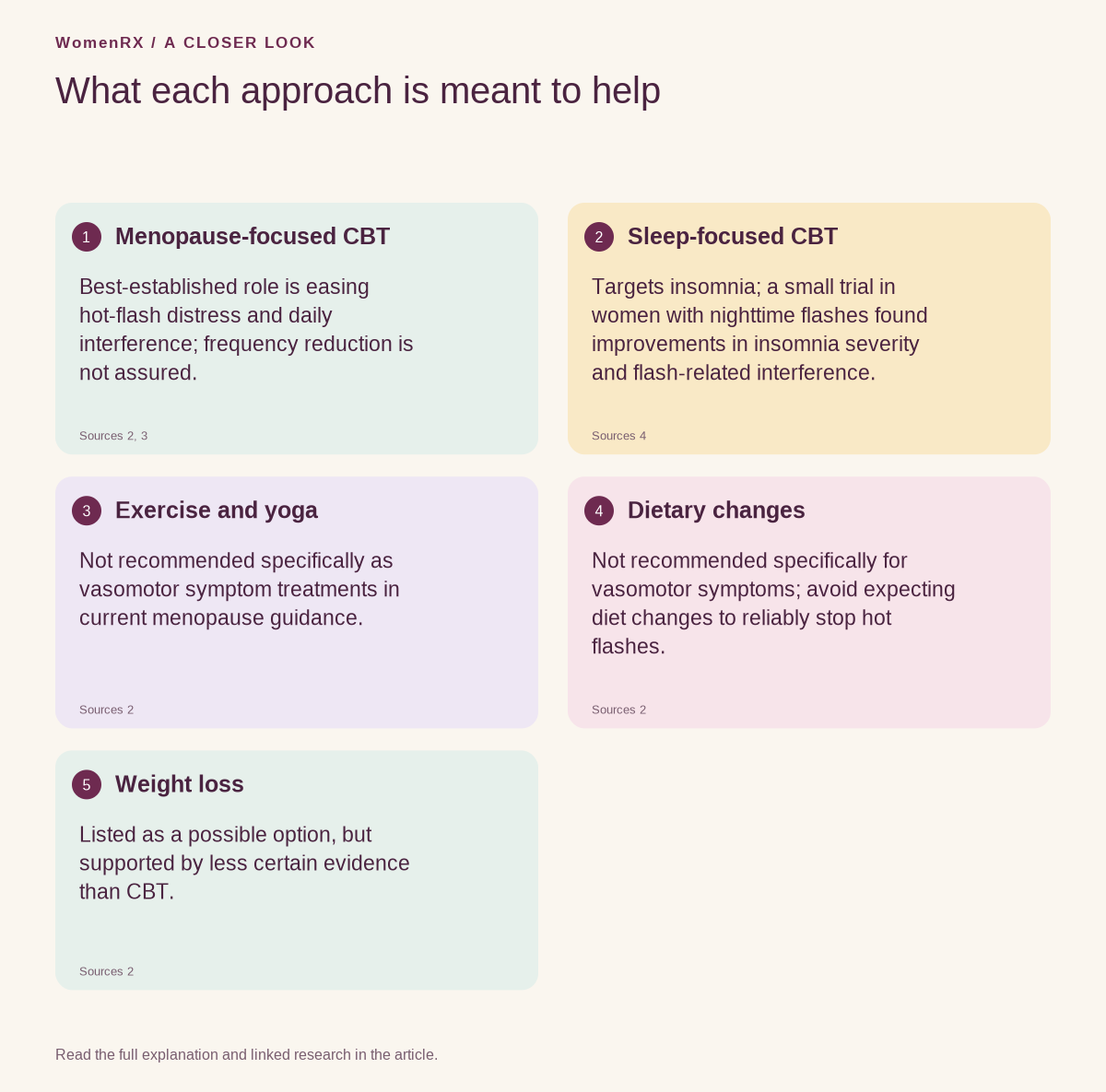
What each approach is meant to help
Menopause-focused CBT: Best-established role is easing hot-flash distress and daily interference; frequency reduction is not assured.23
Sleep-focused CBT: Targets insomnia; a small trial in women with nighttime flashes found improvements in insomnia severity and flash-related interference.4
Exercise and yoga: Not recommended specifically as vasomotor symptom treatments in current menopause guidance.2
Dietary changes: Not recommended specifically for vasomotor symptoms; avoid expecting diet changes to reliably stop hot flashes.2
Weight loss: Listed as a possible option, but supported by less certain evidence than CBT.2
Read the figure as text
The outcome matters: an approach may help hot-flash distress or insomnia without reliably reducing how often flashes occur.- Menopause-focused CBT: Best-established role is easing hot-flash distress and daily interference; frequency reduction is not assured.23
- Sleep-focused CBT: Targets insomnia; a small trial in women with nighttime flashes found improvements in insomnia severity and flash-related interference.4
- Exercise and yoga: Not recommended specifically as vasomotor symptom treatments in current menopause guidance.2
- Dietary changes: Not recommended specifically for vasomotor symptoms; avoid expecting diet changes to reliably stop hot flashes.2
- Weight loss: Listed as a possible option, but supported by less certain evidence than CBT.2
More questions, answered
Does CBT make hot flashes happen less often?
Not reliably, based on the broader description of traditional menopause-focused CBT: its better-established effects are on hot-flash distress and interference. A small trial in postmenopausal Korean women did report reduced frequency, but that result needs confirmation. 3 5
Is CBT for menopause the same as CBT for insomnia?
They can overlap, but the emphasis differs. Menopause-focused CBT commonly targets the distress and disruption associated with hot flashes; sleep-focused CBT specifically targets insomnia. A small trial of an adapted insomnia intervention found improvements in insomnia severity and hot-flash interference. 3 4
Sources you can check
- The 2022 hormone therapy position statement of The North American Menopause Society.“The 2022 Hormone Therapy Position Statement of The North American Menopause Society” Advisory Panel. · Menopause (New York, N.Y.) · 2022Return to first citation
- The 2023 nonhormone therapy position statement of The North American Menopause Society.Menopause (New York, N.Y.) · 2023Return to first citation
- Wait one hot minute: what exactly is cognitive behavioral therapy for menopause?Weitlauf JC, Miles-McLean HA, Millheiser LS. · Current opinion in obstetrics & gynecology · 2026Return to first citation
- Cognitive behavioral therapy for menopausal insomnia in perimenopausal and postmenopausal women with insomnia and nocturnal hot flashes: a randomized-controlled pilot trial.Arentson-Lantz EJ, Muench A, Kokonda M, Meers JM, Swartz M, Manber R, Thurston RC, Nowakowski S. · Menopause (New York, N.Y.) · 2026Return to first citation
- Redefining menopausal care: a randomized trial of group CBT for vasomotor symptoms in Korean women.Jung D, Park JY, Chung KM, Kim MR. · Climacteric : the journal of the International Menopause Society · 2026Return to first citation
- Pharmacological and non-pharmacological treatments for chronic insomnia in perimenopausal and postmenopausal women: a systematic review and meta-analysis.Bruyneel M, Rozenberg S, Sanida C, Demaeyer N, Castermans E, Bruyneel AV. · Sleep medicine · 2026Return to first citation