Bleeding After Menopause: What to Do Next
Even a single spot of blood after 12 months without a period should be assessed, because several different conditions can cause it.
Postmenopausal bleeding means any vaginal bleeding after 12 months without a period. Arrange a medical assessment, even if it’s light or happens only once. Many causes aren’t cancer, but bleeding can sometimes signal a problem with the uterus or its lining. Assessment may include an exam, ultrasound, and tissue sampling; the tests used depend on your circumstances. 1 5
The 12-month distinction
Menopause is generally defined retrospectively: after 12 months without a period, bleeding is considered postmenopausal bleeding. Bleeding before that point may happen during the menopausal transition, but the 12-month boundary is a definition, not a way to determine whether a particular episode is harmless. 1 3
After menopause, don’t dismiss bleeding because it is just a spot, pink or brown discharge, or a one-time episode. Arrange an assessment with a medical clinician. If you’re unsure whether the blood is coming from the vagina, mention that too. 1
Many causes are treatable, but the cause needs checking
Lower estrogen can thin and inflame the vaginal or uterine lining, which may lead to bleeding. Other causes include polyps and a thickened uterine lining, called endometrial hyperplasia. Less commonly, bleeding is linked to cancer. The appearance or amount of blood alone can’t identify the cause. 1
Hormone therapy may be relevant to bleeding. Tell the clinician what you take and when the bleeding started, including any hormone therapy; don’t assume it explains the bleeding without an assessment. 1
What an evaluation may involve
The clinician may ask when your last period was, what the bleeding has been like, and what medicines you use. An examination may include checking your abdomen and examining inside the vagina. 1 3
Transvaginal ultrasound looks at the uterus and its lining, while endometrial sampling collects tissue for examination. These tests aren’t necessarily alternatives: a 2026 perspective describing revised ACOG guidance says it recommends both for most people undergoing an initial assessment. The plan can depend on individual circumstances and local practice. 5
If imaging or tissue sampling doesn’t give a clear answer, or a growth inside the uterus is suspected, hysteroscopy may be considered. In this procedure, a clinician looks inside the uterus with a narrow viewing instrument; a biopsy can be directed at an area that needs closer assessment. A 2026 joint practice guideline favors visually directed biopsy with hysteroscopy when tissue assessment is needed, particularly when earlier tests are inconclusive or a focal problem is suspected. 2 4
A scan or biopsy is part of an evaluation, not a result you need to interpret on your own. For example, ultrasound findings can influence whether tissue sampling is needed, but the clinician considers whether the lining was fully visible, your history, and whether bleeding continues. Research in people with confirmed endometrial cancer has also found that some cancers occurred with a thin lining, underscoring why results must be considered in context. 5 6
A practical next step
When you contact a clinician, say that you’ve had vaginal bleeding after at least 12 months without a period. Include whether it happened once or more than once, roughly when it began, and any hormone therapy or other medicines you use. You don’t need to wait for heavier bleeding before arranging assessment. The goal is to find the cause, not to assume what it is.
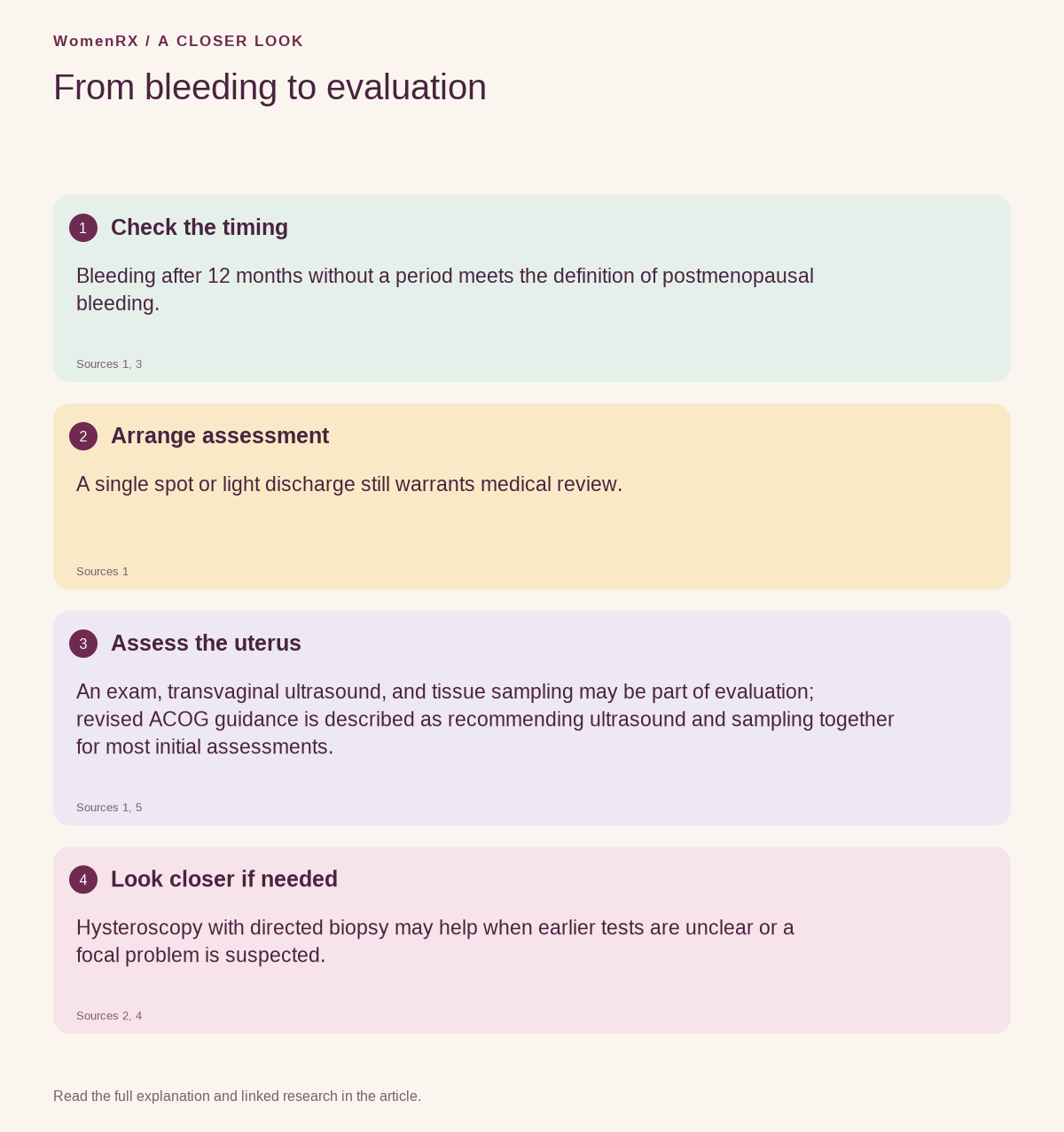
From bleeding to evaluation
Check the timing: Bleeding after 12 months without a period meets the definition of postmenopausal bleeding.13
Arrange assessment: A single spot or light discharge still warrants medical review.1
Assess the uterus: An exam, transvaginal ultrasound, and tissue sampling may be part of evaluation; revised ACOG guidance is described as recommending ultrasound and sampling together for most initial assessments.15
Look closer if needed: Hysteroscopy with directed biopsy may help when earlier tests are unclear or a focal problem is suspected.24
Read the figure as text
A simple path from recognizing postmenopausal bleeding to understanding why clinicians may use more than one kind of test.- Check the timing: Bleeding after 12 months without a period meets the definition of postmenopausal bleeding.13
- Arrange assessment: A single spot or light discharge still warrants medical review.1
- Assess the uterus: An exam, transvaginal ultrasound, and tissue sampling may be part of evaluation; revised ACOG guidance is described as recommending ultrasound and sampling together for most initial assessments.15
- Look closer if needed: Hysteroscopy with directed biopsy may help when earlier tests are unclear or a focal problem is suspected.24
More questions, answered
Does postmenopausal bleeding mean I have cancer?
No. Bleeding can have several causes, including thinning of the vaginal or uterine lining and noncancerous polyps. Cancer is one possible cause, which is why the bleeding should be assessed rather than diagnosed from the symptom alone. 1
Should I mention hormone therapy?
Yes. Hormone therapy may be relevant to bleeding, so tell the clinician what you use and when the bleeding began. Don’t assume the therapy is the cause without an assessment. 1
Sources you can check
- Postmenopausal bleeding - NHSAccessed 2026-09-25Return to first citation
- Visually Directed Hysteroscopic Biopsy in the Evaluation of Abnormal Uterine Bleeding and Postmenopausal Bleeding: A Joint Society Practice Guideline.Joint Society Practice Guideline from AAGL-ESGE-GCH. · Journal of minimally invasive gynecology · 2026Return to first citation
- Histopathological Evaluation of Endometrial Patterns in Women With Postmenopausal Bleeding and Their Correlation With Clinical and Radiological Features.Yadav P, Kaur L, Bagga PK, Grover S, Randhawa M, Singh J. · Cureus · 2026Return to first citation
- Visually directed hysteroscopic biopsy in the evaluation of abnormal uterine bleeding and postmenopausal bleeding: a Joint Society Practice Guideline. Joint Society Practice Guideline from AAGL-ESGE-GCH. · Facts, views & vision in ObGyn · 2026Return to first citation
- A perspective on the revised American College of Obstetricians and Gynecologists' guidance for transvaginal ultrasound in the evaluation of postmenopausal bleeding.Goldstein SR. · Menopause (New York, N.Y.) · 2026Return to first citation
- Endometrial thickness in patients with postmenopausal bleeding and endometrial cancer: A retrospective cohort study.Liu J, Nolin AC, Unnithan S, Erkanli A, Penvose K, Atkins S, Holtzman S, Chess I, Vattakalam A, Blank SV, Wright JD, Albright BB, Hazelton WD, Myers ER, Havrilesky LJ. · Gynecologic oncology reports · 2026Return to first citation