Choosing Kyleena: Bleeding, Placement, and What Comes Next
Kyleena offers up to five years of contraception, but your bleeding preferences and placement plans may matter just as much as its duration.
Kyleena is an IUD that prevents pregnancy by releasing levonorgestrel from a device placed in the uterus. Irregular spotting is common in the first months. Before choosing it, consider how you feel about that possibility, ask what pain relief is offered for placement, and make a plan for removal or for checking its position if you can’t feel the strings. 123

Start with the change you’re most willing to live with
Kyleena is placed in the uterus, where it releases levonorgestrel for contraception for up to five years. Choosing it isn’t only a question of how long you want birth control. Your feelings about unpredictable spotting, hormones, and a placement procedure all belong in the decision. 13
Bleeding may be the clearest starting point if you’re comparing Kyleena with a copper IUD. Irregular bleeding or spotting is common in Kyleena’s first months. Across studies of levonorgestrel IUDs, bleeding generally decreased over time for most users; studies of copper IUDs more often reported heavy bleeding. Those findings describe device categories, not a guarantee of what your periods will look like with Kyleena. 14
For example, if your priority is avoiding a hormone-releasing device, ask about copper and what heavier bleeding might mean for you. If lighter bleeding sounds appealing but months of possible spotting would be difficult, say that too. A German observational study of people who chose Kyleena found that 299 of 406 with bleeding-satisfaction data were satisfied with their bleeding profile at 12 months or when they left the study earlier. That’s useful context, not a prediction for any one person. 34
Plan for placement, not just the years afterward
At placement, a clinician inserts Kyleena into the uterus. Its threads extend through the cervix afterward. Ask what pain-control options the office offers before your appointment. A review of outpatient IUD-placement studies found support for options including local anesthetic approaches, while evidence for anti-inflammatory medicines during the procedure was mixed. An option that helps one part of the experience may not address every concern, so be specific about whether you’re worried about the placement itself, cramping afterward, or both. 12
The timing of placement can also affect whether you need temporary backup contraception. Kyleena’s US prescribing information distinguishes starting it during the first seven days of a menstrual cycle from starting later, and gives separate directions for people switching methods. Rather than assume the same rule applies to you, tell the clinician what contraception you’re using now and ask when your protection begins. 1
If you’re planning around a birth
Kyleena’s prescribing information describes placement immediately after childbirth, after the placenta is removed, as well as later placement after the uterus has returned to its usual size. These aren’t interchangeable plans. If postpartum contraception is on your mind, ask how placement timing, the possibility of expulsion, and your follow-up plan fit your delivery and reproductive plans. 1
You don’t have to intend to use Kyleena for all five years. If you may want to try for pregnancy sooner, ask the office how to arrange removal. Don’t pull on the threads yourself. If you have Kyleena removed for another reason and don’t want to become pregnant, ask about your next contraceptive method. 13
Know which changes need a call
Before you leave the placement appointment, ask how you should check the strings and whom to contact if you can’t feel them. Kyleena’s instructions say not to pull on the strings. If you can’t feel them, contact the clinician and avoid intercourse or use nonhormonal backup contraception until the IUD’s position is confirmed. Excessive pain or bleeding during placement, or pain or bleeding that worsens afterward, also warrants contact because displacement or perforation is possible. 1
That’s a more useful follow-up plan than simply hoping everything is fine: know how to reach the office, what changes to report, and when your particular placement calls for a check. 1
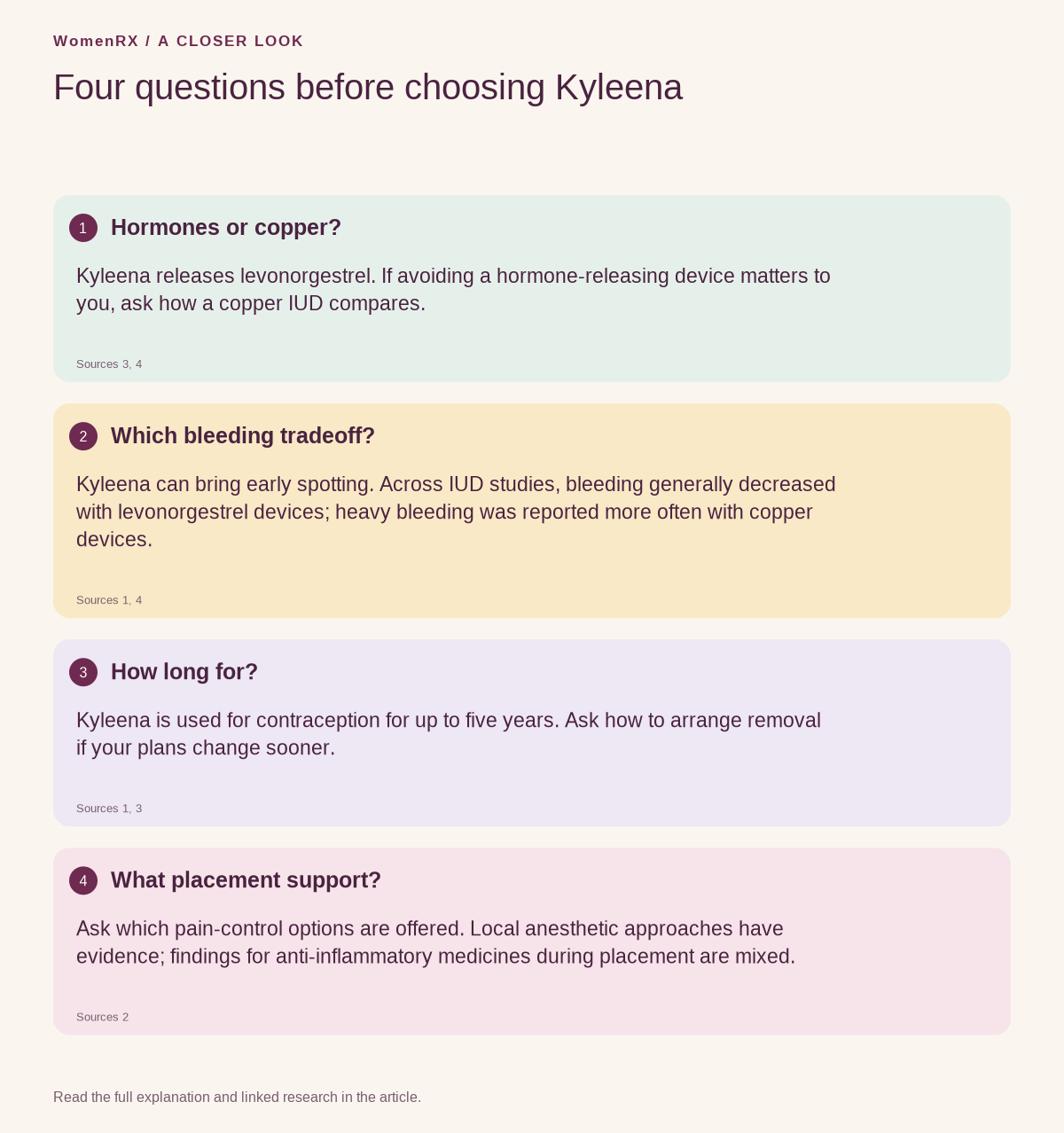
Four questions before choosing Kyleena
Hormones or copper?: Kyleena releases levonorgestrel. If avoiding a hormone-releasing device matters to you, ask how a copper IUD compares.34
Which bleeding tradeoff?: Kyleena can bring early spotting. Across IUD studies, bleeding generally decreased with levonorgestrel devices; heavy bleeding was reported more often with copper devices.14
How long for?: Kyleena is used for contraception for up to five years. Ask how to arrange removal if your plans change sooner.13
What placement support?: Ask which pain-control options are offered. Local anesthetic approaches have evidence; findings for anti-inflammatory medicines during placement are mixed.2
Read the figure as text
Use these decision questions to make an IUD comparison fit your priorities; they aren’t a diagnostic checklist.- Hormones or copper?: Kyleena releases levonorgestrel. If avoiding a hormone-releasing device matters to you, ask how a copper IUD compares.34
- Which bleeding tradeoff?: Kyleena can bring early spotting. Across IUD studies, bleeding generally decreased with levonorgestrel devices; heavy bleeding was reported more often with copper devices.14
- How long for?: Kyleena is used for contraception for up to five years. Ask how to arrange removal if your plans change sooner.13
- What placement support?: Ask which pain-control options are offered. Local anesthetic approaches have evidence; findings for anti-inflammatory medicines during placement are mixed.2
More questions, answered
Does being someone who hasn’t given birth rule out Kyleena?
Not on that fact alone. A German observational study included people who had and had not given birth and found similar satisfaction in both groups. Whether Kyleena suits you still depends on your individual health and preferences. 3
Sources you can check
- KYLEENA (LEVONORGESTREL) INTRAUTERINE DEVICE [BAYER HEALTHCARE PHARMACEUTICALS INC.] | US prescribing information and patient instructionsAccessed 2026-09-25Return to first citation
- Pain control options for intrauterine device placement and endometrial biopsy.Passarelli N, Neill S, Dutton C. · Current opinion in obstetrics & gynecology · 2026Return to first citation
- The use of LNG-IUS-19.5 mg in daily gynecological routine practice in Germany: data from the Kyleena™ Satisfaction Study (KYSS).Römer T, Frenz AK, Dietrich-Ott S, Fiedler A. · Archives of gynecology and obstetrics · 2024Return to first citation
- Discontinuation rates of intrauterine contraception due to unfavourable bleeding: a systematic review.Costescu D, Chawla R, Hughes R, Teal S, Merz M. · BMC women's health · 2022Return to first citation