After a Hormonal IUD: What Changes and When to Call
Spotting and cramps can be part of the adjustment, but worsening symptoms or a possible change in IUD position deserve a call.
In the first few weeks after a hormonal IUD is placed, cramps and irregular bleeding or spotting can happen. Bleeding may stay unpredictable for several months before it becomes lighter, and your pattern may differ from someone else’s. Call your insertion clinic if pain or bleeding worsens, bleeding stays unusually heavy, or you can’t feel the strings when you’ve been instructed to check them.12

The first weeks: notice the direction of change
Cramping, spotting, and irregular or prolonged bleeding can happen in the first few weeks after Mirena or Kyleena placement. Some people have bleeding that’s heavier than usual at first. Those changes can be frustrating without necessarily meaning the IUD has moved.12
What matters is whether symptoms are easing or getting worse. Excessive pain or vaginal bleeding during placement, or pain or bleeding that worsens afterward, can be a sign of expulsion or perforation. Call the clinician who placed your IUD promptly if that happens rather than waiting for an adjustment period to pass.12
The next several months: irregular doesn’t mean predictable
Mirena’s patient information describes more bleeding or spotting days and irregular patterns during the first 3 to 6 months. Kyleena’s describes similar changes during the first 6 months. Bleeding usually becomes lighter than it was before, but that isn’t a promise that every period will look a certain way, or that spotting will stop on a set date.12
There’s a useful distinction between irregular and concerning. Spotting that comes and goes during the adjustment period fits the expected pattern. Bleeding that remains heavier than usual, becomes heavier after it had lightened, or comes with continuing or severe symptoms is a reason to call.12
Bleeding patterns alone can’t tell you exactly where an IUD sits. In a prospective Dutch study of 52-mg levonorgestrel IUDs, ultrasound at six weeks found malposition in 28 of 448 participants assessed. Malposition was more common among participants reporting unfavorable bleeding and/or pelvic pain than among those with favorable bleeding and no pelvic pain. That doesn’t mean spotting proves malposition. It does explain why a clinician may consider a position check when bleeding or pain is troublesome.3
If you were told to check the strings
Follow the string-check instructions your clinic gave you. Don’t pull on the strings. If you can’t feel them, contact your clinician to have the IUD’s location confirmed. Not feeling the strings doesn’t, by itself, establish that the IUD has come out, but expulsion or perforation is possible. Until its position is confirmed, avoid intercourse or use a nonhormonal backup method, such as condoms, because an IUD that has moved or come out may not protect against pregnancy.12
The same advice applies if you think the IUD has come out: call, and don’t rely on it for contraception while its position is uncertain.12
If placement was soon after childbirth
Tell the clinic if your IUD was placed right after delivery and you’re concerned about pain, bleeding, or its position. Mirena and Kyleena information identifies insertion right after delivery as a time of increased expulsion risk. That doesn’t mean a postpartum IUD is expected to come out, but it makes a suspected change in position especially worth checking.12
Your own instructions may reflect when the IUD was placed and what happened during insertion. If you’re unsure whether a symptom fits the plan you were given, it’s reasonable to call the insertion clinic and describe what changed, such as bleeding that had eased and then grew heavier, pain that’s increasing, or strings you were previously able to feel but now can’t.12
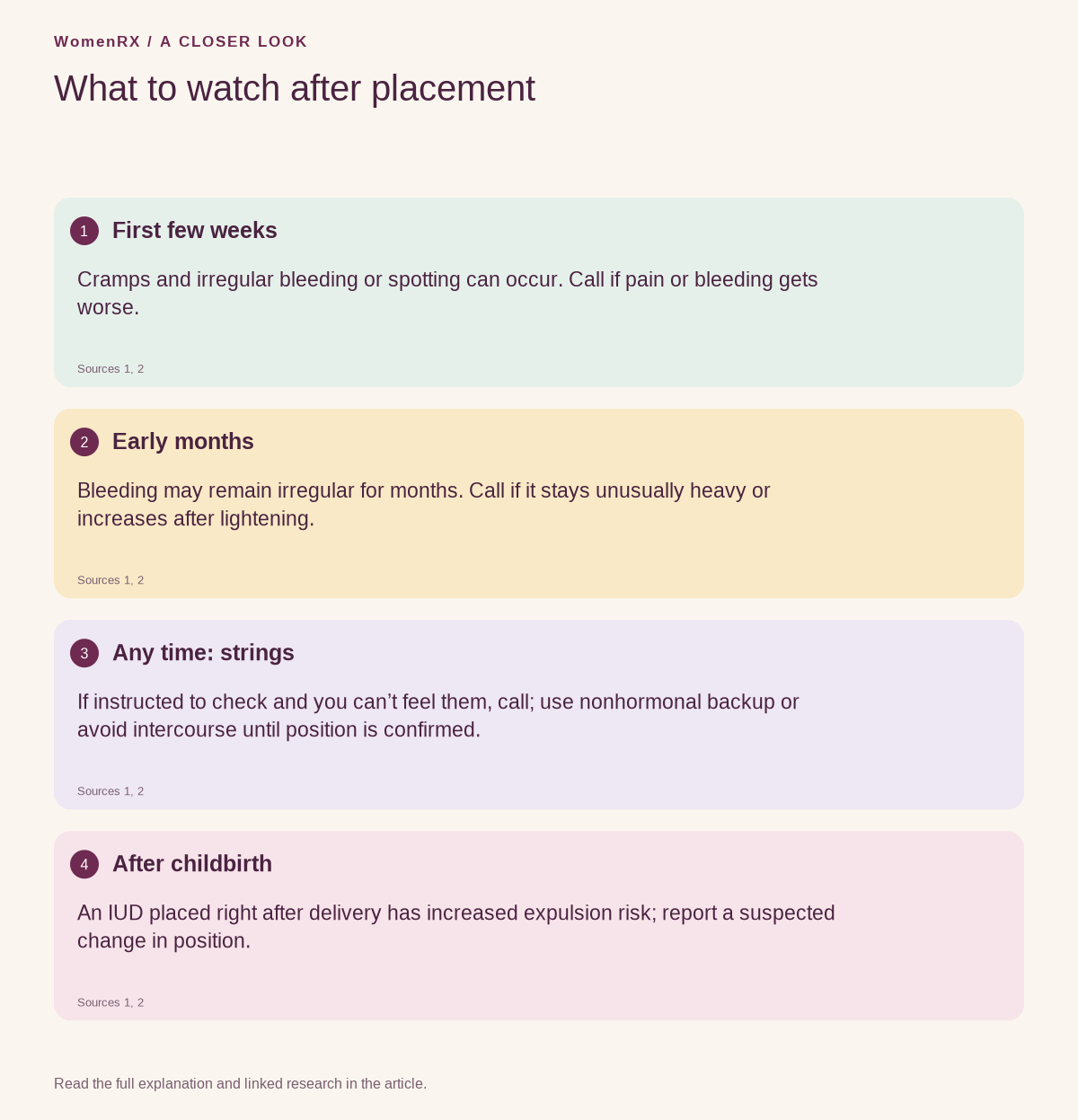
What to watch after placement
First few weeks: Cramps and irregular bleeding or spotting can occur. Call if pain or bleeding gets worse.12
Early months: Bleeding may remain irregular for months. Call if it stays unusually heavy or increases after lightening.12
Any time: strings: If instructed to check and you can’t feel them, call; use nonhormonal backup or avoid intercourse until position is confirmed.12
After childbirth: An IUD placed right after delivery has increased expulsion risk; report a suspected change in position.12
Read the figure as text
These stages describe possible changes, not a guaranteed recovery schedule.- First few weeks: Cramps and irregular bleeding or spotting can occur. Call if pain or bleeding gets worse.12
- Early months: Bleeding may remain irregular for months. Call if it stays unusually heavy or increases after lightening.12
- Any time: strings: If instructed to check and you can’t feel them, call; use nonhormonal backup or avoid intercourse until position is confirmed.12
- After childbirth: An IUD placed right after delivery has increased expulsion risk; report a suspected change in position.12
More questions, answered
Do I need an ultrasound at six weeks?
Not necessarily. In a Dutch prospective study of 52-mg levonorgestrel IUDs, malposition was uncommon among participants who reported neither unfavorable bleeding nor pelvic pain. The researchers suggested considering ultrasound when bleeding is unfavorable, rather than treating a routine six-week scan as necessary for everyone. Your clinician can decide whether your symptoms call for a position check.3
Sources you can check
- MIRENA (LEVONORGESTREL) INTRAUTERINE DEVICE [BAYER HEALTHCARE PHARMACEUTICALS INC.] | US prescribing information and patient instructionsAccessed 2026-09-25Return to first citation
- KYLEENA (LEVONORGESTREL) INTRAUTERINE DEVICE [BAYER HEALTHCARE PHARMACEUTICALS INC.] | US prescribing information and patient instructionsAccessed 2026-09-25Return to first citation
- Is 2-dimensional transvaginal ultrasonography necessary 6 weeks after insertion of the levonorgestrel 52-mg intrauterine device?van der Heijden PAHH, Geomini PMAJ, Ketel I, Veersema S, Bongers MY. · AJOG global reports · 2022Return to first citation