Hormonal IUD cost: what to check before booking
The useful price is what you’ll pay for the device and care together, not just the amount shown on a booking page.
As of September 26, 2026, Planned Parenthood’s U.S. patient page estimated $0 to $1,800 for an IUD, including medical exams, insertion, and follow-up visits. That broad range isn’t a quote for a particular hormonal brand or for your location.7 Get an itemized local estimate, check what your coverage pays, and add up what remains. Online booking doesn’t replace placement by a trained healthcare provider.12
Price the whole visit, not just the IUD
A hormonal IUD may be listed under its brand name, such as Mirena or Kyleena, or described as a levonorgestrel IUD. When you ask for a quote, name the device you’re considering and ask what the quoted amount includes. The device, assessment, placement, and any later visit are separate questions worth settling before you book. Mirena’s instructions, for example, call for an assessment before placement, insertion by a trained healthcare provider, and a follow-up evaluation.1 That describes care, not how a particular clinic will bill for it.
For a starting point, Planned Parenthood’s U.S. patient page gave a broad IUD cost range of $0 to $1,800 as of September 26, 2026. It includes medical exams, insertion, and follow-up visits, and varies by IUD type. It is not a guaranteed price for a hormonal IUD or a quote from a provider near you.7
Start with the clinic that would actually place the IUD. Ask for an itemized estimate for the device and the placement visit. Then ask whether an initial consultation is included or would be a separate appointment. An in-person examination is part of IUD placement, but CDC guidance says few examinations or tests are needed beforehand for healthy patients; STI screening, when indicated, can be done at the placement visit.6 A clinic can tell you which visits or tests it expects in your situation and whether they carry separate charges.
Pain management is another useful question for the same call: what options does the clinic offer, and are any billed separately? CDC guidance calls for discussing placement pain and the available options with each patient; it does not suggest that everyone needs the same medication or procedure.6
Check what “follow-up” means in the quote
Ask who you would contact if you have a concern after placement, whether a planned follow-up visit is offered, and what you might pay for it. Mirena’s product instructions call for an evaluation 4 to 6 weeks after insertion.1 Broader CDC guidance says evidence has not shown that an earlier or more frequent routine follow-up schedule improves IUD continuation.6 Those statements serve different purposes: one is product-specific instruction, while the other addresses the evidence for routine visit schedules. Neither tells you whether your clinic includes a follow-up visit in its price.
If you’re planning an IUD after giving birth, ask the placement team whether the proposed visit is immediately after delivery or later, and which setting would provide it. CDC guidance allows a levonorgestrel IUD to be placed postpartum, including immediately after delivery, when appropriate, but notes that expulsion is more common with postpartum placement and that access to a later appointment matters too.6 Those differences can change which appointment you need to price. Ask for the estimate tied to your planned setting and timing, rather than assuming an office quote covers placement during a hospital stay.
Verify coverage against that estimate
If you have insurance, give the plan the device name, the placing clinician or facility, and the appointments on the clinic’s estimate. Ask which parts it covers and what you would owe for each. A deductible, copayment, or coinsurance can affect what you pay for covered care, depending on the plan and service.5 If you have Medicaid or another public plan, ask that plan and the placement provider the same location-specific questions rather than assuming a privately insured person’s result applies to you.34
The difference between a study average and your bill is real. In an analysis of claims from 727,482 privately insured U.S. women in 2017-2021, 71.5% paid $0 out of pocket for IUD insertion. The study also found differences by IUD type and age.4 It did not give a current, all-in quote for you or show what an uninsured patient would pay. Use it as a reason to check coverage, not as a price promise.
If cost is a barrier, ask local reproductive health providers whether they offer a lower-cost option and what services its quote covers. If privacy matters, ask the provider and any insurer before booking how appointments, bills, and coverage notices are handled. You don’t have to share details with an online form just to find out whether the service can answer those questions.
Know what an online booking page is selling
An online service might offer an assessment request, an appointment, or information about a device. Its advertised price may cover only that step. Ask where placement happens, who provides the IUD, who bills for the device and procedure, and where you would go with a concern afterward. Mirena and Kyleena are placed by trained healthcare providers; ordering or scheduling online is not a way to insert either device yourself.12
To turn the answers into your estimated total, write down what you would owe for each quoted part: consultation, device, placement, any separately billed pain-management option, and planned follow-up. Add those amounts, counting a bundled charge only once. Keep any charge the provider cannot yet estimate separate rather than treating it as $0. Check the result against your plan’s answers about coverage and cost-sharing.5
A useful final request is: “Can you give me one itemized estimate for my planned device and visits, showing what I pay if my coverage applies and what I pay if it doesn’t?” That gives you something concrete to compare across local providers without mistaking a booking fee or an insertion-only figure for the full cost.
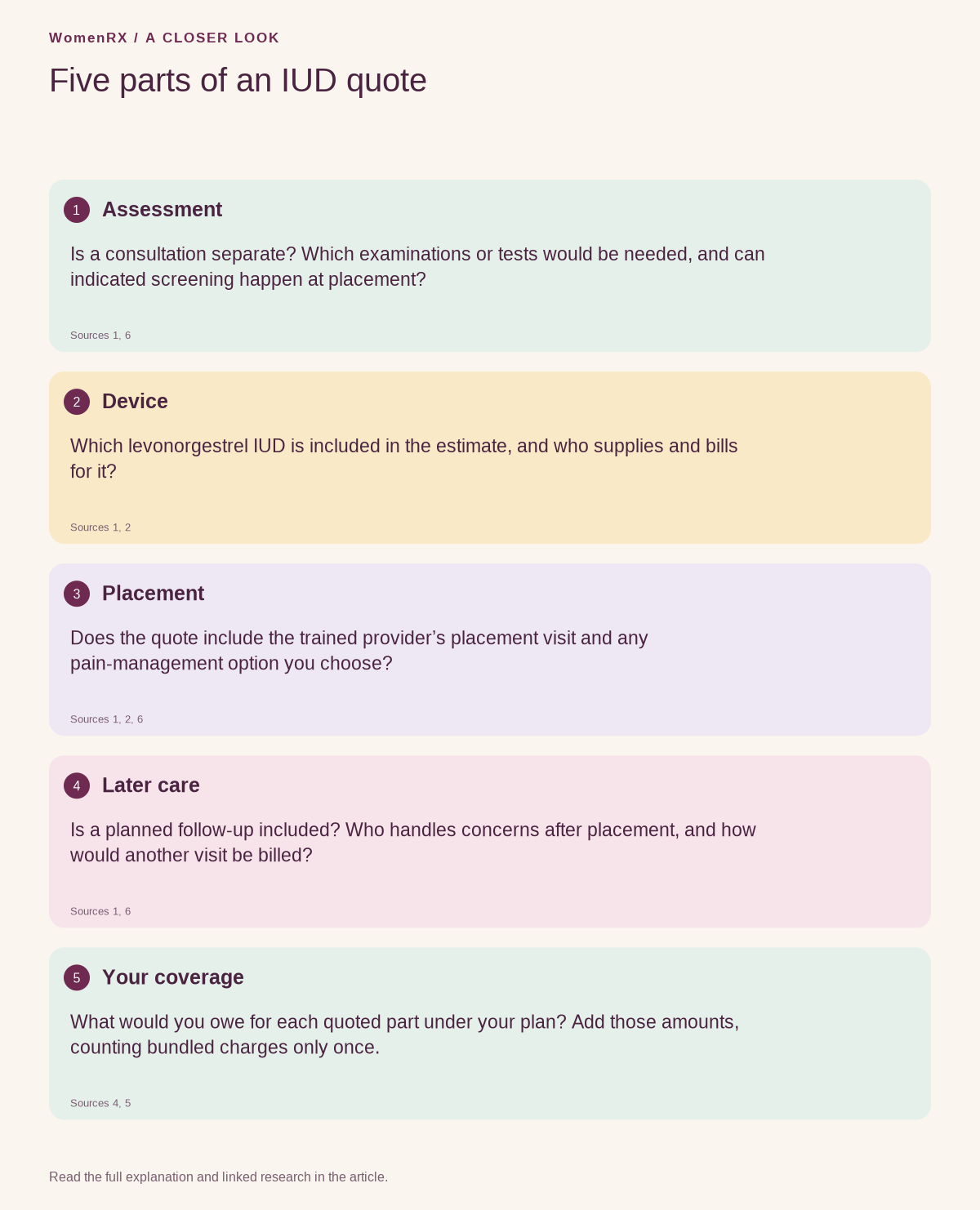
Five parts of an IUD quote
Assessment: Is a consultation separate? Which examinations or tests would be needed, and can indicated screening happen at placement?16
Device: Which levonorgestrel IUD is included in the estimate, and who supplies and bills for it?12
Placement: Does the quote include the trained provider’s placement visit and any pain-management option you choose?126
Later care: Is a planned follow-up included? Who handles concerns after placement, and how would another visit be billed?16
Your coverage: What would you owe for each quoted part under your plan? Add those amounts, counting bundled charges only once.45
Read the figure as text
Use these questions with the provider who would place the IUD, then check the answers with your coverage plan.- Assessment: Is a consultation separate? Which examinations or tests would be needed, and can indicated screening happen at placement?16
- Device: Which levonorgestrel IUD is included in the estimate, and who supplies and bills for it?12
- Placement: Does the quote include the trained provider’s placement visit and any pain-management option you choose?126
- Later care: Is a planned follow-up included? Who handles concerns after placement, and how would another visit be billed?16
- Your coverage: What would you owe for each quoted part under your plan? Add those amounts, counting bundled charges only once.45
Sources you can check
- MIRENA (LEVONORGESTREL) INTRAUTERINE DEVICE [BAYER HEALTHCARE PHARMACEUTICALS INC.] | US prescribing information and patient instructionsAccessed 2026-09-25Return to first citation
- KYLEENA (LEVONORGESTREL) INTRAUTERINE DEVICE [BAYER HEALTHCARE PHARMACEUTICALS INC.] | US prescribing information and patient instructionsAccessed 2026-09-25Return to first citation
- Health Insurance: MedlinePlusAccessed 2026-09-25Return to first citation
- Who Is Still Paying Out-of-Pocket for Their IUDs Despite the ACA Contraceptive Coverage Requirement? Analysis of a Large National Cohort Using Claims Data.Nelson HN, Liu G, Horvath S, Weisman CS, Leslie DL, Atrio J, Chuang CH. · Women's health issues : official publication of the Jacobs Institute of Women's Health · 2026Return to first citation
- Your total costs for health care: Premium, deductible, and out-of-pocket costs | HealthCare.govAccessed 2026-09-25Return to first citation
- CDC: Intrauterine contraception and copper IUD bleedingAccessed 2026-09-25Return to first citation
- Planned Parenthood: How can I get an IUD?Accessed 2026-09-26Return to first citation