Hormonal IUD Dose: Release Rate and Duration
A hormonal IUD releases levonorgestrel gradually, so its total hormone content isn’t a daily dose or a reliable guide to when it needs replacing.
You don’t take a daily dose with a hormonal IUD. The device contains a total amount of levonorgestrel and releases a smaller amount into the uterus over time; that release rate gradually declines. The approved time in place is a separate, product-specific detail. For example, Kyleena’s US label says it must be removed by the end of year five. 12

What “dose” means for an IUD
A hormonal IUD is placed in the uterus and releases levonorgestrel (LNG) gradually. Its label may describe both the total amount in the device, measured in milligrams (mg), and the release rate, measured in micrograms per day (mcg/day). Those numbers describe different things: the first is the reservoir’s contents, while the second is an estimate of how much the device releases at a particular point in time. You don’t take or adjust either amount yourself. 12
For example, Mirena contains 52 mg of LNG. Its estimated release rate is about 21 mcg per day 24 days after insertion, then gradually declines, reaching an estimated 7 mcg per day at year eight. Kyleena contains 19.5 mg; its estimated rate is about 17.5 mcg per day after 24 days and 7.4 mcg per day at year five. These product-specific figures show why total content isn’t the same as the amount released each day. 12
A release curve isn’t a replacement date
The hormone release rate declines over time; it doesn’t stay fixed at the initial rate. But a release estimate by itself doesn’t tell you how long your particular IUD is approved to remain in place. Kyleena’s US prescribing information says it must be removed by the end of the fifth year and can be replaced then if continued contraceptive protection is desired. 2
Mirena’s prescribing information gives release estimates through year eight, but the release figures alone aren’t a substitute for the product’s approved duration or its instructions for a particular use. Don’t use a release-rate table, another person’s device, or the IUD’s total milligrams to decide your replacement date. 1
Check the device and the reason you use it
The practical details to confirm are the device name, when it was inserted, and why you’re using it. Pregnancy prevention and management of menstrual bleeding are different treatment goals; check the product’s instructions for the goal that applies to you rather than assuming one duration covers every use. Approval and duration can also depend on the country. The figures above come from US product information, so they shouldn’t be treated as rules for devices approved elsewhere.
If you don’t know which IUD you have, look for the device name on your insertion paperwork or patient portal, or ask the clinic that placed it. Then confirm the removal or replacement timing for that exact product and use. A useful question is: “What is the last date my IUD is approved for the reason I’m using it?”
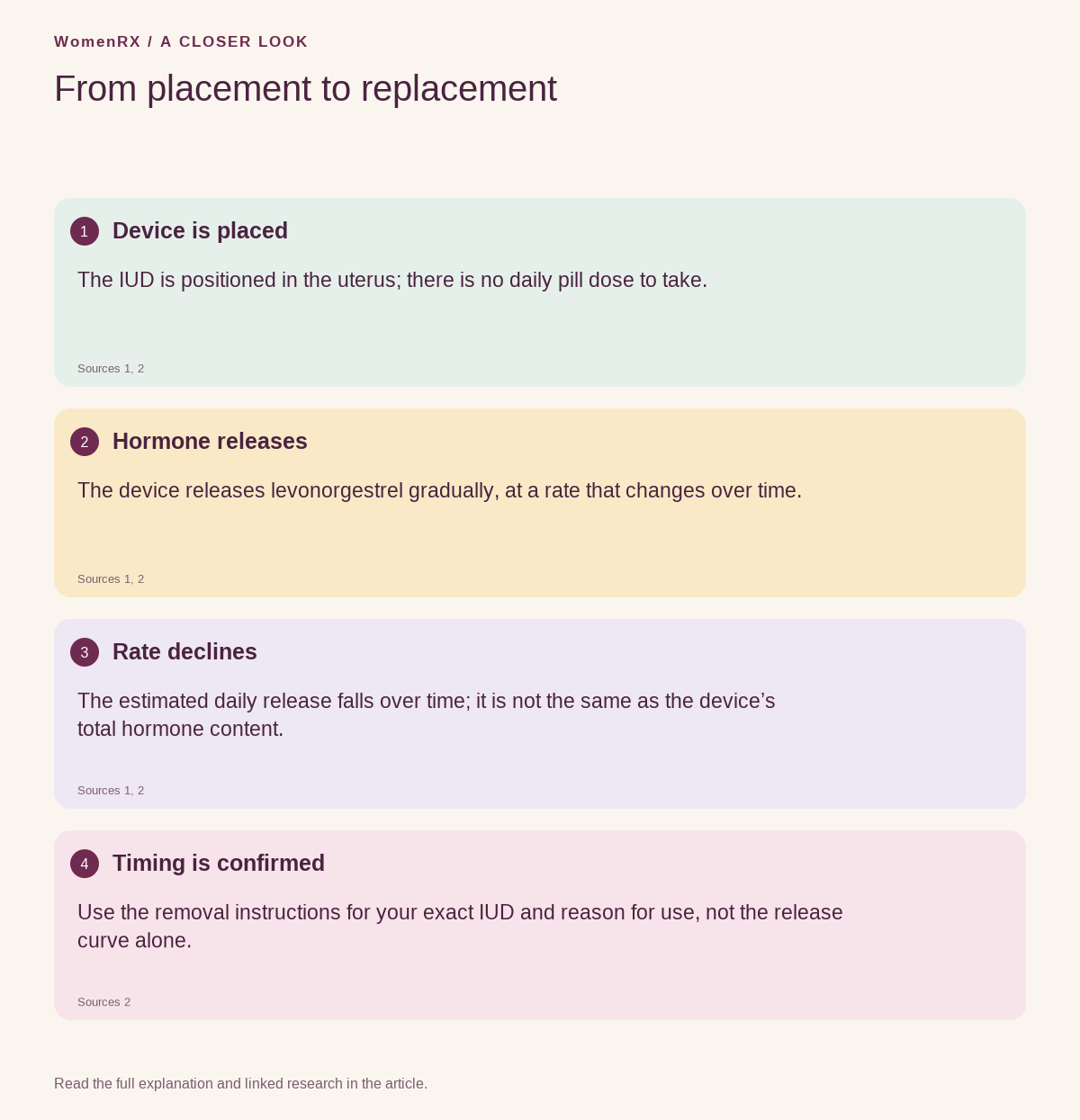
From placement to replacement
Device is placed: The IUD is positioned in the uterus; there is no daily pill dose to take.12
Hormone releases: The device releases levonorgestrel gradually, at a rate that changes over time.12
Rate declines: The estimated daily release falls over time; it is not the same as the device’s total hormone content.12
Timing is confirmed: Use the removal instructions for your exact IUD and reason for use, not the release curve alone.2
Read the figure as text
These steps separate gradual hormone release from the device-specific timing for removal or replacement.- Device is placed: The IUD is positioned in the uterus; there is no daily pill dose to take.12
- Hormone releases: The device releases levonorgestrel gradually, at a rate that changes over time.12
- Rate declines: The estimated daily release falls over time; it is not the same as the device’s total hormone content.12
- Timing is confirmed: Use the removal instructions for your exact IUD and reason for use, not the release curve alone.2
More questions, answered
Does a lower release rate mean the IUD has stopped working?
Not by itself. Release rates decline over time, but a release-rate figure alone doesn’t establish the approved duration. Follow the removal timing for your specific device and use. 12
Is the total amount in the device the amount that enters my body?
No. The listed total content and the estimated amount released per day are different measurements. Mirena’s information also says that only small amounts of its levonorgestrel enter the blood. 1
Sources you can check
- MIRENA (LEVONORGESTREL) INTRAUTERINE DEVICE [BAYER HEALTHCARE PHARMACEUTICALS INC.] | US prescribing information and patient instructionsAccessed 2026-09-25Return to first citation
- KYLEENA (LEVONORGESTREL) INTRAUTERINE DEVICE [BAYER HEALTHCARE PHARMACEUTICALS INC.] | US prescribing information and patient instructionsAccessed 2026-09-25Return to first citation