An Itchy Scalp During Menopause: Causes and Next Steps
Menopause may contribute to skin dryness or itching, but an itchy scalp can also come from a product reaction or a scalp condition.
Skin dryness and itching are reported around menopause, but research doesn’t establish menopause as the cause of scalp itching specifically. Check for flakes, redness, sores, hair changes, and recent hair-product changes: these clues can point toward common scalp conditions or irritation. Simplifying irritating products may help, while severe or persistent itching deserves assessment. Hormone therapy isn’t indicated for skin or hair symptoms alone. 2 3
The menopause connection is possible, not proven for the scalp
Skin dryness and itching are described among symptoms that can occur around menopause. But that broad connection doesn’t show that menopause itself is the reason your scalp itches, or that a particular itchy scalp is hormone-related. The available review discusses skin and hair changes together, rather than establishing a menopause-specific cause of scalp pruritus. 2 3
That distinction matters because scalp itch has several everyday explanations. Dry or irritated skin, dandruff, eczema, psoriasis, and reactions to cosmetics or other substances can all cause itching. A new shampoo, hair dye, styling product, or fragranced product is worth considering if the timing fits. 1 2
Let the scalp clues guide your next step
Look for visible changes. Flaking, redness, a rash, bumps, or sores can help narrow down what might be happening, though appearance alone doesn’t confirm a diagnosis. Dandruff, eczema, and psoriasis are among the long-term skin conditions associated with itch. 2
Think about what changed. If the itching started after trying a new product, irritation or an allergic reaction is one possibility. Consider pausing recently added or fragranced scalp products and keeping your routine simple while you see whether the irritation settles. Cosmetics and other substances are recognized causes of itchy skin; this isn’t a way to diagnose an allergy. 1 2
Notice other sensations and hair changes. Burning, tenderness, or prickling alongside itch may be useful to mention, especially if the scalp looks relatively unchanged. These sensations can occur with sensitive scalp, but the condition is poorly studied and its causes are uncertain. Hair shedding or changes in hair quality can occur around menopause too, but they don’t by themselves explain the itch. 3 4
A practical note can keep the pattern clear: when the itch began, where it is, whether there’s a visible change, which products you recently used, and whether you’ve noticed burning, tenderness, or hair changes. This is a way to organize the clues, not a diagnostic checklist.
Try gentle care, and know when to get help
For mild itching, avoid scratching as much as you can, and try a cool compress. Heat can make itching worse, and irritating substances may add to it. If a product seems linked, stop using the recently added product rather than layering on more treatments. 1
Get medical advice if the itch is severe, affects daily life, lasts for a few weeks, or has no clear cause. Seek an assessment sooner if you’re seeing persistent scalp changes or are concerned about hair loss; a clinician can examine the scalp and work out whether a skin condition or another cause needs attention. 1 2
Hormone therapy shouldn’t be started just to treat an itchy scalp. A menopause review says it isn’t indicated for skin and hair symptoms alone; decisions about hormone therapy should be based on appropriate indications and an individualized discussion, not the assumption that scalp itch is hormonal. 3
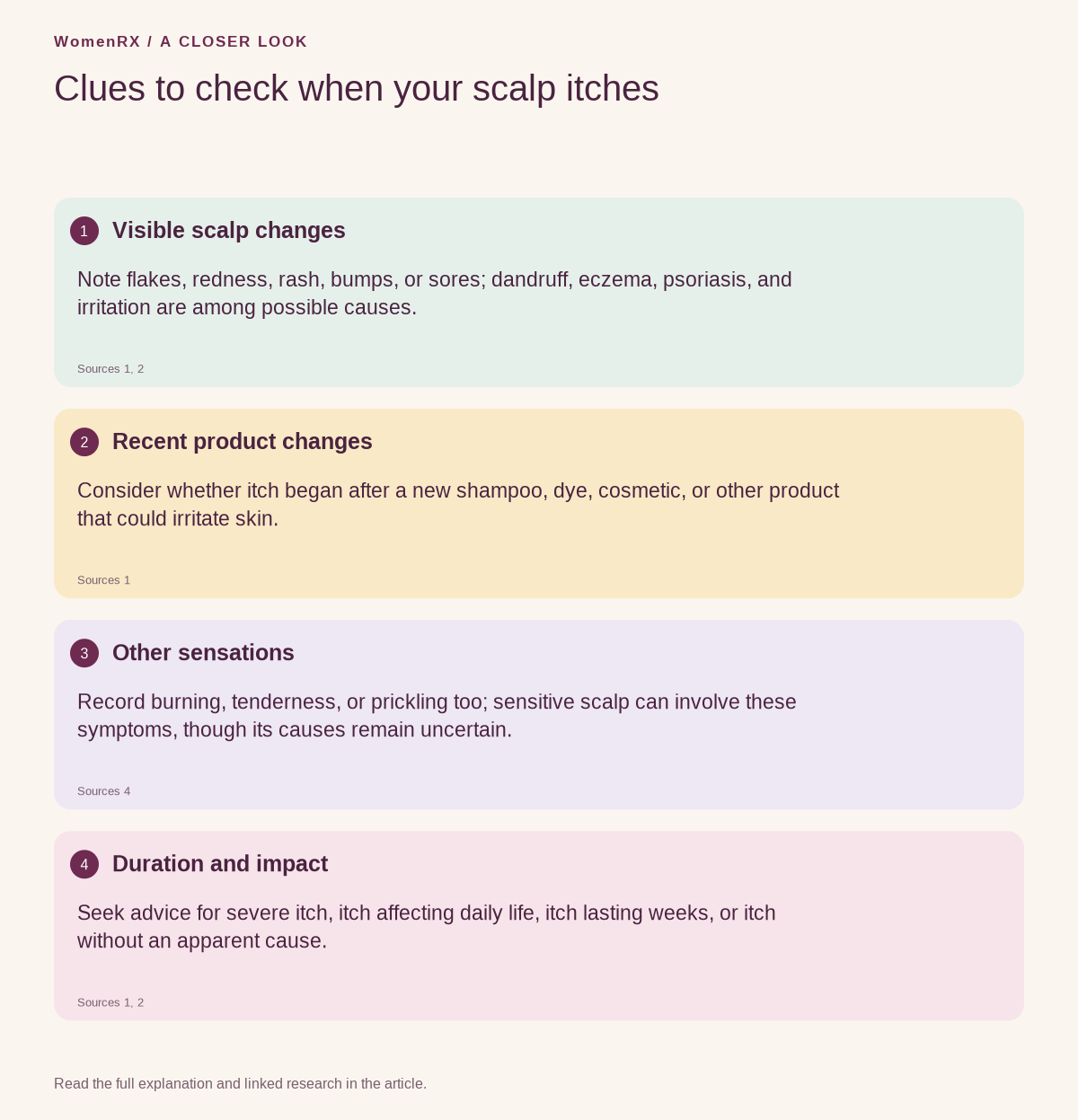
Clues to check when your scalp itches
Visible scalp changes: Note flakes, redness, rash, bumps, or sores; dandruff, eczema, psoriasis, and irritation are among possible causes.12
Recent product changes: Consider whether itch began after a new shampoo, dye, cosmetic, or other product that could irritate skin.1
Other sensations: Record burning, tenderness, or prickling too; sensitive scalp can involve these symptoms, though its causes remain uncertain.4
Duration and impact: Seek advice for severe itch, itch affecting daily life, itch lasting weeks, or itch without an apparent cause.12
Read the figure as text
These observations can help you choose a sensible next step, but they don’t diagnose the cause.- Visible scalp changes: Note flakes, redness, rash, bumps, or sores; dandruff, eczema, psoriasis, and irritation are among possible causes.12
- Recent product changes: Consider whether itch began after a new shampoo, dye, cosmetic, or other product that could irritate skin.1
- Other sensations: Record burning, tenderness, or prickling too; sensitive scalp can involve these symptoms, though its causes remain uncertain.4
- Duration and impact: Seek advice for severe itch, itch affecting daily life, itch lasting weeks, or itch without an apparent cause.12
More questions, answered
Does an itchy scalp mean I’m in menopause?
No. Itching can occur among broader skin changes reported around menopause, but scalp itch alone doesn’t establish menopause as the cause. Irritation, dandruff, eczema, psoriasis, and other causes are also possible. 1 2 3
Should I try hormone therapy for scalp itching?
Hormone therapy isn’t indicated for skin and hair symptoms alone, according to a menopause review. An itchy scalp needs attention to its likely cause rather than an assumption that hormones are responsible. 3
Sources you can check
- Itching | Pruritus | Itchy skin | MedlinePlusAccessed 2026-09-25Return to first citation
- Itchy skin - NHSAccessed 2026-09-25Return to first citation
- Skin, hair and beyond: the impact of menopause.Zouboulis CC, Blume-Peytavi U, Kosmadaki M, Roó E, Vexiau-Robert D, Kerob D, Goldstein SR. · Climacteric : the journal of the International Menopause Society · 2022Return to first citation
- Sensitive Scalp and Trichodynia: Epidemiology, Etiopathogenesis, Diagnosis, and Management.Souza EN, Anzai A, Costa Fechine CO, Sakai Valente NY, Romiti R. · Skin appendage disorders · 2023Return to first citation