Perimenopause Breast Tenderness: Patterns and Next Steps
Breast tenderness may follow a period-related pattern, but pain that doesn’t improve or comes with another breast change deserves assessment.
Period-related breast pain often begins up to two weeks before bleeding and eases when the period ends. That general pattern does not establish how long an episode of tenderness lasts specifically in perimenopause. If your periods are unpredictable, noting both pain and bleeding dates may help you spot that pattern. Arrange an assessment if pain isn’t improving or you notice a hard lump that doesn’t move, nipple discharge, or skin or shape change. 1 2
Look for how the tenderness changes
Breast tenderness that comes and goes around bleeding may be cyclical. Period-related pain often begins up to two weeks before a period, worsens, then eases when the period ends. It may affect both breasts and sometimes extend toward the armpit. 2
If your periods are unpredictable, there may be no expected date to compare the pain with. A brief note of when discomfort starts and settles, whether it affects one area or both breasts, and when bleeding occurs can help you notice a possible pattern. This is a way to organize what you’re experiencing, not a test that can identify the cause.
Timing is a clue, not a diagnosis
Pain unrelated to the menstrual cycle is described as noncyclical. 3 Breast pain can also have causes other than a cycle, including some medicines and pain referred from the neck, shoulder, or back. Hormone changes during menopause are another possible contributor. 2
Pain by itself is unlikely to be a sign of cancer, but a new breast change or pain that isn’t improving still needs assessment. 2
When to move from tracking to an appointment
Tracking can help you see whether tenderness settles around bleeding. Arrange an assessment if pain is not improving, painkillers are not helping, or you notice any of the changes below. 2
If pain is new or confined to one area, note when it began and whether it settles around bleeding. If it does not improve, arrange an assessment. 2
Seek assessment for a hard lump that doesn’t move, nipple discharge, a change in breast shape, dimpling, a nipple that has sunk inward, or a rash on or around the nipple. A breast that is red, hot, or swollen is another reason to seek medical advice. 1 2
An appointment does not automatically mean you need imaging. For noncyclical breast pain without examination findings or cancer risk factors, a systematic review found that evidence to guide imaging versus clinical follow-up was very limited; it describes imaging decisions as an area for shared decision-making in primary care. Assessment and the decision to image are separate steps. 4
What to bring to the conversation
If you’ve been tracking the discomfort, share when it began, whether it affects one area or both breasts, how it relates to bleeding, and whether you’ve noticed any other changes. Mention medicines you take, too, since some medicines can be associated with breast pain. These details can help make the assessment more focused. 2
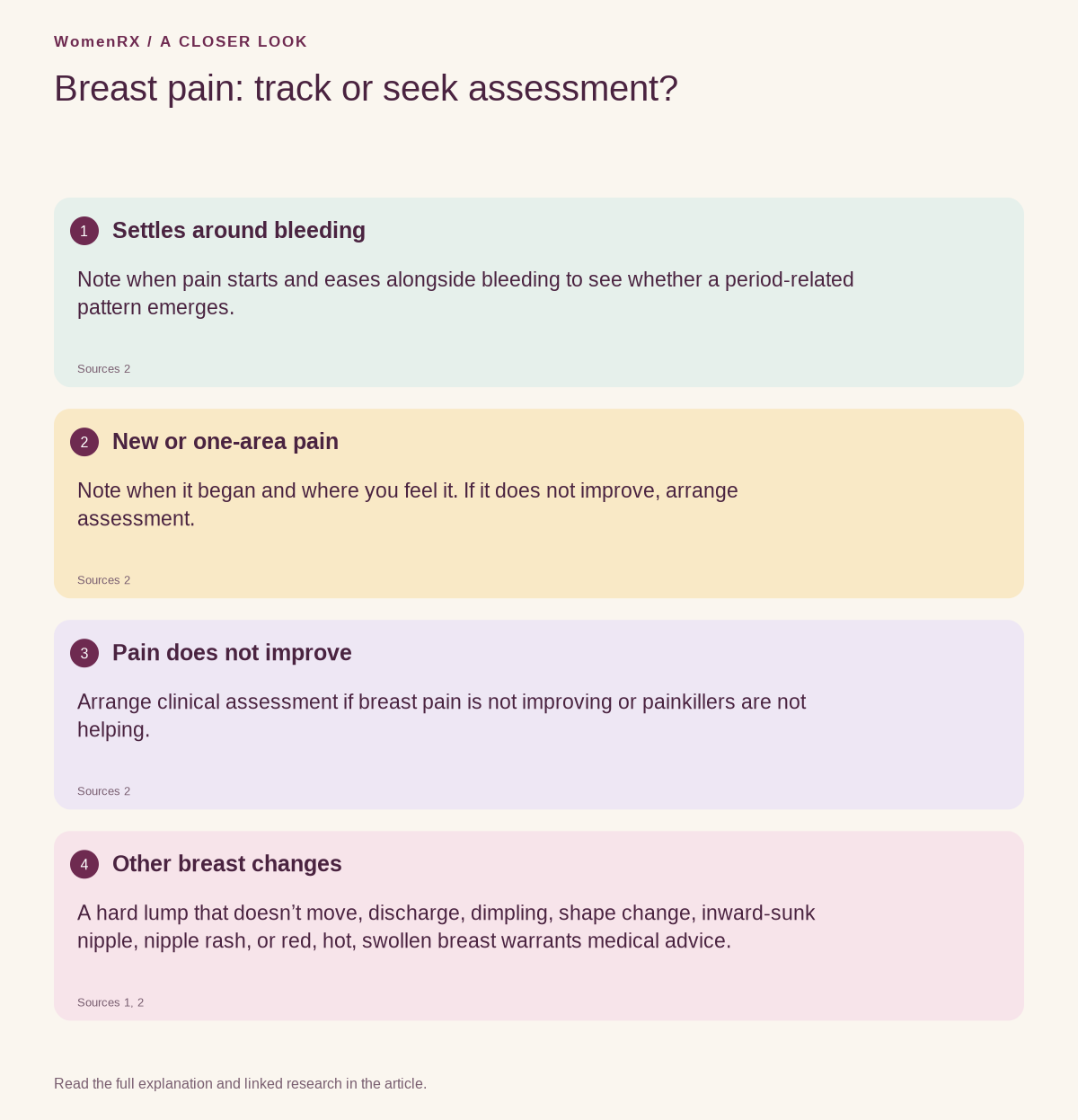
Breast pain: track or seek assessment?
Settles around bleeding: Note when pain starts and eases alongside bleeding to see whether a period-related pattern emerges.2
New or one-area pain: Note when it began and where you feel it. If it does not improve, arrange assessment.2
Pain does not improve: Arrange clinical assessment if breast pain is not improving or painkillers are not helping.2
Other breast changes: A hard lump that doesn’t move, discharge, dimpling, shape change, inward-sunk nipple, nipple rash, or red, hot, swollen breast warrants medical advice.12
Read the figure as text
Use the pattern and any associated changes to choose a next step. Where pain occurs is useful to describe, but it does not identify the cause by itself.- Settles around bleeding: Note when pain starts and eases alongside bleeding to see whether a period-related pattern emerges.2
- New or one-area pain: Note when it began and where you feel it. If it does not improve, arrange assessment.2
- Pain does not improve: Arrange clinical assessment if breast pain is not improving or painkillers are not helping.2
- Other breast changes: A hard lump that doesn’t move, discharge, dimpling, shape change, inward-sunk nipple, nipple rash, or red, hot, swollen breast warrants medical advice.12
More questions, answered
Does breast tenderness alone mean breast cancer?
Breast pain by itself is unlikely to be a sign of cancer. But a hard lump that doesn’t move, nipple discharge, skin or shape change, or pain that isn’t improving should be assessed. 1 2
Sources you can check
- Nipple discharge - NHSAccessed 2026-09-25Return to first citation
- Breast pain - NHSAccessed 2026-09-25Return to first citation
- The effectiveness of vitamin B6 in reducing mastalgia: a systematic review and meta-analysis.Sharifipour F, Siahkal SF, Bagherinia M. · BMC women's health · 2025Return to first citation
- To image or not in noncyclic breast pain? A systematic review.Martín-Díaz M, Maes-Carballo M, Khan KS, Bueno-Cavanillas A. · Current opinion in obstetrics & gynecology · 2017Return to first citation