Perimenopause Breast Tenderness: Track Patterns, Find Relief
A simple record of timing, location, and what helps can show whether tenderness follows your changing cycle or needs a closer look.
Breast tenderness can occur during perimenopause, but it doesn’t prove that hormones are the cause. Note when it happens in relation to bleeding, where you feel it, possible triggers, medication changes, and what eases it. A supportive bra may help; persistent pain in one specific area or pain unrelated to your cycle deserves assessment. 1 2 3
Start with the pattern, not a hormone assumption
Breast tenderness can happen during perimenopause, when hormonal patterns may be less predictable. But breast pain also has causes unrelated to perimenopause, including pregnancy, infection, musculoskeletal problems, and an ill-fitting bra. Pain that comes and goes with the menstrual cycle is considered cyclical; pain that doesn’t track with it is noncyclical. Tenderness alone can’t tell you which cause applies. 1 2
As periods become irregular, comparing symptoms with bleeding may be more useful than relying on the same calendar date each month. The goal isn’t to diagnose yourself. It’s to capture a clear pattern you can explain.
A brief record that’s useful at an appointment
Make a note when tenderness starts and eases, and whether bleeding began around the same time. If your period doesn’t arrive, record that too. Describe the location: both breasts or one, a broad area or one specific spot. Add how the pain feels and whether it affects sleep or usual activities.
Record possible context, such as pressure, a change in bra support, or an activity that seems to bring the pain on. Note any medication or supplement changes, too. These are details to review, not proof that a particular trigger or product caused the tenderness. Finally, write down what you tried and whether it helped, did nothing, or made things worse.
Keep the notes short enough that you’ll use them. A few lines when symptoms change can be more useful than trying to remember several weeks of details at an appointment.
Comfort measures, with realistic expectations
A supportive bra is one commonly recommended conservative measure for breast pain. Many cases improve with supportive care, and breast pain often resolves on its own. These measures may make tenderness easier to manage, but they don’t establish why it started. 1 3
If pain continues despite conservative measures, topical nonsteroidal anti-inflammatory treatment is a clinician-directed option described in breast-pain reviews. Whether it’s suitable for you depends on your circumstances, so ask before using it for ongoing breast pain. More intensive treatments are not first steps and require specialist consideration because of potential side effects. 1 3
When the pattern deserves assessment
Pain focused in one area and not linked to your cycle is different from tenderness that comes and goes with bleeding. A breast-pain review recommends assessment of focal, noncyclical pain; its imaging recommendations vary by age, with ultrasound for women younger than 40 and mammography plus ultrasound for women 40 and older. Your clinician can determine what evaluation fits your symptoms. 1
Cyclical pain, by itself, does not require an imaging work-up according to that review. That statement concerns evaluation of breast pain, not whether you should keep up with routine breast screening. If pain is persistent, severe, or affecting your quality of life, it’s reasonable to bring it up rather than assuming it’s simply part of perimenopause. 1 3
Bring your brief notes and mention any medication changes. The most useful question is often not just “Could this be hormones?” but “Does this pattern fit cyclical pain, or does its location or persistence call for a different assessment?”
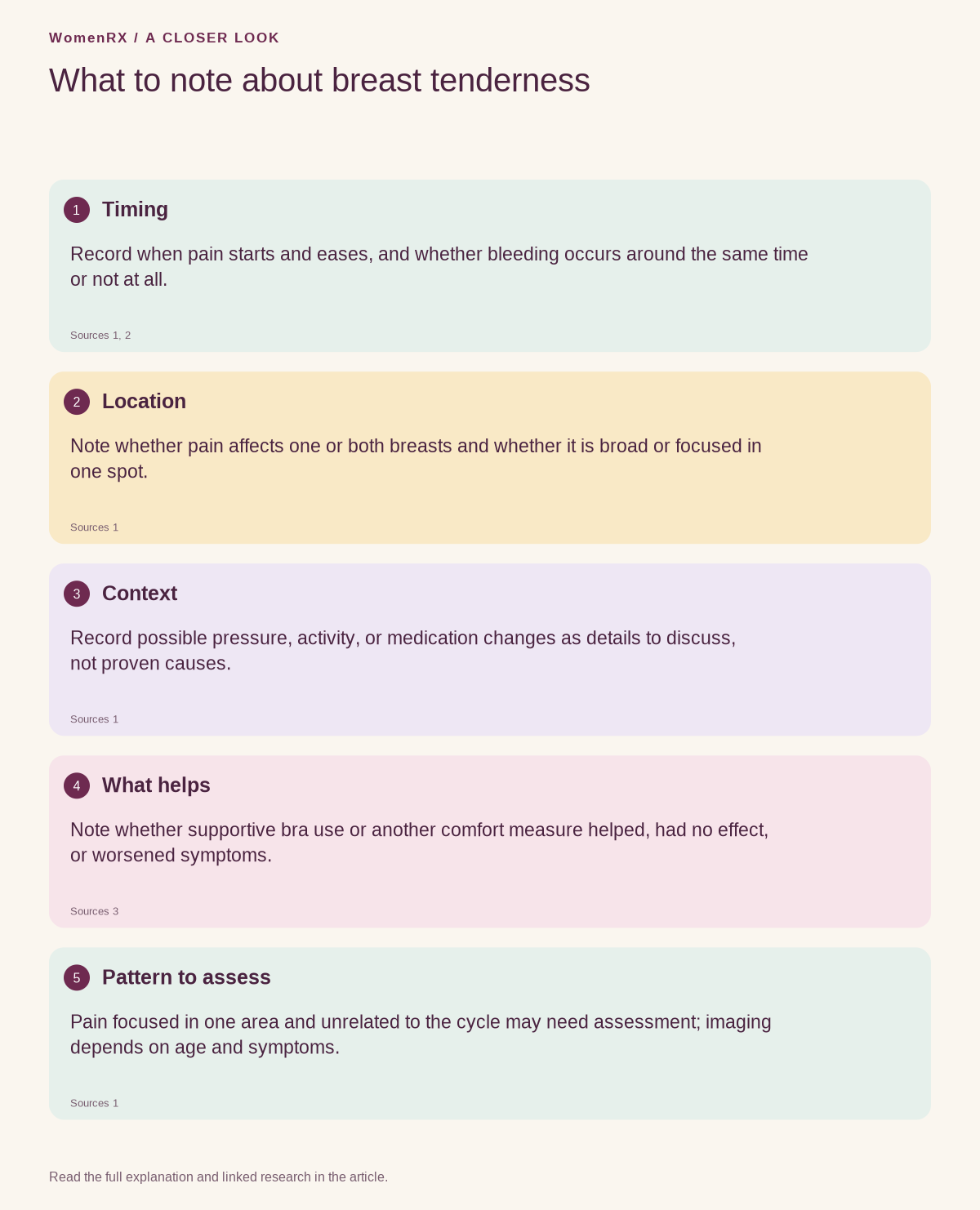
What to note about breast tenderness
Timing: Record when pain starts and eases, and whether bleeding occurs around the same time or not at all.12
Location: Note whether pain affects one or both breasts and whether it is broad or focused in one spot.1
Context: Record possible pressure, activity, or medication changes as details to discuss, not proven causes.1
What helps: Note whether supportive bra use or another comfort measure helped, had no effect, or worsened symptoms.3
Pattern to assess: Pain focused in one area and unrelated to the cycle may need assessment; imaging depends on age and symptoms.1
Read the figure as text
A few consistent details can help describe the pattern without turning your notes into a self-diagnosis.- Timing: Record when pain starts and eases, and whether bleeding occurs around the same time or not at all.12
- Location: Note whether pain affects one or both breasts and whether it is broad or focused in one spot.1
- Context: Record possible pressure, activity, or medication changes as details to discuss, not proven causes.1
- What helps: Note whether supportive bra use or another comfort measure helped, had no effect, or worsened symptoms.3
- Pattern to assess: Pain focused in one area and unrelated to the cycle may need assessment; imaging depends on age and symptoms.1
Sources you can check
- A Review of Breast Pain: Causes, Imaging Recommendations, and Treatment.Sivarajah R, Welkie J, Mack J, Casas RS, Paulishak M, Chetlen AL. · Journal of breast imaging · 2020Return to first citation
- [The perimenopause. Problems and therapeutic changes].Tinelli A, Torresin L, Menis T. · Minerva ginecologica · 2002Return to first citation
- A systematic review of current understanding and management of mastalgia.Kataria K, Dhar A, Srivastava A, Kumar S, Goyal A. · The Indian journal of surgery · 2014Return to first citation