Breast Tenderness in Perimenopause: Patterns and Relief
Tenderness that comes and goes with bleeding may be cycle-related, but a new lump, skin change, or unusual discharge deserves assessment rather than a hormonal guess.
In perimenopause, irregular periods can make it harder to tell whether breast tenderness follows a cycle. Note when pain starts and eases, whether it affects one or both breasts, and any other changes; this can help describe a pattern, but it can’t diagnose the cause. Topical anti-inflammatory medicine is one treatment option for breast pain. Get a new lump, skin change, or concerning nipple discharge assessed. 1 2 4
Breast tenderness can be uncomfortable and unsettling, especially when periods have become unpredictable. If it eases and returns around bleeding, a cycle-related pattern is possible. But tenderness alone can’t establish that hormones are the cause, and a new breast change shouldn’t be written off as perimenopause.
Look for a pattern, not a diagnosis
In a small study of 50 women aged 25 to 45 with regular cycles, 30 reported premenstrual breast pain, which the study recorded as lasting four days. The study also observed breast tissue changes across cycle phases, but it did not study perimenopause, when cycles may be irregular. It can help explain why some breast symptoms vary with a cycle, but it doesn’t prove that any individual’s tenderness is hormonal. 1
For a few cycles, make a simple note of when tenderness begins and settles, whether it is on one or both sides, where you feel it, and whether you notice a lump, skin change, or nipple discharge. If your bleeding is unpredictable, record dates rather than trying to label a particular cycle phase. This log is a way to describe what’s happening, not a validated test or a reason to delay assessment.
Pain in one specific spot is focal pain; pain that isn’t confined to one spot is nonfocal pain. Focal pain may need diagnostic imaging; the choice of imaging depends on age and symptoms. 2 4
What may help with discomfort
For pain relief, you can consider a topical nonsteroidal anti-inflammatory medicine such as diclofenac. A review of common breast problems lists topical NSAIDs as a first-line treatment option for mastalgia. If you’re unsure whether one suits your situation, ask a pharmacist. 4
It can also be useful to review medicines if tenderness is new or worsening. The same review notes associations with mastalgia for hormone therapy, oral contraceptives, some psychotropic medicines, and some cardiovascular medicines. That doesn’t show that a medicine is the cause in your case; don’t stop a prescribed medicine on your own, but mention the timing of the symptom and any medication changes when asking about relief. 4
A log can help you judge whether a comfort measure seems to make a difference. Keep it practical: when the pain occurs, what you tried, and whether it helped. If the pain stays in one spot, is worsening, or comes with another breast change, arrange an assessment rather than relying on self-care alone. 2 4
Changes to have assessed
Arrange prompt assessment for a new breast lump, a visible skin change, or nipple discharge that is spontaneous, bloody, or comes from one breast. A breast lump needs further assessment, and suspicious findings may require imaging and sometimes a biopsy. 2 4
Breast pain by itself is usually not a sign of cancer, but that general reassurance does not apply to a new lump or other concerning change. In a study of 91 cases of focal breast pain, imaging found two cancers that were incidental and not at the pain site; the study excluded people with lumps or skin changes. The useful takeaway is not to diagnose yourself from pain location: have focal pain or a separate breast change assessed in context. 3 4
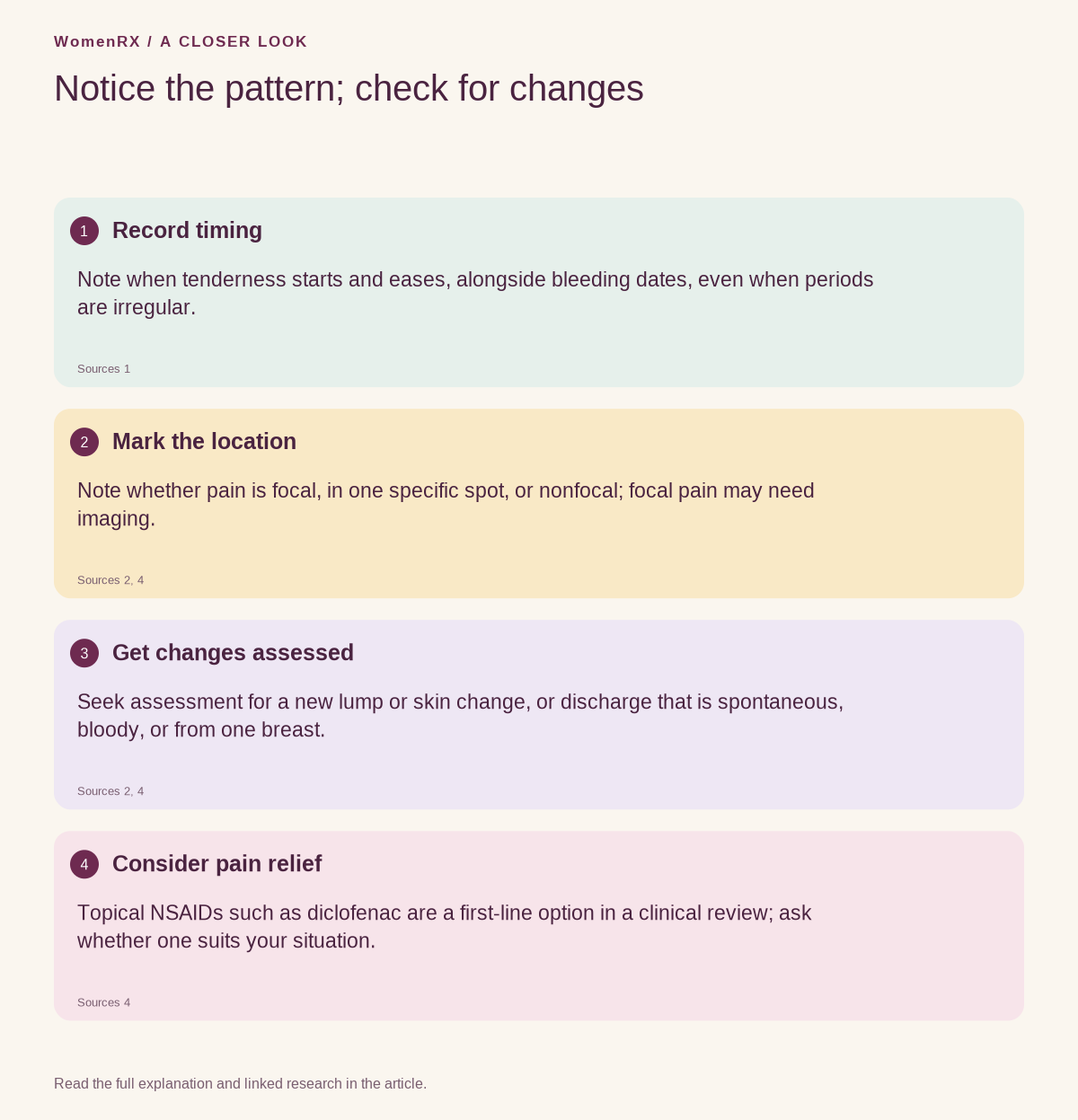
Notice the pattern; check for changes
Record timing: Note when tenderness starts and eases, alongside bleeding dates, even when periods are irregular.1
Mark the location: Note whether pain is focal, in one specific spot, or nonfocal; focal pain may need imaging.24
Get changes assessed: Seek assessment for a new lump or skin change, or discharge that is spontaneous, bloody, or from one breast.24
Consider pain relief: Topical NSAIDs such as diclofenac are a first-line option in a clinical review; ask whether one suits your situation.4
Read the figure as text
Use these prompts to describe breast symptoms and consider pain relief. A log can clarify timing, but it cannot diagnose the cause or replace assessment of a new change.- Record timing: Note when tenderness starts and eases, alongside bleeding dates, even when periods are irregular.1
- Mark the location: Note whether pain is focal, in one specific spot, or nonfocal; focal pain may need imaging.24
- Get changes assessed: Seek assessment for a new lump or skin change, or discharge that is spontaneous, bloody, or from one breast.24
- Consider pain relief: Topical NSAIDs such as diclofenac are a first-line option in a clinical review; ask whether one suits your situation.4
More questions, answered
Does tenderness mean I need breast imaging?
Not necessarily. Imaging decisions depend on the symptom and your age. A review recommends diagnostic imaging for focal breast pain, while tenderness alone is usually not an indication of underlying malignancy. A lump, skin change, or spontaneous, bloody, or one-sided nipple discharge calls for assessment. 2 4
Sources you can check
- [Features of breast ultrasound image and its correlation with estradiol and progesterone level in different phases of menstrual cycle in normal women].Zhou YZ, Jiang YX, Sun Q, Zhang SQ, Zhang Y, Chen FL, Lin SQ. · Zhongguo yi xue ke xue yuan xue bao. Acta Academiae Medicinae Sinicae · 2001Return to first citation
- ESR Essentials: diagnostic work-up in patients with symptomatic breast disease-practice recommendations by the European Society of Breast Imaging.Athanasiou A, Appelman L, Pijnappel RM, Gilbert FJ, Pediconi F, Mann R. · European radiology · 2025Return to first citation
- Role of digital breast tomosynthesis in the evaluation of focal breast pain.Taylor-Cho MW, Peacock S, Wolf S, Thomas S, Grimm LJ, Johnson KS. · Clinical imaging · 2022Return to first citation
- Common Breast Problems.Salzman B, Collins E, Hersh L. · American family physician · 2019Return to first citation