Breast Tenderness During Menopause: Read the Pattern
Breast tenderness can occur around menopause, but its timing, location, and accompanying changes help guide what to do next.
Breast pain can be linked to periods or to hormone changes during menopause, and it may also appear or change after starting hormone therapy. The pattern can help you describe what’s happening, but tenderness alone can’t confirm its cause. Note whether it affects one or both breasts, comes and goes, or stays in one specific area; persistent focal pain or a new breast change deserves assessment. 2 5 If breast pain comes with nipple discharge, seek urgent medical advice even if there is no visible blood. 2
Start with timing, not a guess about the cause
Breast tenderness can happen during the menopause transition, but the word “menopause” doesn’t explain every ache. Period-related breast pain often begins in the two weeks before a period, affects both breasts, and eases when bleeding ends. 2
Breast pain can also occur with hormone changes around menopause. For some women, it may start or change after beginning hormone therapy (HRT). Neither timing nor tenderness by itself proves that hormones are responsible, so pay attention to the pattern without treating it as a diagnosis. 2 5
Compare the pattern you’re noticing
Tenderness in both breasts that comes and goes: This can fit a cycle-linked pattern, especially if it settles after a period. If you’re still having periods, note their dates alongside the tenderness so you can describe whether the two seem connected. 2
A tender area that stays in one specific spot: Localized, persistent pain is a different pattern from general soreness in both breasts. It doesn’t mean you have cancer, but it’s worth discussing with a clinician. Clinical guidance recommends evaluation of focal breast pain, and a review of breast problems notes that imaging may be appropriate for it. 4 5
Tenderness after periods have stopped: Menopause-related hormone changes or HRT may be relevant, but they aren’t the only possible explanations. Breast pain can also be related to an injury or strain in the neck, shoulder, or back, or to some medicines. If it began after starting or changing HRT or another medicine, mention that timing rather than changing treatment on your own. 2 4 5
Tenderness alongside another breast change: A lump, a change in breast shape, dimpling, a new nipple rash or inversion, or skin that is red, hot, or swollen calls for assessment rather than watchful pattern-tracking alone. Nipple discharge should also be checked; if it occurs with breast pain, seek urgent medical advice even if it is not blood-streaked. 1 2 3
A short, useful way to observe it
For a few weeks, jot down when the tenderness starts and eases, whether it affects one breast or both, and whether you can point to one specific area. Add period dates if you’re still having them, and note any recent HRT or medicine changes. This isn’t a test for the cause; it gives you a clearer description to share if the pain persists or changes.
A comfortable, supportive bra may help ease breast pain. If tenderness isn’t improving, keeps returning in the same spot, or is worrying you, arrange an assessment. A clinician can consider your symptoms and examination when deciding whether any further evaluation is needed. 2 5
When not to wait for a pattern to emerge
Arrange an assessment for a new breast lump, or for nipple discharge without breast pain. Seek urgent medical advice if you have breast pain with nipple discharge, even if it is not blood-streaked, or if a lump is hard and doesn’t move, a breast changes shape, the skin is dimpled, a nipple develops a rash or turns inward, or any part of the breast is red, hot, or swollen. Breast pain with a high temperature or feeling hot, cold, or shivery also needs urgent advice. These signs don’t establish a cause, but they’re reasons not to assume tenderness is simply part of menopause. 1 2 3
Breast tenderness is a symptom to interpret, not a menopause test. A repeating, both-breast pattern can offer one clue; persistent pain in a particular spot or a new breast change calls for a different next step.
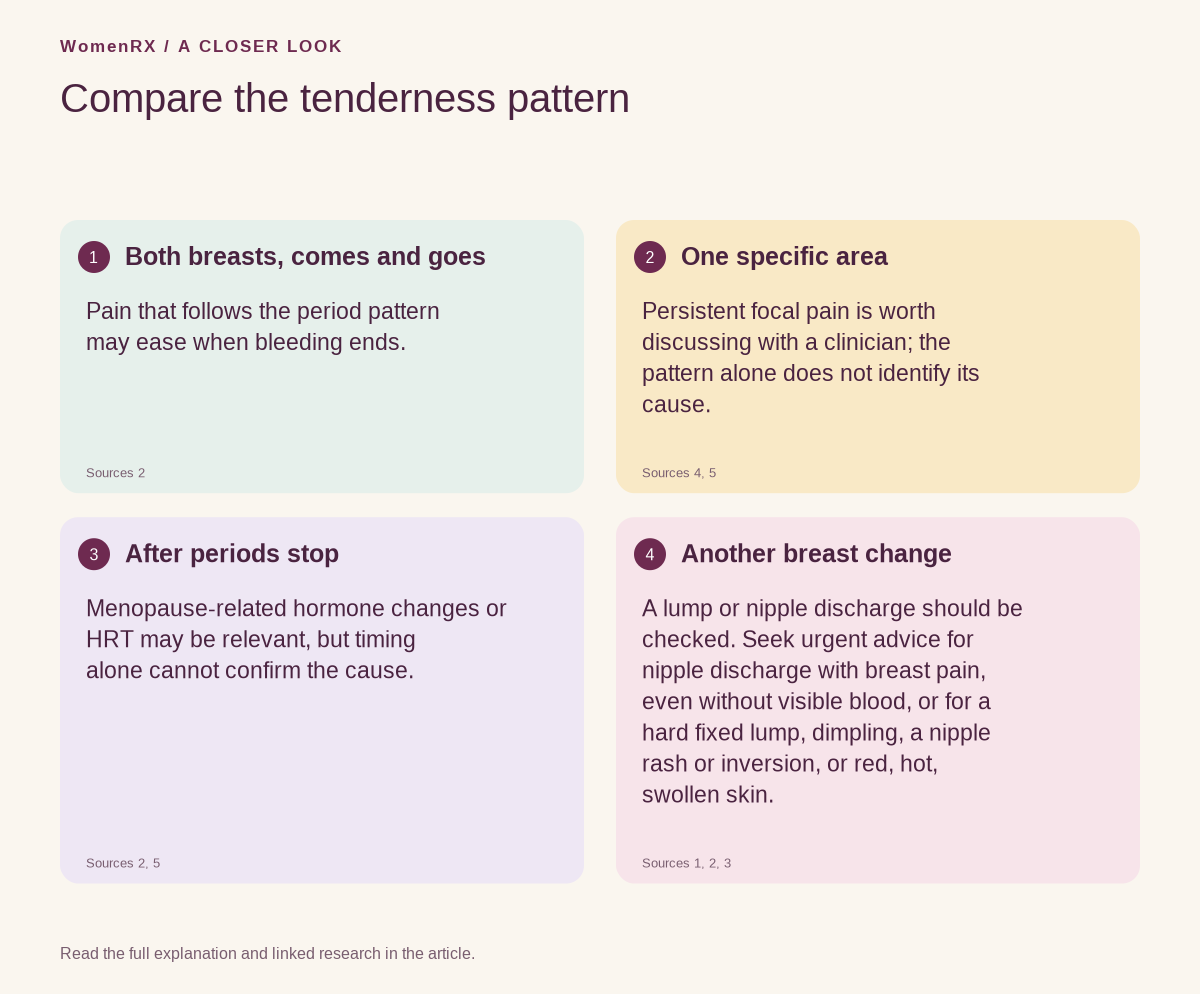
Compare the tenderness pattern
Both breasts, comes and goes: Pain that follows the period pattern may ease when bleeding ends.2
One specific area: Persistent focal pain is worth discussing with a clinician; the pattern alone does not identify its cause.45
After periods stop: Menopause-related hormone changes or HRT may be relevant, but timing alone cannot confirm the cause.25
Another breast change: A lump or nipple discharge should be checked. Seek urgent advice for nipple discharge with breast pain, even without visible blood, or for a hard fixed lump, dimpling, a nipple rash or inversion, or red, hot, swollen skin.123
Read the figure as text
These patterns can help you describe what you notice; they do not diagnose the cause.- Both breasts, comes and goes: Pain that follows the period pattern may ease when bleeding ends.2
- One specific area: Persistent focal pain is worth discussing with a clinician; the pattern alone does not identify its cause.45
- After periods stop: Menopause-related hormone changes or HRT may be relevant, but timing alone cannot confirm the cause.25
- Another breast change: A lump or nipple discharge should be checked. Seek urgent advice for nipple discharge with breast pain, even without visible blood, or for a hard fixed lump, dimpling, a nipple rash or inversion, or red, hot, swollen skin.123
More questions, answered
Can breast tenderness after starting HRT be related?
It can be: breast pain may appear or change after HRT begins. Note when it started and discuss persistent tenderness with the clinician managing your treatment rather than changing HRT on your own. 5
Does breast tenderness by itself mean cancer?
No. Breast pain alone is usually not a sign of cancer, but that doesn’t identify its cause. A new lump, nipple discharge, or a change in the skin, nipple, or breast shape should be assessed. If breast pain accompanies nipple discharge, seek urgent medical advice even if the discharge is not blood-streaked. 1 2 4
Sources you can check
- Nipple discharge - NHSAccessed 2026-09-25Return to first citation
- Breast pain - NHSAccessed 2026-09-25Return to first citation
- Lumps - NHSAccessed 2026-09-25Return to first citation
- Common Breast Problems.Salzman B, Collins E, Hersh L. · American family physician · 2019Return to first citation
- [The HRT follow-up consultation. What to do in case of breast pain. Postmenopausal women management: CNGOF and GEMVi clinical practice guidelines].Mathelin C. · Gynecologie, obstetrique, fertilite & senologie · 2021Return to first citation