Nipple Tenderness During Menopause: When to Get It Checked
Note whether tenderness follows bleeding, stays in one spot, or comes with a separate breast change.
If you still have periods, note whether nipple tenderness returns around bleeding, even if your cycles are irregular. If periods have stopped, notice whether it’s new, persistent, or in the same small spot. Arrange a check for persistent, localized tenderness that isn’t cycle-linked, or if you notice a new lump, nipple discharge, or a newly inverted nipple. A pattern is a clue, not a diagnosis. 1234
What the pattern can, and can’t, tell you
Nipple tenderness can happen during the menopause transition, but its timing alone doesn’t establish menopause as the cause. Breast pain is described as cyclic when it has a clear relationship to the menstrual cycle. Pain without that relationship is noncyclic and often occurs after menopause. These categories describe a pattern, not a diagnosis, and the guidance is about breast pain generally rather than nipple tenderness specifically. 1
If you’re in perimenopause, irregular bleeding can make a cycle-related pattern harder to see. Note whether tenderness tends to return around bleeding, rather than expecting it to follow a predictable monthly schedule. If your periods have stopped, there’s no cycle to compare against; pay attention instead to whether the tenderness is new, persistent, or repeatedly in the same small area.
Possible sources of tenderness
A recurring link with bleeding may fit cyclic breast pain. That association is a useful clue, but it doesn’t prove what is causing the tenderness or mean that every episode is hormone-related. 1
Tenderness without a cycle link may be noncyclic breast pain. Pain can also come from the chest wall or another nearby source and be mistaken for pain within the breast. Neither pattern identifies the cause on its own. 1
One nipple-area condition with a more specific pattern is mammary duct ectasia. It involves changes and widening in milk ducts near the nipple, with inflammation around the ducts; it can cause nipple or areolar tenderness. Discharge is common in this condition, and a lump or an inverted nipple can also occur. These symptoms overlap with other conditions, so they don’t identify duct ectasia on their own. 4
Touch, clothing, or a product on the skin may seem to coincide with tenderness. You can note that timing, but it doesn’t prove the contact caused the symptom.
Make a short note you can use
You don’t need an elaborate diary. When tenderness happens, jot down:
- Timing: when it started, whether it settled or returned, and any nearby bleeding.
- Location: one nipple, both, or a wider part of the breast; whether the same small spot stays sore.
- Contact: whether you noticed tenderness with touch, clothing, or a product on the area. Treat this as an observation, not proof of cause.
- Other changes: a lump, nipple discharge, or a nipple that has newly turned inward. Record these separately from tenderness.
For example, “both nipples felt tender near two episodes of bleeding” describes a different pattern from “the same spot on one nipple has stayed sore.” The note isn’t a diagnostic test. It can help you describe the timing, location, and any separate changes clearly.
When a check may be useful
Arrange an evaluation if tenderness is persistent, focal, and not linked to a cycle. Breast-imaging guidance says imaging may be appropriate for focal, noncyclic breast pain, with the choice depending in part on age. Cyclic or widespread pain, on its own, generally doesn’t call for diagnostic imaging beyond recommended screening. 23
Arrange a check if you notice a new lump, nipple discharge, or a nipple that has newly turned inward, whether or not you also have tenderness. Duct ectasia is one possible benign explanation for some combinations of tenderness and nipple changes, but those signs can overlap with other conditions and can’t establish the cause by themselves. 34
Breast pain without another suspicious finding is rarely associated with breast cancer. That’s reassuring, but a persistent localized symptom or a new change alongside it is still worth describing and assessing. 13
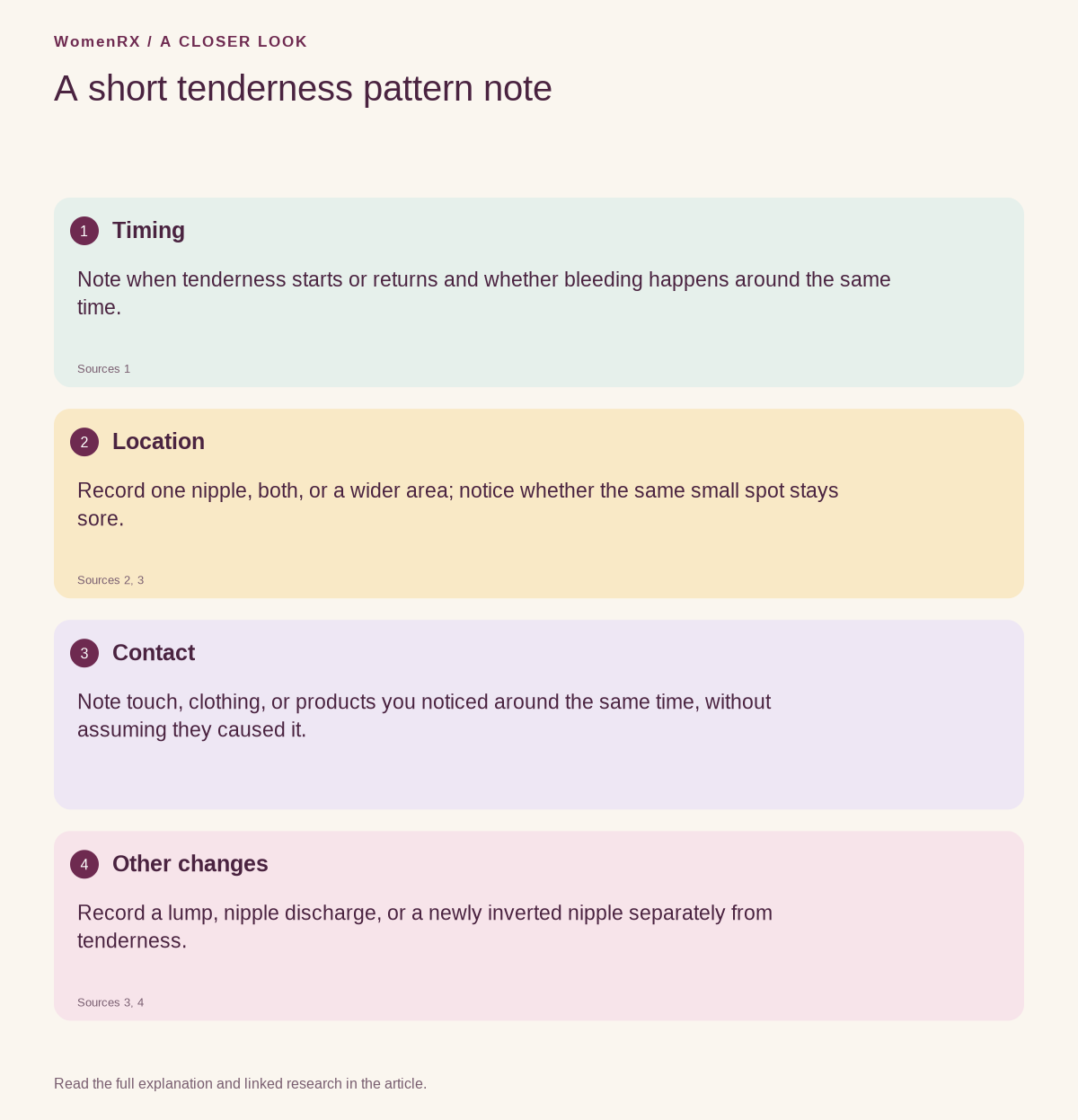
A short tenderness pattern note
Timing: Note when tenderness starts or returns and whether bleeding happens around the same time.1
Location: Record one nipple, both, or a wider area; notice whether the same small spot stays sore.23
Contact: Note touch, clothing, or products you noticed around the same time, without assuming they caused it.
Other changes: Record a lump, nipple discharge, or a newly inverted nipple separately from tenderness.34
Read the figure as text
These four details help describe the pattern and any separate changes; they don’t diagnose the cause.- Timing: Note when tenderness starts or returns and whether bleeding happens around the same time.1
- Location: Record one nipple, both, or a wider area; notice whether the same small spot stays sore.23
- Contact: Note touch, clothing, or products you noticed around the same time, without assuming they caused it.
- Other changes: Record a lump, nipple discharge, or a newly inverted nipple separately from tenderness.34
Sources you can check
- Evaluation and management of breast pain.Smith RL, Pruthi S, Fitzpatrick LA. · Mayo Clinic proceedings · 2004Return to first citation
- ACR Appropriateness Criteria® Breast Pain.Expert Panel on Breast Imaging:, Jokich PM, Bailey L, D'Orsi C, Green ED, Holbrook AI, Lee SJ, Lourenco AP, Mainiero MB, Moy L, Sepulveda KA, Slanetz PJ, Trikha S, Yepes MM, Newell... · Journal of the American College of Radiology : JACR · 2017Return to first citation
- ACR Appropriateness Criteria® Breast Pain.Expert Panel on Breast Imaging:, Holbrook AI, Moy L, Akin EA, Baron P, Didwania AD, Heller SL, Le-Petross HT, Lewin AA, Lourenco AP, Mehta TS, Niell BL, Slanetz PJ, Stuckey AR, Tus... · Journal of the American College of Radiology : JACR · 2018Return to first citation
- Mammary Duct EctasiaHamwi MW, Winters R. · 2023Return to first citation