Breathlessness During Menopause: When to Get It Checked
Menopause may be happening at the same time, but new or recurring breathlessness deserves attention on its own.
Don’t assume breathlessness is a normal menopause symptom. If it comes on suddenly or feels severe, seek emergency care now: acute shortness of breath can signal a serious problem. If episodes keep returning, arrange timely medical evaluation. Menopause guidance recognizes hot flashes and other symptoms, but that alone doesn’t establish that menopause is causing your breathing difficulty. 124
First, decide how urgent it feels
If you’re suddenly struggling to breathe or the difficulty feels severe, seek emergency care now. Acute breathlessness can be a high-risk symptom, and it has many possible causes. Don’t wait to see whether it passes because you’re in the menopause transition. 12
If the episodes aren’t severe but keep returning, arrange a timely evaluation rather than writing them off as hormonal. The pattern and context can help a clinician assess what might be behind them, but symptoms alone can’t reliably identify the cause.
Menopause can overlap without being the explanation
Hot flashes are a recognized menopause symptom. But menopause guidance on hormone and nonhormone treatments addresses hot flashes and other established menopause concerns; it doesn’t establish breathlessness as a menopause symptom or show that menopause treatment will relieve it. If shortness of breath happens during a hot flash, that timing is worth mentioning, but it doesn’t prove one caused the other. 45
The same caution applies if you feel anxious when an episode happens. Anxiety and menopause may be part of the same moment, but that doesn’t rule out a physical cause. Don’t use the timing of an episode to decide on your own that it’s harmless.
Breathing symptoms have more than one possible cause
Breathlessness is a symptom, not a diagnosis. In emergency-care studies of people with acute breathlessness, possible diagnoses included asthma, pneumonia, pulmonary embolism, heart failure, and heart attack, among others. Those studies involved people seeking emergency care, so they don’t tell us what is most likely for any one woman with recurring episodes. They do show why it’s unwise to assume a menopause explanation without assessment. 13
Heart-related symptoms can also look different from the familiar picture of chest pain. A review of cardiovascular disease in women notes that breathlessness may accompany some forms of coronary disease, sometimes alongside symptoms such as nausea or fatigue. That doesn’t mean breathlessness is usually a heart problem; it means a woman’s symptoms deserve attention rather than dismissal. 6
A practical way to choose your next step
- Sudden or severe difficulty breathing: seek emergency care now. Acute breathlessness can signal a high-risk condition. 12
- Episodes that recur: arrange timely medical evaluation, even if they settle. Several lung and heart conditions can cause breathlessness, and the symptom alone doesn’t distinguish them. 13
- Episodes that seem tied to a hot flash: note the overlap, but don’t treat the timing as proof that menopause is the cause. Menopause treatment guidance supports care for vasomotor symptoms, not a general claim that it treats breathlessness. 45
You don’t need to work out the cause before asking for help. If you can, describe when the episodes happen, whether they start suddenly or build, and whether anything else happens at the same time. Those details can help make the conversation more specific, but they aren’t a substitute for assessment when breathing difficulty is severe or keeps returning.
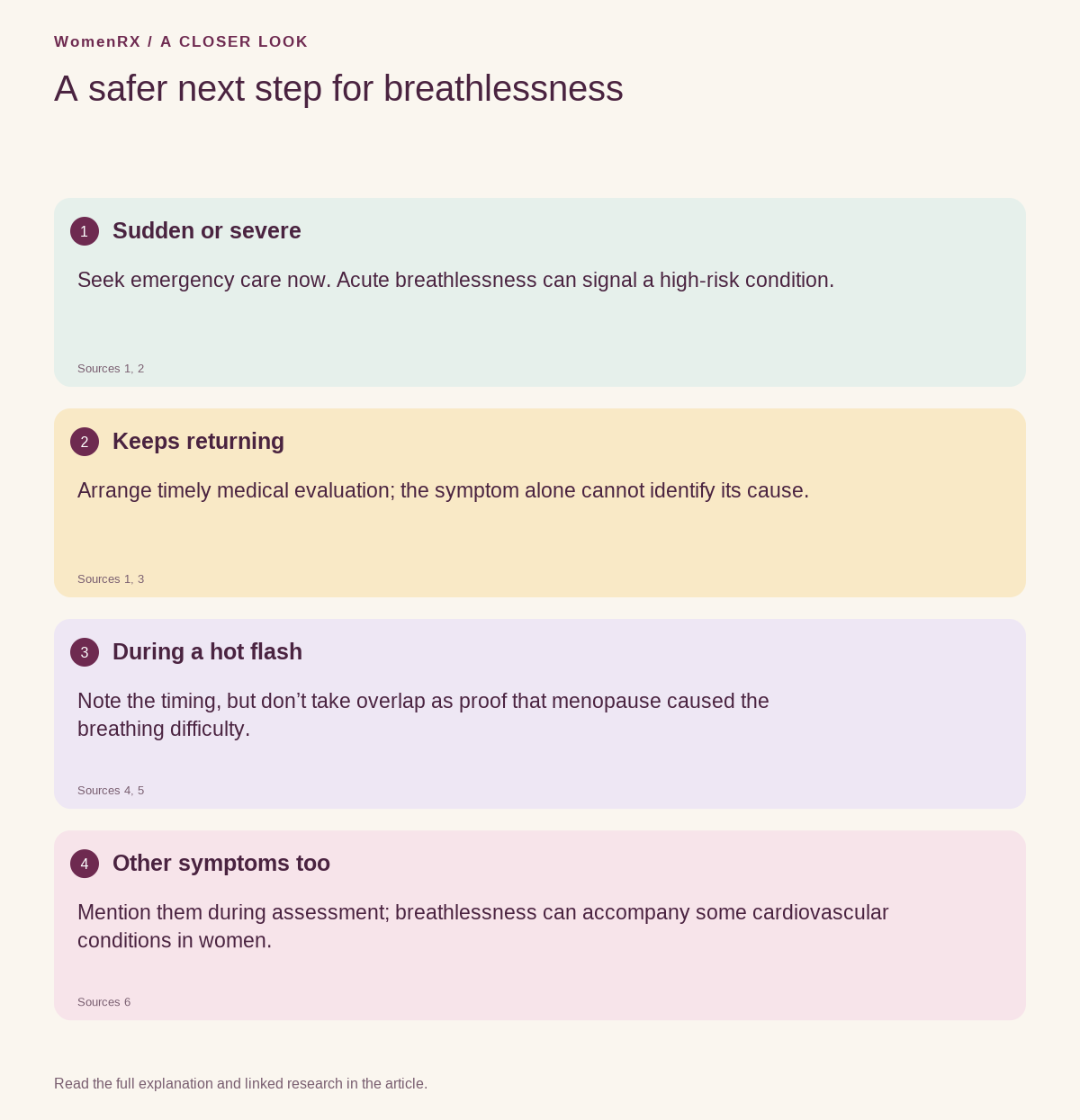
A safer next step for breathlessness
Sudden or severe: Seek emergency care now. Acute breathlessness can signal a high-risk condition.12
Keeps returning: Arrange timely medical evaluation; the symptom alone cannot identify its cause.13
During a hot flash: Note the timing, but don’t take overlap as proof that menopause caused the breathing difficulty.45
Other symptoms too: Mention them during assessment; breathlessness can accompany some cardiovascular conditions in women.6
Read the figure as text
Use how the breathing difficulty feels and whether it returns to choose a next step; menopause timing by itself cannot identify the cause.- Sudden or severe: Seek emergency care now. Acute breathlessness can signal a high-risk condition.12
- Keeps returning: Arrange timely medical evaluation; the symptom alone cannot identify its cause.13
- During a hot flash: Note the timing, but don’t take overlap as proof that menopause caused the breathing difficulty.45
- Other symptoms too: Mention them during assessment; breathlessness can accompany some cardiovascular conditions in women.6
More questions, answered
If breathlessness happens during a hot flash, does that mean it’s hormonal?
No. The overlap may be useful to mention, but it doesn’t establish that the hot flash caused the breathing difficulty. Menopause guidance recognizes hot flashes as a symptom and describes treatments for them; it doesn’t establish breathlessness as a menopause symptom. 45
Sources you can check
- Predictive Value of SpO2/RR Ratio for Short-Term Intubation and Mortality Risks in Pre-ED Patients With Acute Dyspnea Without Oxygen Therapy: A Retrospective Cohort Study.Tan Y, Yuan S, Wu P, Du X, Wang H, Guo G, Li L, Dou L, Guo T. · Emergency medicine international · 2026Return to first citation
- A simplified clinical frailty scale predicts mortality in emergency department patients with acute dyspnea.Zwawi A, Wessman T, Wändell P, Melander O, Carlsson AC, Ruge T. · GeroScience · 2026Return to first citation
- Plasma calprotectin in the emergency department: a potential clinical biomarker for patients with infectious diseases.Wollmer M, Wändell P, Rosenqvist M, Larsson A, Melander O, Wessman T, Ärnlöv J, Ruge T. · Scandinavian journal of clinical and laboratory investigation · 2021Return to first citation
- The 2022 hormone therapy position statement of The North American Menopause Society.“The 2022 Hormone Therapy Position Statement of The North American Menopause Society” Advisory Panel. · Menopause (New York, N.Y.) · 2022Return to first citation
- The 2023 nonhormone therapy position statement of The North American Menopause Society.Menopause (New York, N.Y.) · 2023Return to first citation
- Peculiarities of cardiovascular disease in women.Zhvania N, Ratiani L, Avaliani Sh. · Georgian medical news · 2012Return to first citation