Shortness of Breath During Menopause: When to Act
Sudden or severe breathlessness needs urgent attention, even if you’re in the menopause transition.
Don’t assume new shortness of breath is caused by menopause, a hot flash, or anxiety. Sudden or severe breathlessness warrants urgent evaluation because heart and lung problems can cause it. If it isn’t severe but is new or keeps returning, arrange medical assessment rather than waiting for menopause symptoms to explain it. Breathlessness can matter even without chest pain, particularly as people get older. 2 3
Start with how suddenly it came on
If you’re suddenly very short of breath or the breathing difficulty is severe, seek emergency evaluation now. Acute breathlessness can have life-threatening causes, including heart events or a blood clot in the lung. Don’t wait to see whether it passes or assume it’s a menopause symptom. 3
If the breathlessness is milder but new, recurring, or affecting what you can do, arrange a prompt medical assessment. A clinician can take a history, examine you, and choose tests based on what may be causing it. The right evaluation depends on the person; shortness of breath is a symptom, not a diagnosis. 3
No chest pain doesn’t rule out a serious cause
Breathlessness can be the main symptom of a heart problem. In a registry of people aged 50 and older who underwent coronary angiography, presentations involving breathlessness became more common with age in both patients with and without acute coronary syndrome. This was a selected clinical group, not a study of everyone in midlife, but it’s a reason not to use the absence of chest pain as reassurance. 2
Menopause timing doesn’t identify the cause
Breathlessness may happen around the same time as menopause symptoms, but timing alone can’t show that menopause caused it. Anxiety or a hot-flush episode also can’t establish the cause of a new breathing problem. The available menopause statement focuses on hormone therapy for vasomotor and genitourinary symptoms; it doesn’t establish that menopause explains breathlessness. 1
Shortness of breath has several possible causes, including heart and lung conditions. It can also have psychological or other contributors, and the sensation doesn’t always match an oxygen measurement. That’s why a feeling that comes and goes, or an apparently normal oxygen reading, shouldn’t substitute for evaluating new or worsening symptoms. 3
A simple next step
- Sudden or severe: seek emergency evaluation now. 3
- New or recurring, but not severe: arrange a prompt assessment so the cause can be considered rather than attributed to menopause. 3
- Already assessed, but getting worse: seek further assessment; worsening symptoms shouldn’t be explained away by the timing of menopause.
If you’re unsure whether your breathing difficulty is severe, err on the side of urgent help. The key point is not to diagnose yourself from the timing: acute breathlessness needs attention, and a menopause transition doesn’t rule out a heart or lung cause. 3
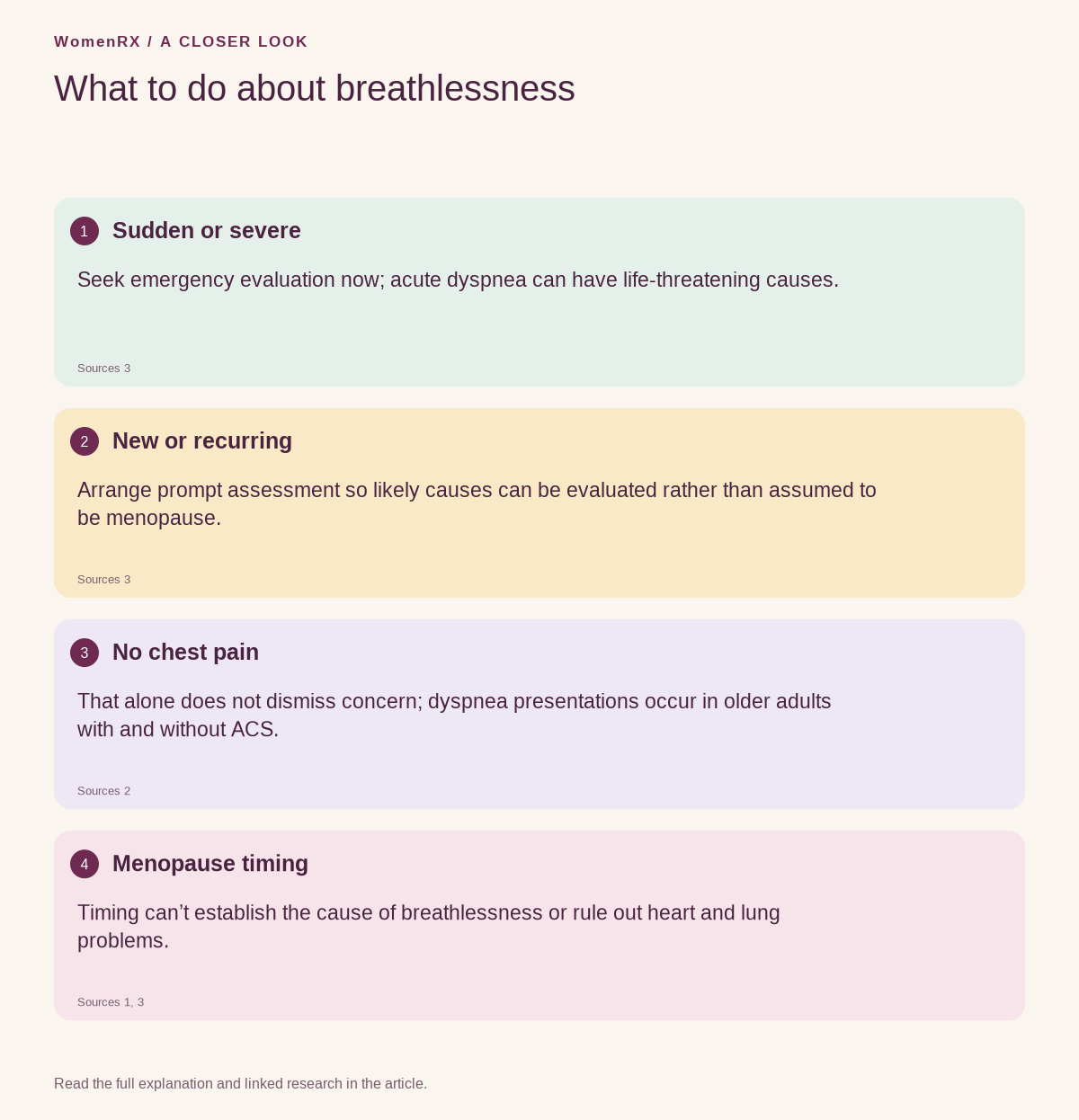
What to do about breathlessness
Sudden or severe: Seek emergency evaluation now; acute dyspnea can have life-threatening causes.3
New or recurring: Arrange prompt assessment so likely causes can be evaluated rather than assumed to be menopause.3
No chest pain: That alone does not dismiss concern; dyspnea presentations occur in older adults with and without ACS.2
Menopause timing: Timing can’t establish the cause of breathlessness or rule out heart and lung problems.13
Read the figure as text
Use how sudden or severe the breathing difficulty is to choose the next step; menopause timing alone cannot identify its cause.- Sudden or severe: Seek emergency evaluation now; acute dyspnea can have life-threatening causes.3
- New or recurring: Arrange prompt assessment so likely causes can be evaluated rather than assumed to be menopause.3
- No chest pain: That alone does not dismiss concern; dyspnea presentations occur in older adults with and without ACS.2
- Menopause timing: Timing can’t establish the cause of breathlessness or rule out heart and lung problems.13
Sources you can check
- The 2022 hormone therapy position statement of The North American Menopause Society.“The 2022 Hormone Therapy Position Statement of The North American Menopause Society” Advisory Panel. · Menopause (New York, N.Y.) · 2022Return to first citation
- When dyspnea replaces chest pain: Age-dependent symptom profiles in ACS and non-ACS patients undergoing coronary angiography.Bruoha S, Abu-Arar T, Yassin R, Chitoroga V, Bruoha M, Adler L, Yosefy C, Shlyakhover VE, Rozenbaum Z. · The American journal of emergency medicine · 2026Return to first citation
- Dyspnea, Pulmonary Rehabilitation, and Supplemental Oxygen Therapy in Older Adults.Austin CA, Garvey C. · Clinics in geriatric medicine · 2025Return to first citation