Vaginal Discharge After Menopause: When to Get It Checked
New, persistent, changed, or blood-stained discharge after menopause deserves attention, and appearance alone can’t tell you what’s causing it.
If you notice new or ongoing vaginal discharge after menopause, contact a clinician for assessment, especially if it smells different, changes in color or texture, or comes with discomfort. Any blood or spotting, including blood mixed with discharge, should be assessed promptly. These details can help guide the conversation, but discharge appearance alone can’t diagnose the cause. 15
Start with what’s changed
A new or ongoing discharge after menopause is worth discussing with a clinician, particularly if it’s different from what you’re used to. Notice whether it has changed in amount, color, smell, or texture, and whether you also have soreness, itching, pain, or discomfort when urinating. Changes like these can occur with vaginal infections, but they don’t identify the cause by themselves. 1
This is different from saying that every change signals something serious. It means the change deserves attention rather than a guess based on appearance or smell. Guidance on vaginal discharge advises against self-diagnosis when discharge changes, and a study of postmenopausal patients with abnormal cervical screening results concluded that bleeding or abnormal discharge warrants evaluation. That study involved a specific group at one hospital, so its findings shouldn’t be treated as a measure of risk for every woman after menopause. 15
Blood or spotting is a separate signal
If you see blood or spotting after menopause, including blood mixed into discharge, contact a clinician promptly for assessment. Don’t assume it’s simply a menopause-related vaginal change or wait for the discharge to look more clearly bloody. The retrospective study’s recommendation to evaluate bleeding and abnormal discharge came from women with abnormal cervical screening results; it supports taking these symptoms seriously, but it does not establish how often a particular cause occurs in the wider postmenopausal population. 5
If you’re not sure whether the fluid is blood, describe what you saw and when. You don’t have to figure out its source before asking for help.
Menopause-related dryness isn’t the same as an explanation
Lower estrogen after menopause can contribute to vaginal dryness and irritation. Those symptoms may be treated with options such as vaginal estrogen, but that does not mean new discharge should automatically be attributed to menopause or treated without assessment. 23
Some vaginal treatments can themselves affect discharge. In one randomized, placebo-controlled trial of vaginal DHEA in postmenopausal women, discharge related to the treatment’s dissolving vehicle was reported by about 6% of participants. If you’ve recently started an inserted vaginal treatment, mention that and when the discharge began. It may be relevant, but it doesn’t rule out other causes. 4
What to note before you contact someone
A few observations can make it easier to explain what’s happening: when it started, whether it’s ongoing or comes and goes, what changed, whether you’ve seen any blood, and whether you have discomfort or urinary symptoms. If you use a vaginal product or medicine, include its name and when you started it. These notes aren’t a test or a way to diagnose yourself; they help describe the change clearly. 14
The useful next step is an assessment, not a home diagnosis. A change in color or odor may be associated with infection, while dryness and irritation can occur with menopause-related tissue changes. Because those possibilities can overlap in how they feel or look, let a clinician help determine what’s going on rather than choosing a treatment from discharge appearance alone. 12
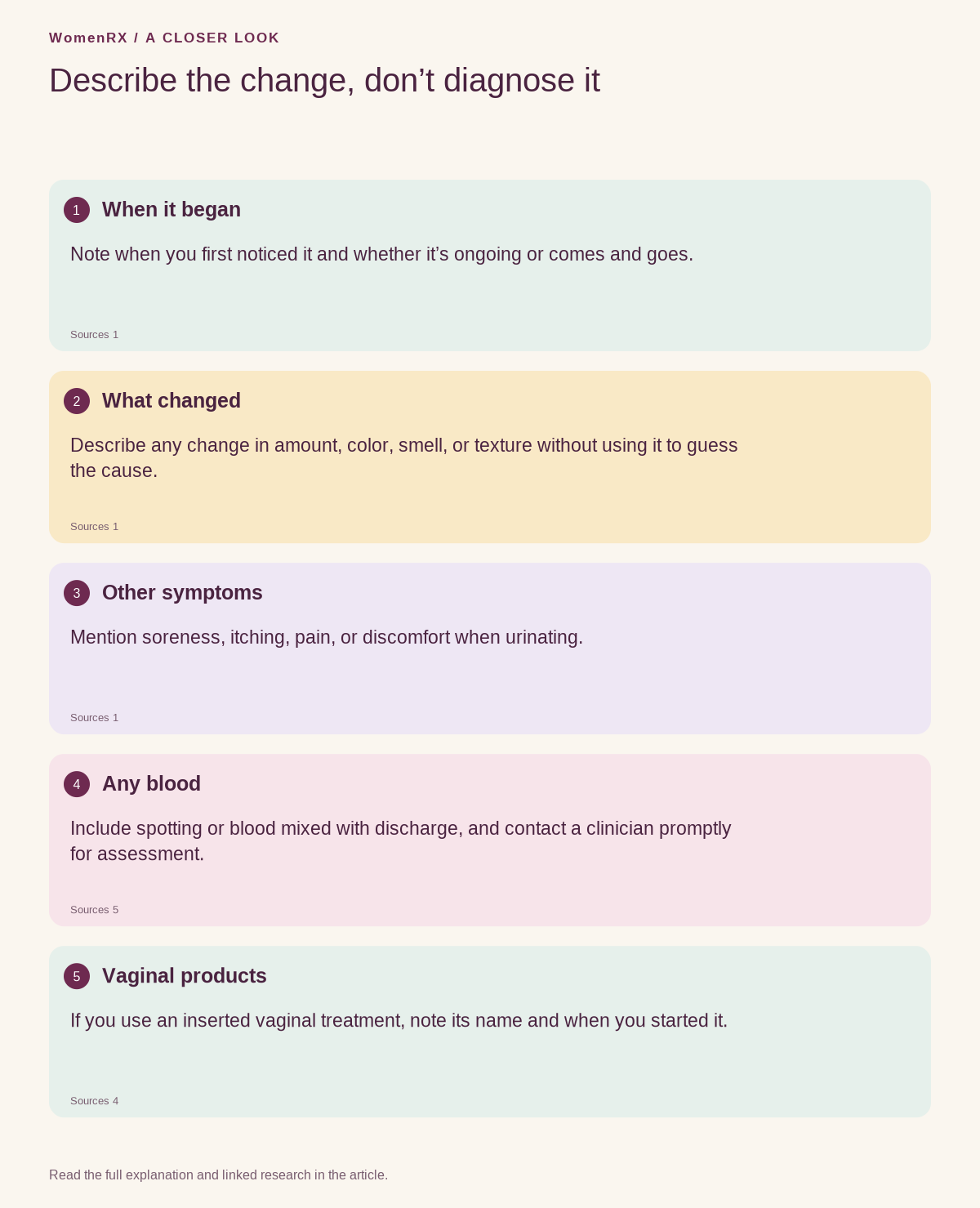
Describe the change, don’t diagnose it
When it began: Note when you first noticed it and whether it’s ongoing or comes and goes.1
What changed: Describe any change in amount, color, smell, or texture without using it to guess the cause.1
Other symptoms: Mention soreness, itching, pain, or discomfort when urinating.1
Any blood: Include spotting or blood mixed with discharge, and contact a clinician promptly for assessment.5
Vaginal products: If you use an inserted vaginal treatment, note its name and when you started it.4
Read the figure as text
These details can help you explain what you’ve noticed. They are not a self-diagnosis tool, and blood or spotting after menopause should be mentioned promptly.- When it began: Note when you first noticed it and whether it’s ongoing or comes and goes.1
- What changed: Describe any change in amount, color, smell, or texture without using it to guess the cause.1
- Other symptoms: Mention soreness, itching, pain, or discomfort when urinating.1
- Any blood: Include spotting or blood mixed with discharge, and contact a clinician promptly for assessment.5
- Vaginal products: If you use an inserted vaginal treatment, note its name and when you started it.4
More questions, answered
Can menopause cause vaginal dryness and irritation?
Yes. Falling estrogen levels can contribute to vaginal dryness and irritation after menopause. Those symptoms can be treated, but they don’t by themselves explain new or persistent discharge. 2
What if I recently started a vaginal treatment?
Mention the product and when you started it. A trial of vaginal DHEA in postmenopausal women reported treatment-related discharge in about 6% of participants, but a possible treatment effect doesn’t rule out another cause. 4
Sources you can check
- Vaginal discharge - NHSAccessed 2026-09-25Return to first citation
- About vaginal oestrogen - NHSAccessed 2026-09-25Return to first citation
- The 2022 hormone therapy position statement of The North American Menopause Society.“The 2022 Hormone Therapy Position Statement of The North American Menopause Society” Advisory Panel. · Menopause (New York, N.Y.) · 2022Return to first citation
- Efficacy of intravaginal dehydroepiandrosterone (DHEA) on moderate to severe dyspareunia and vaginal dryness, symptoms of vulvovaginal atrophy, and of the genitourinary syndrome of menopause.Labrie F, Archer DF, Koltun W, Vachon A, Young D, Frenette L, Portman D, Montesino M, Côté I, Parent J, Lavoie L, BSc AB, Martel C, Vaillancourt M, Balser J, Moyneur É, members of ... · Menopause (New York, N.Y.) · 2018Return to first citation
- The diagnostic value of colposcopy in postmenopausal women: a retrospective study.Li P, Wang H. · BMC women's health · 2026Return to first citation