Clear, Stretchy Discharge After Menopause: What Needs Checking?
Clear discharge can happen at any age, but a change in amount, smell, or texture after menopause is worth checking, especially if there’s blood or discomfort.
Clear, stretchy discharge after menopause doesn’t tell you that you’re ovulating, and its appearance alone can’t identify the cause. Discharge can occur at any age. If you’re producing more than usual or notice a change in smell or texture, arrange an appointment. If it looks pink, brown, or bloody, seek prompt assessment, even if you’re unsure whether it contains blood. 13
Why it can look familiar
Before menopause, discharge often becomes clearer and wetter around ovulation. That familiar “egg-white” look may make a new discharge seem like a cycle sign. After your periods have stopped, though, texture alone isn’t a reliable way to tell what’s happening. Vaginal discharge can occur at any age, and several different conditions can change how it looks or feels. 1
The more useful question is what has changed for you and whether anything comes with it. For example, a small amount of clear discharge without odor or irritation presents a different concern from discharge that has become noticeably heavier, smells unpleasant, or comes with soreness. None of those details establishes a diagnosis, but they help guide what needs checking. 1
What changes the level of concern
Pink, brown, or bloody discharge needs prompt assessment. After menopause, even a small amount of spotting counts as bleeding, including when you aren’t sure whether the color is blood. Common causes include thinning of the vaginal or uterine lining and polyps, but bleeding can also be a sign of cancer. The point of checking is to find the cause, not to assume the worst. 3
A new odor, itching, soreness, pain when you pee, or pelvic pain also calls for an appointment. Changes in discharge can occur with infections, but smell or texture isn’t enough to tell which infection, if any, is present. Avoid treating a presumed infection solely from its appearance. 1
No blood or other symptoms doesn’t mean you have to dismiss a noticeable change. Clear discharge itself can occur at any age. If you’re producing more than usual, or its texture has changed, arrange an appointment rather than trying to match it to a premenopausal cycle day. 1
If you use a vaginal pessary for prolapse, mention it. In a randomized trial of postmenopausal ring-pessary users, excessive discharge was reported in both study groups, as were vaginal erosion or ulcer and bleeding. That makes pessary use relevant context, not proof that the device caused your discharge. 2
What an assessment may involve
At an appointment, describe what has changed: when the discharge began, whether it has persisted, its color and smell, and whether you’ve noticed itching, pain, or any possible bleeding. Mention vaginal treatments or devices, such as a pessary. These details help distinguish a discharge change from possible postmenopausal bleeding. 123
If the discharge may contain blood, evaluation can include an examination of the pelvis and vagina. A clinician may use a speculum to see the vagina and cervix and may recommend a transvaginal ultrasound to look for a cause. Those are possible steps for bleeding, not tests that everyone with clear discharge automatically needs. 3
For now, don’t douche or use scented products to try to clear the discharge. They can add irritation without telling you what caused the change. A simple description of what you’ve noticed is more useful than trying to label it “ovulation mucus” or an infection. 1
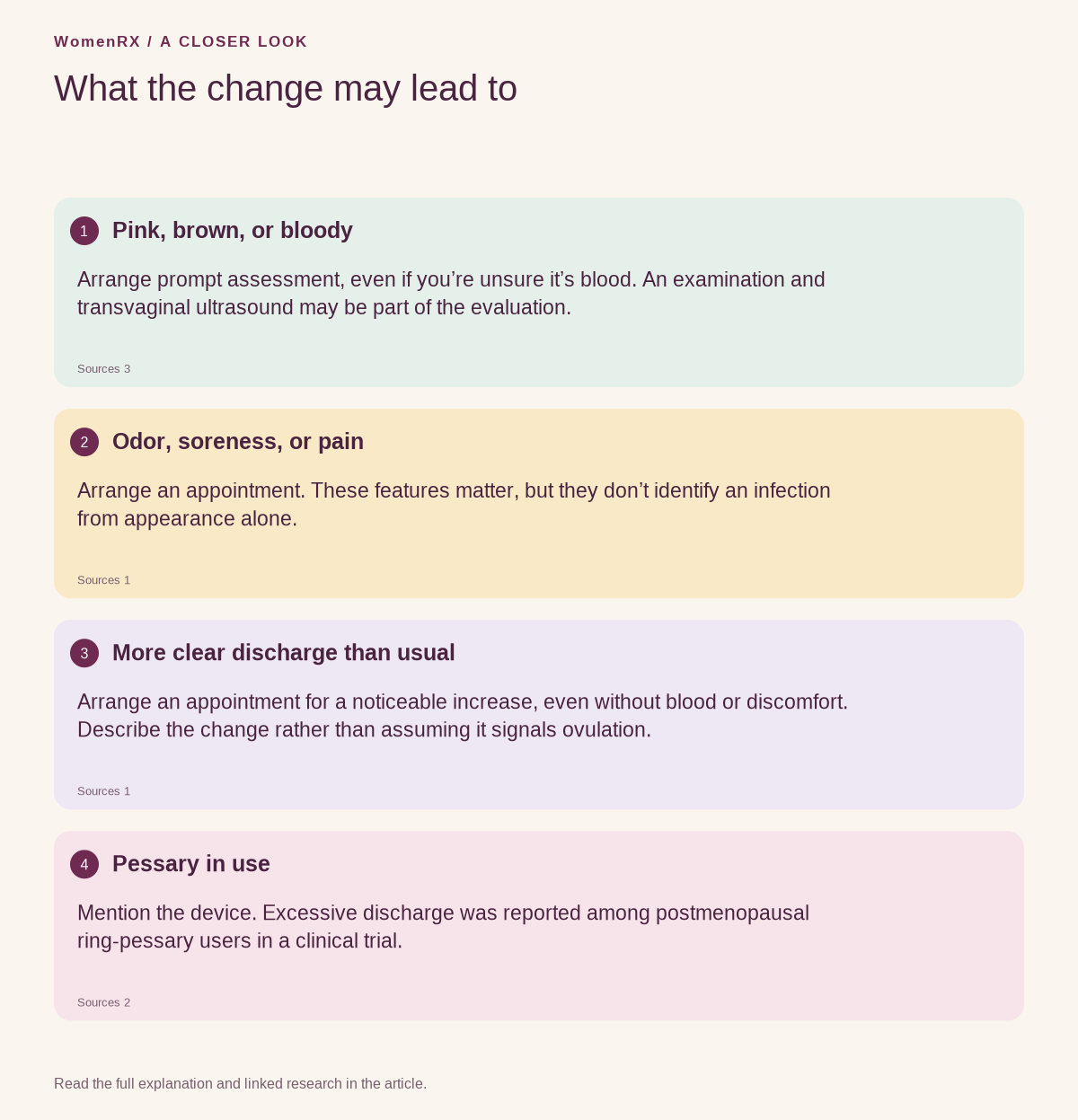
What the change may lead to
Pink, brown, or bloody: Arrange prompt assessment, even if you’re unsure it’s blood. An examination and transvaginal ultrasound may be part of the evaluation.3
Odor, soreness, or pain: Arrange an appointment. These features matter, but they don’t identify an infection from appearance alone.1
More clear discharge than usual: Arrange an appointment for a noticeable increase, even without blood or discomfort. Describe the change rather than assuming it signals ovulation.1
Pessary in use: Mention the device. Excessive discharge was reported among postmenopausal ring-pessary users in a clinical trial.2
Read the figure as text
Start with whether the discharge could contain blood; then consider other changes and relevant context.- Pink, brown, or bloody: Arrange prompt assessment, even if you’re unsure it’s blood. An examination and transvaginal ultrasound may be part of the evaluation.3
- Odor, soreness, or pain: Arrange an appointment. These features matter, but they don’t identify an infection from appearance alone.1
- More clear discharge than usual: Arrange an appointment for a noticeable increase, even without blood or discomfort. Describe the change rather than assuming it signals ovulation.1
- Pessary in use: Mention the device. Excessive discharge was reported among postmenopausal ring-pessary users in a clinical trial.2
More questions, answered
What if I can’t tell whether the discharge is pink or bloody?
Treat possible pink or brown discharge as possible postmenopausal bleeding and arrange prompt assessment. It still needs checking when you’re unsure whether the color is blood. 3
Does unpleasant-smelling discharge mean cancer?
No single smell identifies a cause. An odor change can occur with infection, while smelly or bloodstained discharge can also occur with other conditions that need assessment. Get the change checked rather than diagnosing it by smell. 14
Sources you can check
- Vaginal discharge - NHSAccessed 2026-09-25Return to first citation
- Effects of intravaginal conjugated oestrogen on pessary continuation for pelvic organ prolapse: multicentre, randomised, double blind, placebo controlled trial.Zhou Y, Yin R, Zhang Y, Wang X, Jin F, Li X, Peng C, Wang P, Shen H, Weng Q, Xie H, Wang H, Jiang B, Zhou K, Liang N, He Y, Dai Y, Fang Z, Liang S, Zhang Y, Morse A, Zhu L. · BMJ (Clinical research ed.) · 2025Return to first citation
- Postmenopausal bleeding - NHSAccessed 2026-09-25Return to first citation
- Symptoms of vaginal cancer - NHSAccessed 2026-09-25Return to first citation