Heart Palpitations Around Menopause: What Needs Checking?
Menopause may be one reason your heartbeat feels different, but warning symptoms and a changing pattern matter more when deciding what to do next.
Get emergency care now if palpitations won’t stop or happen with chest pain, fainting, or feeling faint. If those warning symptoms have stopped, seek urgent medical assessment. If palpitations keep returning, become more frequent, last longer than a few minutes, or you have a personal or family history of heart problems, arrange an assessment. Don’t assume menopause explains a new or changing pattern. 1
First, decide how quickly you need care
A palpitation is a heartbeat that suddenly feels unusually noticeable or uncomfortable. It might feel like fluttering in your chest, neck, or throat. That sensation alone doesn’t tell you what your heart rhythm is doing. 1
Get emergency care now if palpitations won’t go away or happen with chest pain, fainting, or feeling faint. If those warning symptoms happened but have stopped, seek urgent medical assessment. Don’t wait for another episode to decide whether they count. 1
If you feel well now, arrange an assessment when episodes keep coming back, happen more often, last longer than a few minutes, or you have a heart condition or a family history of heart problems. These are reasons to get the pattern checked, not proof that something serious is wrong. 1
Why menopause isn’t a complete explanation
Palpitations can happen around menopause. They can also be associated with caffeine, alcohol, nicotine, or recreational drugs, or with iron-deficiency anemia, an overactive thyroid, an abnormal heart rhythm, or another heart problem. Several explanations can feel similar from the inside, which is why the timing of your symptoms doesn’t settle the cause. 1
Age deserves its own consideration rather than being folded into menopause. In an observational study of 215 adults who came to an emergency department for palpitations, people aged 50 or older had higher odds of a serious underlying cause than younger adults. That finding comes from people already seeking emergency care. It doesn’t estimate the risk for every woman around menopause or show that menopause itself causes an arrhythmia. 4
What an assessment can sort out
An electrocardiogram, or ECG, records the heart’s electrical signals and may help identify a cause. A clinician may also consider other possible causes, including anemia or an overactive thyroid, based on your symptoms and health history. If episodes come and go, rhythm monitoring may be considered to try to capture what’s happening during one. 13
The timing matters: a brief recording may not coincide with an occasional episode. In a study of 350 people referred for palpitations or other symptoms suggestive of an arrhythmia, symptom-triggered ECG recordings made over 30 days detected some arrhythmias that standard ambulatory monitoring did not. That result applies to the full study group, not specifically to people with palpitations or to women around menopause. It helps explain why the frequency of your episodes can matter when testing is discussed, but it doesn’t mean everyone needs a monitoring device. 3
Make the pattern easier to describe
If you’re well between episodes, a short note can help you give a clear account: when the sensation began and ended, whether it felt like fluttering or a racing heartbeat, what you were doing, and whether you had chest pain or felt faint. Note if it’s happening more often and whether caffeine, alcohol, or nicotine preceded it. You don’t need to name the rhythm yourself. If warning symptoms occur, seek care rather than stopping to keep a record. 1
If you’re also considering treatment for hot flashes or night sweats, keep that as a separate conversation. Menopause hormone therapy guidance addresses those symptoms, but it does not establish hormone therapy as a treatment for palpitations or a way to prevent arrhythmia. 2
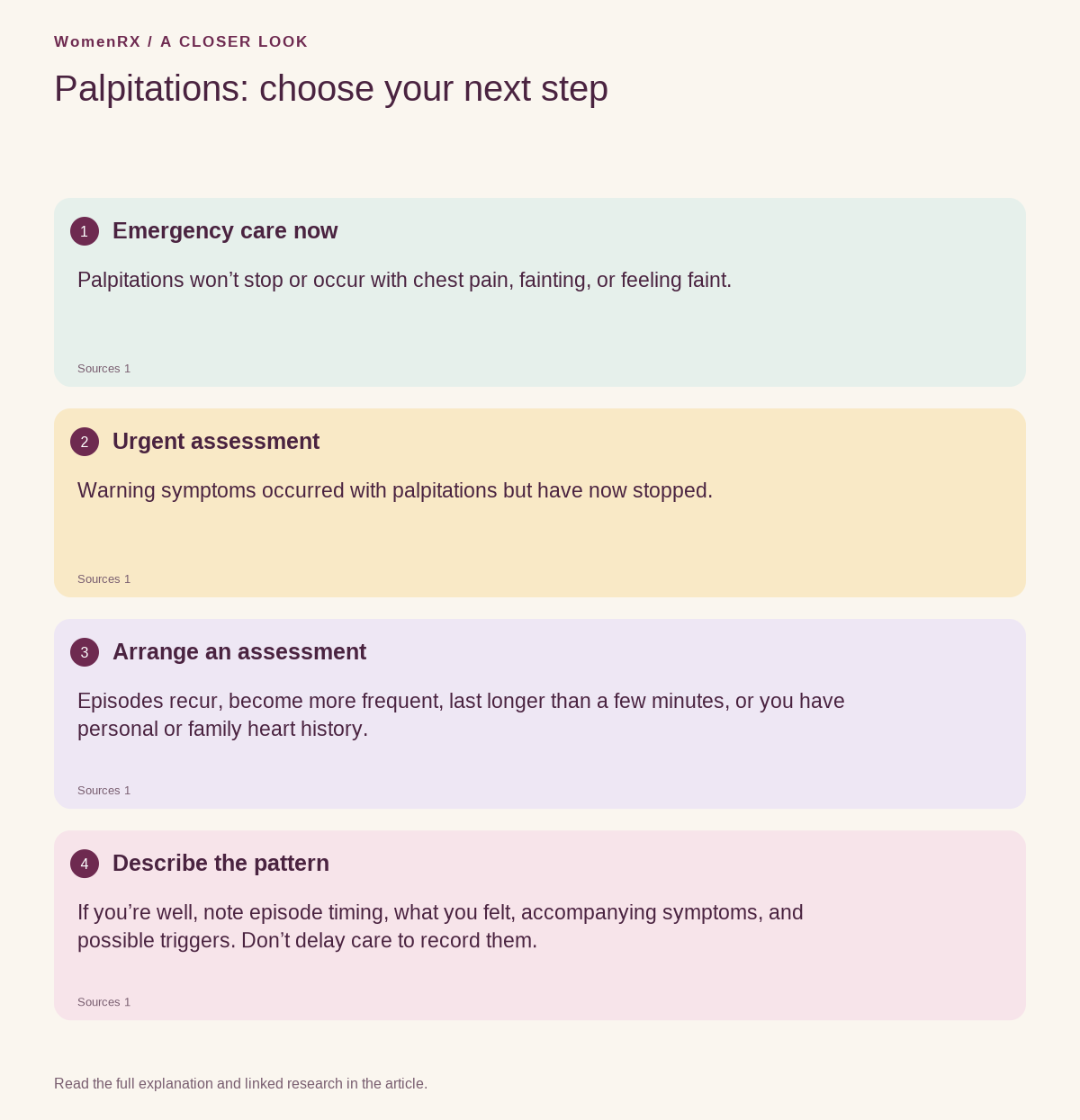
Palpitations: choose your next step
Emergency care now: Palpitations won’t stop or occur with chest pain, fainting, or feeling faint.1
Urgent assessment: Warning symptoms occurred with palpitations but have now stopped.1
Arrange an assessment: Episodes recur, become more frequent, last longer than a few minutes, or you have personal or family heart history.1
Describe the pattern: If you’re well, note episode timing, what you felt, accompanying symptoms, and possible triggers. Don’t delay care to record them.1
Read the figure as text
Start with warning symptoms, then consider whether episodes are returning or changing. Recording details is useful only when it’s safe to do so.- Emergency care now: Palpitations won’t stop or occur with chest pain, fainting, or feeling faint.1
- Urgent assessment: Warning symptoms occurred with palpitations but have now stopped.1
- Arrange an assessment: Episodes recur, become more frequent, last longer than a few minutes, or you have personal or family heart history.1
- Describe the pattern: If you’re well, note episode timing, what you felt, accompanying symptoms, and possible triggers. Don’t delay care to record them.1
Sources you can check
- Heart palpitations - NHSAccessed 2026-09-25Return to first citation
- The 2022 hormone therapy position statement of The North American Menopause Society.“The 2022 Hormone Therapy Position Statement of The North American Menopause Society” Advisory Panel. · Menopause (New York, N.Y.) · 2022Return to first citation
- Symptom-Triggered 6-Lead ECG Monitoring Significantly Increases Arrhythmia Detection Beyond Traditional Ambulatory Monitoring.Dzikowicz DJ, Aktas MK, Horn R, MacKecknie B, Cutter K, Mykins B, Cenname K, McNitt S, Couderc JP, Strawderman RL, Zareba W, Steinberg JS. · JACC. Advances · 2026Return to first citation
- Risk Factors of a Serious Underlying Cause of Palpitations Among Patients Attending an Emergency Department.Balen F, Louisot S, Thiruganasambandamoorthy V, Dubucs X, Charpentier S. · CJC open · 2026Return to first citation