Menopause and Heart Palpitations: Symptom, Rhythm, and Evidence
Palpitations can happen around menopause, but the sensation alone can’t show whether hormones are involved or whether your heart has an abnormal rhythm.
Menopause is recognized as one possible context for palpitations, but that link doesn’t establish why an individual episode happens or how often menopause-related palpitations reflect an arrhythmia. Palpitations describe a felt heartbeat change; an ECG or other rhythm recording can help identify what the heart is doing. Other triggers and medical causes can also be involved. 1
What the feeling can, and can’t, tell you
A racing, pounding, fluttering, or skipped-beat feeling is a palpitation: it means your heartbeat feels unusual or uncomfortable. It doesn’t, by itself, tell you whether your heart’s electrical rhythm is abnormal. An arrhythmia is a heart rhythm problem, and an ECG can help investigate whether one is present. 1
Palpitations can occur around menopause, but the guidance that recognizes this link doesn’t establish how common they are, explain a specific hormonal mechanism, or show whether they predict an arrhythmia. So the timing may be relevant, but it isn’t a diagnosis. 1
A rhythm recording answers a different question
An ECG records electrical signals from the heart. If an episode is happening during the test, the recording may help connect the sensation with the heart’s rhythm. But palpitations can come and go. A person may have no symptoms during a brief ECG, and a normal reading at that moment may not explain a symptom that happened earlier. 12
A retrospective study of patients evaluated at a specialist cardiac clinic in Ghana noted that symptoms may be absent during evaluation and a resting ECG may be normal; the clinic used 24-hour Holter monitoring in its selected patient group. That finding helps explain why a clinician might consider longer rhythm monitoring when symptoms are intermittent. It doesn’t tell us how often people in menopause have arrhythmias, or how common arrhythmias are among everyone who feels palpitations. 2
When you describe an episode, details such as whether it felt fast or irregular, how long it lasted, and whether it keeps returning can help clarify the pattern. It can also help to mention whether it occurred alongside a menopause symptom. These details don’t determine the cause, but they give a clinician useful context when considering whether an ECG or further assessment makes sense.
Menopause is one possibility among several
Stress, caffeine, alcohol, nicotine, and recreational drugs can contribute to palpitations. Medical causes can include iron-deficiency anemia, an overactive thyroid, an arrhythmia, or other heart problems. 1
That range of possibilities is why it’s better not to assume a hormonal cause, even if symptoms begin during the menopause transition or seem to happen around hot flashes. The useful distinction is between what you feel, what a rhythm test records, and what may be contributing to the symptom.
When to get the symptoms checked
Arrange medical evaluation if palpitations keep coming back, are happening more often, last longer than a few minutes, or you have a heart condition or a family history of heart problems. If palpitations are happening now and don’t go away, or occur with chest pain, seek emergency care. 1
The main takeaway is straightforward: palpitations are real symptoms, but they don’t identify their own cause. A rhythm recording can help answer whether an arrhythmia is present, while the broader assessment considers menopause and other possible contributors.
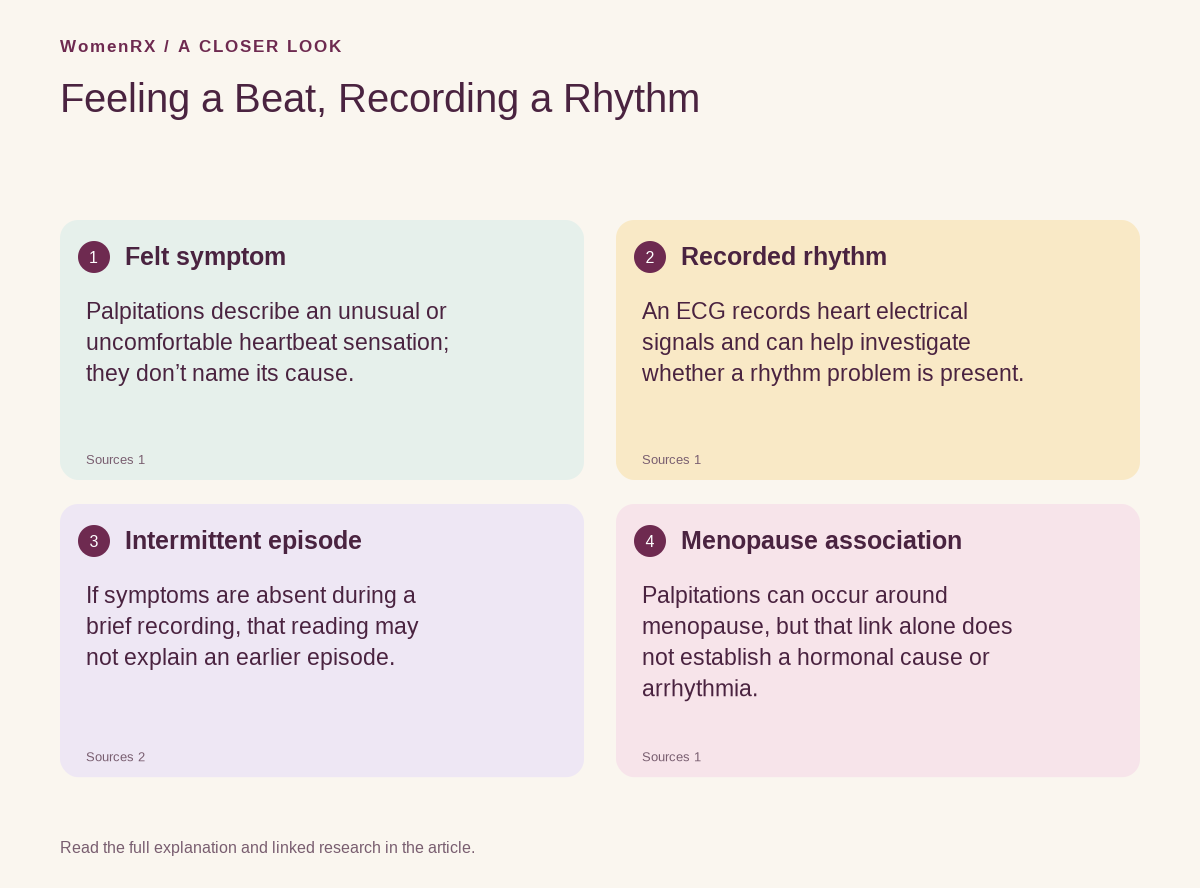
Feeling a Beat, Recording a Rhythm
Felt symptom: Palpitations describe an unusual or uncomfortable heartbeat sensation; they don’t name its cause.1
Recorded rhythm: An ECG records heart electrical signals and can help investigate whether a rhythm problem is present.1
Intermittent episode: If symptoms are absent during a brief recording, that reading may not explain an earlier episode.2
Menopause association: Palpitations can occur around menopause, but that link alone does not establish a hormonal cause or arrhythmia.1
Read the figure as text
These four distinctions help separate the symptom of palpitations from a recorded rhythm finding and a possible menopause association.- Felt symptom: Palpitations describe an unusual or uncomfortable heartbeat sensation; they don’t name its cause.1
- Recorded rhythm: An ECG records heart electrical signals and can help investigate whether a rhythm problem is present.1
- Intermittent episode: If symptoms are absent during a brief recording, that reading may not explain an earlier episode.2
- Menopause association: Palpitations can occur around menopause, but that link alone does not establish a hormonal cause or arrhythmia.1
More questions, answered
Does a palpitation mean I have an arrhythmia?
No. Palpitations describe a sensation; an arrhythmia is a heart rhythm problem. An ECG can help investigate the rhythm, but an intermittent episode may not be captured if it isn’t happening during the recording. 12
Sources you can check
- Heart palpitations - NHSAccessed 2026-09-25Return to first citation
- The Burden of Arrhythmias and Conduction Abnormalities Among Patients Presenting With Palpitations at a Cardiac Specialist Care Center in Ghana: A Retrospective Cross-Sectional Study.Amponsah GM, Gyan KF, Acheamfour-Akowuah E, Owusu P, Owusu IK. · Health science reports · 2026Return to first citation