Menopause Palpitations: What to Track and When to Get Care
Palpitations can happen around menopause, but the sensation alone can’t tell you whether your heart rhythm is normal.
Pounding, racing, fluttering, or skipped beats are reported during perimenopause and after menopause, sometimes alongside hot flashes. But palpitations can also have causes such as caffeine, alcohol, nicotine, anemia, thyroid problems, or a heart rhythm condition. Note what an episode feels like and when it happens; seek emergency care for ongoing palpitations or palpitations with chest pain, shortness of breath, faintness, or fainting. 2 5
Menopause may be part of the picture, not the whole explanation
Palpitations describe a heartbeat that feels unusually noticeable: it may seem fast, pounding, fluttery, or as if it skips or adds a beat. They’re reported during perimenopause and postmenopause, and may occur alongside hot flashes. In a large study following women through the menopause transition, the high-probability palpitation group had more vasomotor symptoms, sleep problems, perceived stress, and higher blood pressure at baseline. These were associations, not proof that menopause or any one factor caused the heartbeat sensations. 2 6
A small pilot study offers another useful reminder: among 15 midlife women who reported palpitations, recorded symptoms occurred during both altered rhythms and normal sinus rhythm. That finding doesn’t show what is happening in any individual episode. It does show why a feeling of fluttering or racing can’t, by itself, identify the rhythm or establish that menopause is the cause. 5
Other possible contributors include caffeine, alcohol, nicotine, recreational drugs, iron-deficiency anemia, an overactive thyroid, and heart rhythm or valve problems. Stress can also be a trigger. More than one factor may be involved, so noticing a pattern can help, but it can’t rule out a medical cause. 2
A short log can make the pattern clearer
If an episode passes and you feel well, jot down a few details while they’re fresh. This isn’t a diagnostic test or a requirement to track every heartbeat. It’s a way to describe what happened clearly if you decide to seek care.
- What it felt like: racing, pounding, fluttering, or skipped beats.
- When it happened: time, what you were doing, and whether it started or stopped suddenly.
- How long and how often: an estimate is useful; exact timing isn’t necessary.
- What was happening around it: for example, a hot flash, disrupted sleep, stress, caffeine, alcohol, or nicotine. Note medicines or supplements you take and any recent changes, too.
- What came with it: chest pain, shortness of breath, feeling faint, or fainting.
These are practical observations, not a validated scoring tool. Research on how menopausal palpitations are measured has found inconsistent definitions and questions across studies, which is one reason a simple description in your own words can be more useful than trying to fit an episode into a precise category. 7
If you use a smartwatch or phone-connected ECG device, save a recording or report if one is available and share it with a clinician. Treat it as additional information, not a diagnosis or a reason to delay care. Research on consumer devices has involved selected groups, and a systematic review found substantial differences between studies; a device result still needs clinical interpretation. 3 4
Choose care based on what’s happening now
Get emergency care now if palpitations are happening and won’t go away, or occur with chest pain, shortness of breath, feeling faint, or fainting. Don’t wait to see whether changing a trigger makes these symptoms disappear. 2
Get urgent medical assessment if palpitations came with those symptoms but have now stopped. Chest discomfort that feels tight or heavy, or severe difficulty breathing, also calls for emergency care. 1 2
Arrange a clinical assessment if episodes keep returning or are happening more often, even if you feel well between them. A clinician can consider the whole picture, including possible thyroid or anemia-related causes and heart rhythm problems. An electrocardiogram (ECG) records the heart’s electrical signals and may help identify a cause; further testing or specialist assessment may be considered depending on the findings. 2
Look for patterns without using them as a diagnosis
A log may reveal that episodes seem to cluster around hot flashes, poor sleep, stress, or a particular drink. If you notice a possible trigger, you can mention it and ask whether a cautious change is reasonable. Avoiding a suspected trigger may help some people when no health condition is causing the palpitations, but improvement doesn’t prove the cause or rule out a heart problem. 2 6
You don’t need to work out whether an episode was “menopausal” before asking for help. The useful distinction is whether you have emergency symptoms now, whether episodes are recurring or increasing, and what details might help a clinician assess them.
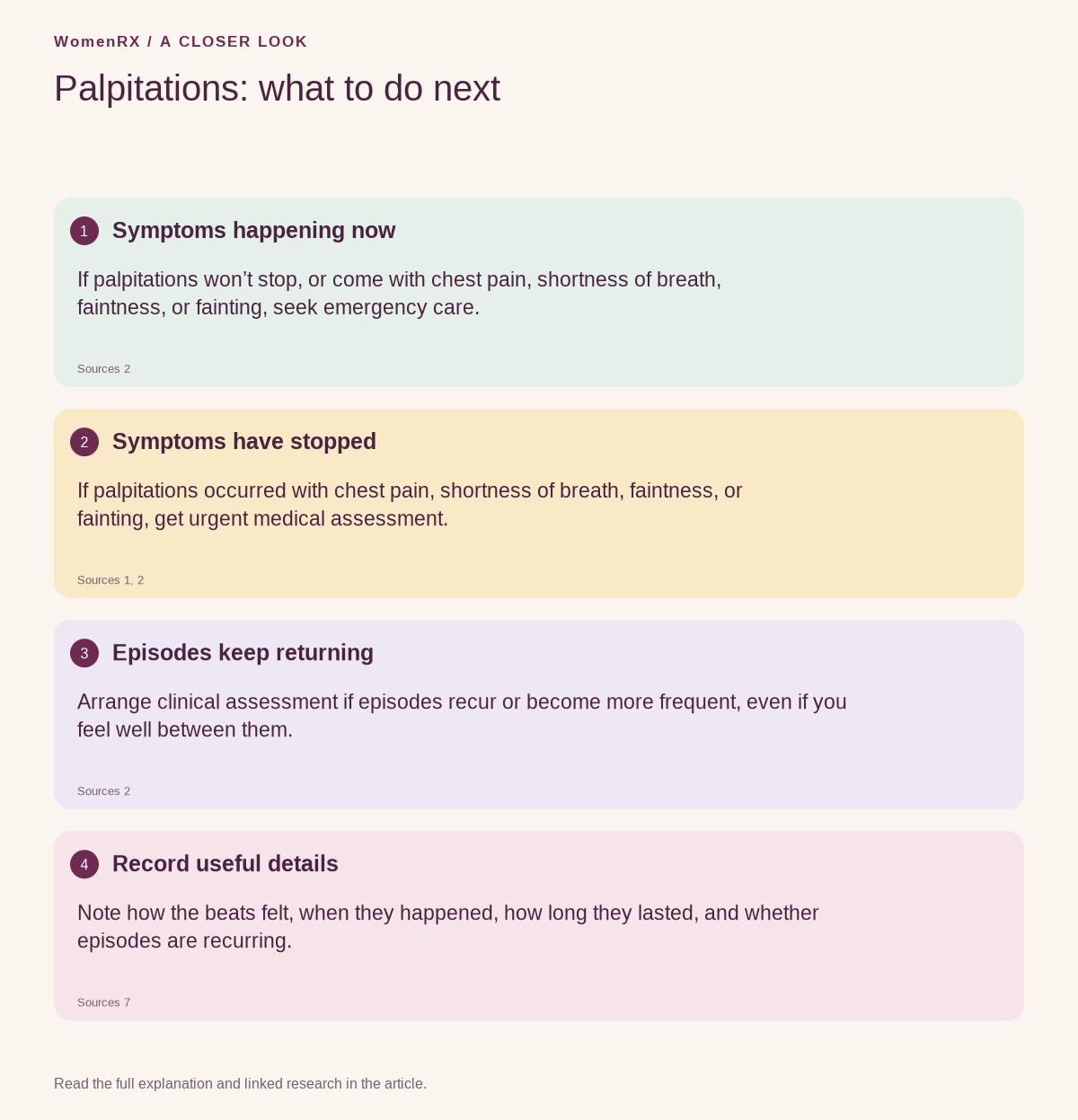
Palpitations: what to do next
Symptoms happening now: If palpitations won’t stop, or come with chest pain, shortness of breath, faintness, or fainting, seek emergency care.2
Symptoms have stopped: If palpitations occurred with chest pain, shortness of breath, faintness, or fainting, get urgent medical assessment.12
Episodes keep returning: Arrange clinical assessment if episodes recur or become more frequent, even if you feel well between them.2
Record useful details: Note how the beats felt, when they happened, how long they lasted, and whether episodes are recurring.7
Read the figure as text
Use the episode and accompanying symptoms to choose a next step. A symptom log can support an assessment, but it cannot diagnose the rhythm.- Symptoms happening now: If palpitations won’t stop, or come with chest pain, shortness of breath, faintness, or fainting, seek emergency care.2
- Symptoms have stopped: If palpitations occurred with chest pain, shortness of breath, faintness, or fainting, get urgent medical assessment.12
- Episodes keep returning: Arrange clinical assessment if episodes recur or become more frequent, even if you feel well between them.2
- Record useful details: Note how the beats felt, when they happened, how long they lasted, and whether episodes are recurring.7
More questions, answered
Can a smartwatch tell whether palpitations are harmless?
No. A device may capture information that helps a clinician, but consumer-device studies have involved selected populations and results vary. Share a recording if you have one, but don’t use it to dismiss concerning symptoms or as a substitute for assessment. 3 4
Does a hot flash explain a racing heartbeat?
Not necessarily. Palpitations and vasomotor symptoms were related in a large menopause-transition study, but that association does not establish the cause of an individual episode. 6
Sources you can check
- Shortness of breath - NHSAccessed 2026-09-25Return to first citation
- Heart palpitations - NHSAccessed 2026-09-25Return to first citation
- Smartwatch-Based Detection of Ventricular Dysrhythmias: A Systematic Review of Literature.Avidan Y, Khoury R, Naoum I, Danon A, Aker A. · The Journal of emergency medicine · 2025Return to first citation
- Impact of Mobile Health Devices for the Detection of Atrial Fibrillation: Systematic Review.Biersteker TE, Schalij MJ, Treskes RW. · JMIR mHealth and uHealth · 2021Return to first citation
- Palpitations in midlife women: the Menopause Racing Heart Pilot Study.Carpenter JS, Jaynes HA, Alzahrani MA, Chen PS, Kovacs RJ, Tisdale JE. · Menopause (New York, N.Y.) · 2025Return to first citation
- Palpitations across the menopause transition in SWAN: trajectories, characteristics, and associations with subclinical cardiovascular disease.Carpenter JS, Cortés YI, Tisdale JE, Sheng Y, Jackson EA, Barinas-Mitchell E, Thurston RC. · Menopause (New York, N.Y.) · 2023Return to first citation
- Review of menopausal palpitations measures.Sheng Y, Carpenter JS, Elomba CD, Alwine JS, Yue M, Pike CA, Chen CX, Tisdale JE. · Women's midlife health · 2021Return to first citation