Palpitations in Your 40s: Could It Be Perimenopause?
Perimenopause is one possible context for palpitations, but the pattern of an episode and any accompanying symptoms matter more than age alone.
A racing, fluttering, or irregular heartbeat can happen around the menopause transition, but it can also reflect a trigger, iron-deficiency anemia, a thyroid condition, or a heart rhythm problem. Notice how long an episode lasts and whether you feel faint, short of breath, or have chest pain. Repeated episodes deserve assessment; palpitations that won’t stop or occur with those symptoms need immediate help.14
What the feeling tells you, and what it doesn’t
Palpitations mean you’re unusually aware of your heartbeat. It might feel fast, fluttering, or irregular, with a skipped or extra beat. You may notice it in your chest, neck, or throat. An episode can last seconds, minutes, or longer. The sensation is worth describing, but it cannot tell you by itself whether the cause is hormonal or whether your heart rhythm needs attention.1
Perimenopause is the transition before menopause. Palpitations have been included among symptoms assessed in studies of perimenopausal women, and clinical guidance also recognizes menopause as a possible context for them. Neither point means a particular episode was caused by changing hormones. If you’re in your 40s, consider reproductive changes as part of the picture, not the answer before other possibilities have been considered.31
Look at the episode and its context
If it happens again, start with the details you can actually observe. Did your heartbeat feel fast, fluttering, or uneven? About how long did the feeling last? Did it settle, or is it still happening? Note whether you also had chest pain, shortness of breath, or a faint feeling. Those accompanying symptoms change how quickly you need help.1
Context can help too. For example, you might notice an episode after caffeine or alcohol, or during a stressful time. Caffeine, alcohol, nicotine, and recreational drugs are recognized possible triggers. Prescription and over-the-counter medicines can also matter, so be ready to say what you take and whether anything has changed. A trigger is a clue, not proof that there’s no other cause.14
Your health history belongs in the same conversation. Iron-deficiency anemia, an overactive thyroid, heart rhythm problems, and other heart conditions are among the possible causes of palpitations. A personal history of cardiovascular disease, concerning heart symptoms, or a family history of heart rhythm problems can affect how closely a clinician evaluates them.14 Anemia may also come with tiredness, dizziness, or shortness of breath, though those symptoms alone don’t establish its cause.2
When to get help
Get immediate medical help if palpitations are happening now and won’t go away, or if they occur with chest pain, shortness of breath, feeling faint, or fainting. Don’t wait to see whether they fit a perimenopause pattern.1
If you feel well now but episodes keep returning or are happening more often, arrange a medical assessment rather than dismissing them as hormonal. A clinician can review the pattern, medicines, and health history, examine you, and decide what testing fits. An electrocardiogram, or ECG, checks the heart’s electrical signals and may be part of that assessment.14
The useful distinction isn’t hormones versus heart based on how the beat feels. It’s whether there are symptoms that call for help now, followed by enough detail to assess episodes that recur. Perimenopause can remain part of the conversation without becoming a self-diagnosis.134
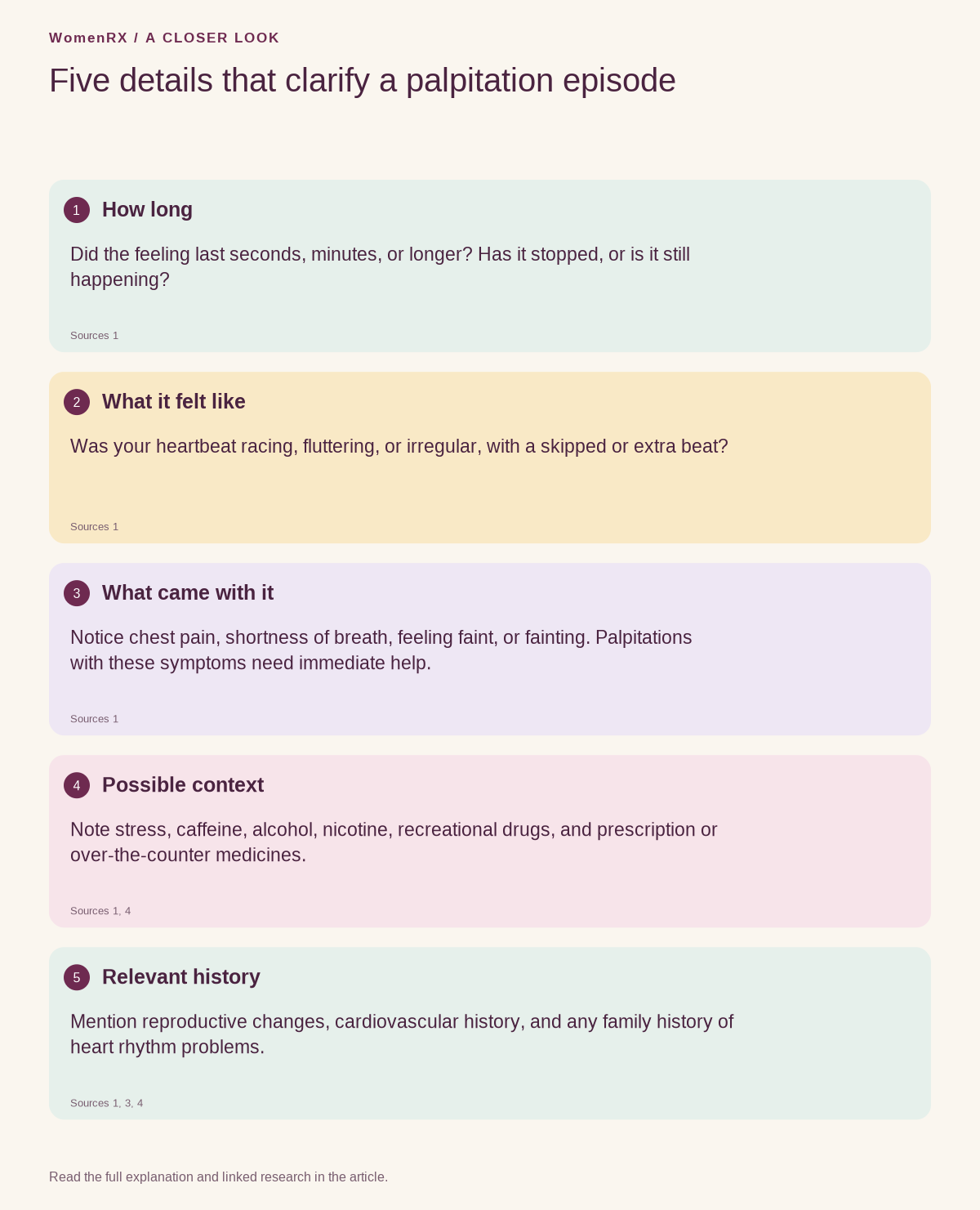
Five details that clarify a palpitation episode
How long: Did the feeling last seconds, minutes, or longer? Has it stopped, or is it still happening?1
What it felt like: Was your heartbeat racing, fluttering, or irregular, with a skipped or extra beat?1
What came with it: Notice chest pain, shortness of breath, feeling faint, or fainting. Palpitations with these symptoms need immediate help.1
Possible context: Note stress, caffeine, alcohol, nicotine, recreational drugs, and prescription or over-the-counter medicines.14
Relevant history: Mention reproductive changes, cardiovascular history, and any family history of heart rhythm problems.134
Read the figure as text
Use these prompts to describe what happened. They aren’t a test of whether palpitations are hormonal or harmless.- How long: Did the feeling last seconds, minutes, or longer? Has it stopped, or is it still happening?1
- What it felt like: Was your heartbeat racing, fluttering, or irregular, with a skipped or extra beat?1
- What came with it: Notice chest pain, shortness of breath, feeling faint, or fainting. Palpitations with these symptoms need immediate help.1
- Possible context: Note stress, caffeine, alcohol, nicotine, recreational drugs, and prescription or over-the-counter medicines.14
- Relevant history: Mention reproductive changes, cardiovascular history, and any family history of heart rhythm problems.134
More questions, answered
Do palpitations always mean I have an arrhythmia?
No. Palpitations describe a sensation, not a diagnosis. Possible explanations include triggers such as caffeine, iron-deficiency anemia, an overactive thyroid, and heart rhythm problems. Assessment helps sort out which explanation fits your situation.14
Sources you can check
- Heart palpitations - NHSAccessed 2026-09-25Return to first citation
- Anemia | MedlinePlusAccessed 2026-09-25Return to first citation
- Impact of Exercise on Perimenopausal Syndrome: A Systematic Review of Randomized Controlled Trials.Philip AE, Singh H, Nanjundiah SY, Samudrala PC, Theunissen W, Robinson J, Banerjee I. · Cureus · 2025Return to first citation
- Palpitations: Evaluation in the Primary Care Setting.Wexler RK, Pleister A, Raman SV. · American family physician · 2017Return to first citation