Perimenopause Palpitations: What to Notice and When to Act
Palpitations can happen during the menopause transition, but the sensation alone can’t tell you whether your heart rhythm is normal.
Palpitations describe a heartbeat that feels unusually noticeable, such as racing, pounding, fluttering, or seeming to skip. They’re reported during perimenopause, but they can also come from causes such as caffeine, anemia, thyroid problems, or a heart rhythm condition. Note how long they last and what else is happening. Seek emergency care for palpitations with chest pain or fainting; arrange routine assessment if they keep returning or last more than a few minutes. 1 4
What “palpitations” actually means
Palpitations are a sensation, not a diagnosis. You might notice a racing, pounding, fluttering, or skipped-beat feeling in your chest, neck, or throat. The sensation may last seconds, minutes, or longer, and it doesn’t by itself show whether your heart is beating normally or abnormally. 1 6
That distinction matters during perimenopause. In a small pilot study that monitored 30 midlife women, reported palpitations occurred during both altered heart rhythms and normal sinus rhythm. The study was exploratory, so it can’t determine what is happening during your own episode, but it shows why the feeling alone doesn’t identify the cause. 3
Menopause may be part of the picture, not the whole answer
Palpitations are reported by women during the menopause transition. In the large SWAN study, researchers identified different patterns over time: some women reported palpitations more often during perimenopause and early postmenopause, while others reported them infrequently. The study found no association between these patterns and the measures of subclinical cardiovascular disease it examined. That finding doesn’t rule out a rhythm problem or another cause for an individual woman. 4
Other research has found that palpitations are associated with factors such as more bothersome hot flashes and poorer sleep, but those associations don’t prove that menopause hormones caused the heartbeat sensation. 5 The evidence on treatments specifically for menopausal palpitations is limited; a systematic review found that no treatment could be fully recommended for this symptom based on the available studies. 2
Menopause isn’t the only possible explanation. Palpitations can be associated with caffeine, alcohol, nicotine, or recreational drugs, as well as iron-deficiency anemia, an overactive thyroid, heart rhythm problems, and other heart conditions. 1 You don’t have to work out which cause applies before asking for an assessment.
Let the pattern guide your next step
Get emergency care now if palpitations are happening and don’t go away, or if they come with chest pain, feeling faint, or fainting. If those symptoms have stopped, seek urgent medical advice rather than treating the episode as settled. 1
Arrange a routine medical assessment if palpitations keep coming back, become more frequent, last longer than a few minutes, or you have a heart condition or a family history of heart problems. 1 A clinician may use an electrocardiogram (ECG), which records the heart’s electrical signals, to help assess the cause. 1
For an appointment, a short description is more useful than trying to label the sensation. If you can, note when it starts, how long it lasts, whether it feels fast or irregular, what was happening beforehand, and whether you also had symptoms such as a hot flash, chest pain, or feeling faint. A brief note can help you describe the pattern; it can’t confirm that a rhythm is safe.
Mention possible context, too, such as caffeine or alcohol, and whether the episodes are new or changing. These details don’t prove a cause, but they can help your clinician decide what to assess. If symptoms are happening now with chest pain or faintness, don’t wait to collect notes before seeking emergency care. 1
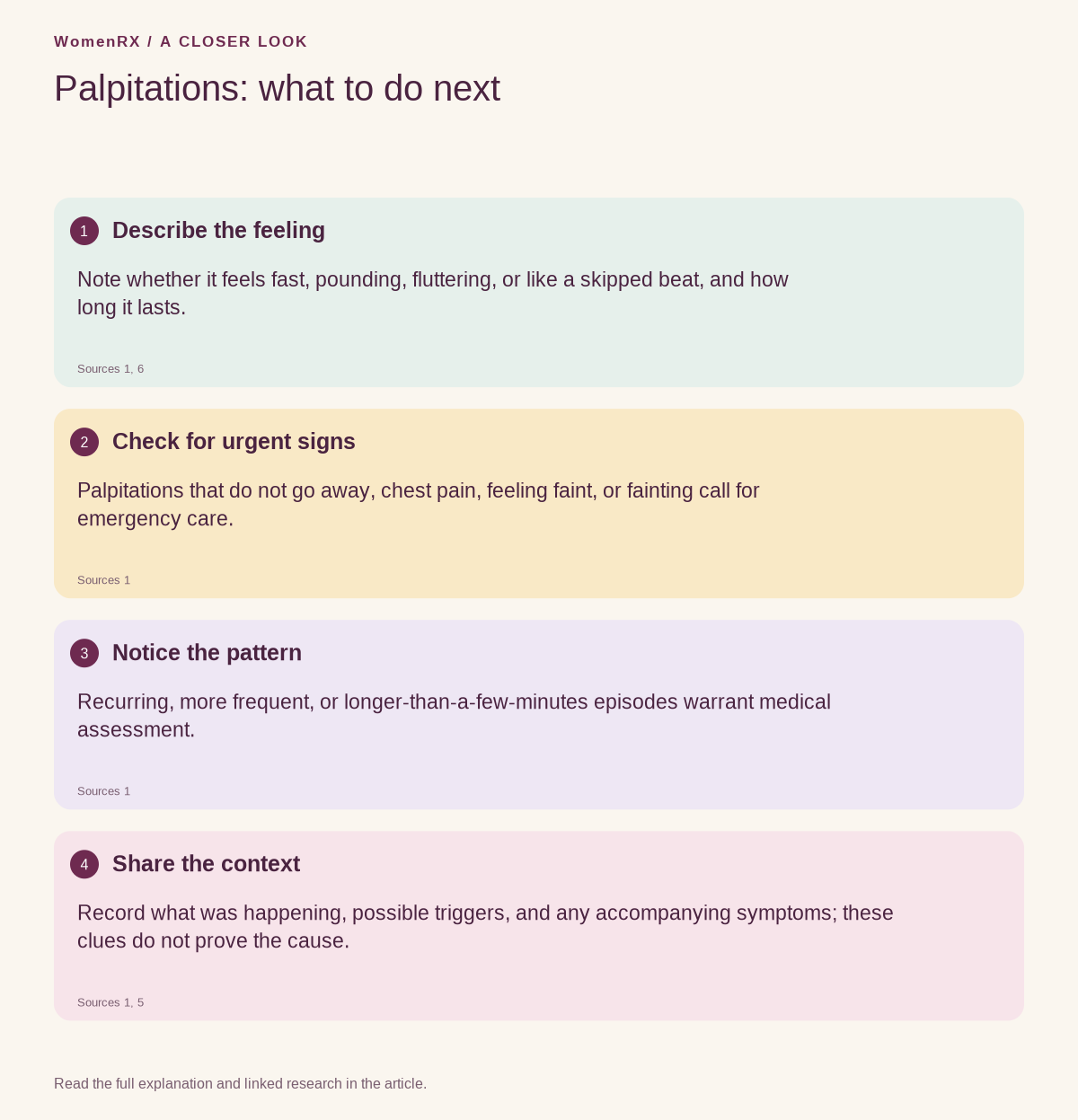
Palpitations: what to do next
Describe the feeling: Note whether it feels fast, pounding, fluttering, or like a skipped beat, and how long it lasts.16
Check for urgent signs: Palpitations that do not go away, chest pain, feeling faint, or fainting call for emergency care.1
Notice the pattern: Recurring, more frequent, or longer-than-a-few-minutes episodes warrant medical assessment.1
Share the context: Record what was happening, possible triggers, and any accompanying symptoms; these clues do not prove the cause.15
Read the figure as text
Use the episode’s duration, pattern, and accompanying symptoms to choose a next step. The sensation alone cannot identify its cause.- Describe the feeling: Note whether it feels fast, pounding, fluttering, or like a skipped beat, and how long it lasts.16
- Check for urgent signs: Palpitations that do not go away, chest pain, feeling faint, or fainting call for emergency care.1
- Notice the pattern: Recurring, more frequent, or longer-than-a-few-minutes episodes warrant medical assessment.1
- Share the context: Record what was happening, possible triggers, and any accompanying symptoms; these clues do not prove the cause.15
More questions, answered
Does a normal heartbeat during an episode mean nothing is wrong?
No. A small pilot study found reported palpitations during both normal sinus rhythm and altered rhythms, but it wasn’t large enough to determine the cause of an individual episode. If palpitations recur, last more than a few minutes, or come with concerning symptoms, use those details to guide your next step rather than relying on how the sensation feels. 1 3
Sources you can check
- Heart palpitations - NHSAccessed 2026-09-25Return to first citation
- Effect of menopausal symptom treatment options on palpitations: a systematic review.Sheng Y, Carpenter JS, Elomba CD, Alwine JS, Yue M, Chen CX, Tisdale JE. · Climacteric : the journal of the International Menopause Society · 2022Return to first citation
- Palpitations in midlife women: the Menopause Racing Heart Pilot Study.Carpenter JS, Jaynes HA, Alzahrani MA, Chen PS, Kovacs RJ, Tisdale JE. · Menopause (New York, N.Y.) · 2025Return to first citation
- Palpitations across the menopause transition in SWAN: trajectories, characteristics, and associations with subclinical cardiovascular disease.Carpenter JS, Cortés YI, Tisdale JE, Sheng Y, Jackson EA, Barinas-Mitchell E, Thurston RC. · Menopause (New York, N.Y.) · 2023Return to first citation
- Correlates of palpitations during menopause: A scoping review.Carpenter JS, Sheng Y, Pike C, Elomba CD, Alwine JS, Chen CX, Tisdale JE. · Women's health (London, England) · 2022Return to first citation
- Review of menopausal palpitations measures.Sheng Y, Carpenter JS, Elomba CD, Alwine JS, Yue M, Pike CA, Chen CX, Tisdale JE. · Women's midlife health · 2021Return to first citation