Menopause Palpitations: What to Know Before Taking Magnesium
Palpitations can happen around menopause, but their timing doesn’t confirm the cause or make a supplement the right fix.
Magnesium isn’t an established treatment for menopause-related palpitations. Menopause is one possible association, but anemia, thyroid problems, and heart rhythm conditions can also cause them. Seek emergency care if palpitations won’t stop or come with chest pain. If they recur, become more frequent, or last longer than a few minutes, arrange an assessment before trying magnesium or potassium. 1
Start with whether you need urgent care
A racing, fluttering, or skipped-beat sensation can have different causes. If palpitations are happening now and won’t go away, or you have them with chest pain, seek emergency care. If you feel well but they keep coming back, happen more often, last longer than a few minutes, or you have a heart condition or a family history of heart problems, arrange a medical assessment. An ECG may help assess the cause. 1
Menopause can be associated with palpitations, but it isn’t the only possible explanation. Iron-deficiency anemia, an overactive thyroid, and heart rhythm or other heart problems are among the alternatives. Caffeine, alcohol, nicotine, recreational drugs, and stress can also contribute. 1
Notice the pattern without treating it as a diagnosis
You might notice palpitations around the same time as hot flashes or changing periods. That timing is useful context to share, but it can’t establish that menopause is the cause or rule out other explanations. The available guidance identifies menopause as one possible association; it doesn’t make the sensation a diagnosis. 1
The evidence also doesn’t settle whether magnesium works differently at different menopause stages. In one small study of symptomatic menopausal women, the abstract doesn’t show whether results varied between perimenopause and postmenopause. And because the tested product had several ingredients, the study can’t tell whether magnesium itself affected palpitations. 5
Magnesium’s role in the body isn’t proof a supplement will help
Magnesium is involved in processes that help nerves and muscles function and support normal heart rhythm. Severe magnesium deficiency can cause abnormal heart rhythms, but that doesn’t show that extra magnesium will calm palpitations when a person isn’t deficient. Symptomatic deficiency from low dietary intake alone is uncommon in otherwise healthy people, though some health conditions, ongoing losses, and medicines can affect magnesium status. 2
A randomized, controlled 24-week study included 89 symptomatic menopausal women. It compared a combination product containing magnesium, soy isoflavones, and other ingredients with calcium plus vitamin D. The abstract reports that palpitations improved with the combination, but it can’t identify which ingredient, if any, was responsible. It doesn’t establish that a magnesium-only supplement treats palpitations. 5
Menopause guidance that advises against supplements and herbal remedies addresses vasomotor symptoms such as hot flashes. It isn’t a direct assessment of supplements for heart rhythm symptoms, so it shouldn’t be taken as a specific finding about magnesium and palpitations. 4
Let assessment guide any nutrient check
If palpitations are recurring or prolonged, start by assessing the symptom and its possible causes rather than choosing a nutrient supplement. Depending on your situation, a clinician may consider anemia, thyroid problems, or heart conditions; an ECG may help. Health conditions, ongoing losses, and some medicines can also affect magnesium status, so whether a nutrient check makes sense depends on your history. 12
Don’t take potassium to treat palpitations without appropriate assessment. Both low and high blood potassium can occur with certain conditions or medicines, and severe low potassium can be life-threatening. Potassium supplements and potassium-containing salt substitutes can also pose risks for some people, including those with kidney disease or taking certain medicines. 3
Magnesium supplements and medicines containing magnesium can cause diarrhea, nausea, or abdominal cramping in high amounts. Very high amounts can cause serious toxicity, including an irregular heartbeat. Mention any magnesium-containing products you take when discussing the palpitations. 2
The useful sequence is: respond to urgent warning signs, get recurring or prolonged palpitations assessed, and consider a nutrient supplement only if the likely cause and your circumstances support it. A connection with hot flashes or cycle changes can be part of the picture, not the whole explanation.
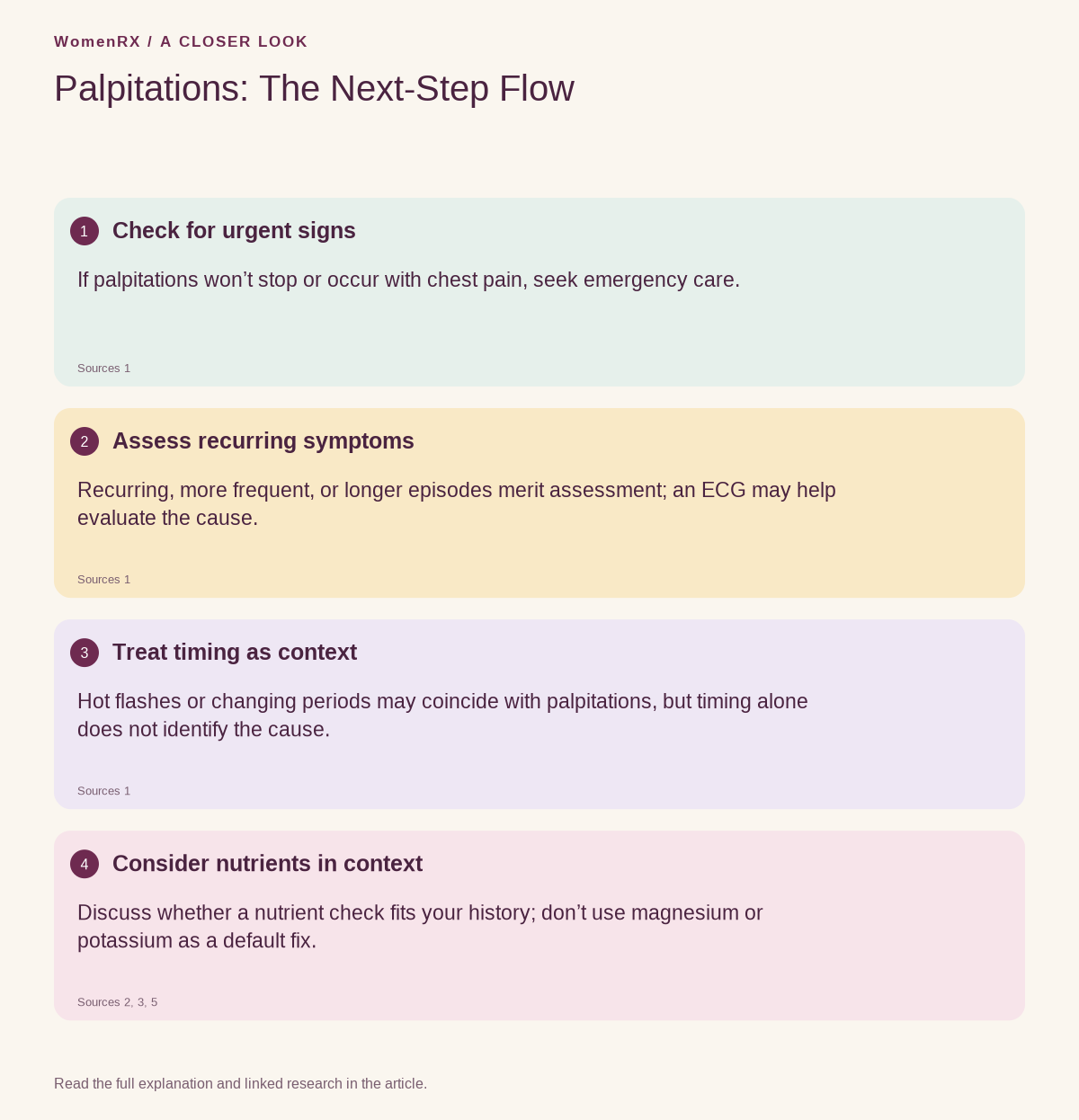
Palpitations: The Next-Step Flow
Check for urgent signs: If palpitations won’t stop or occur with chest pain, seek emergency care.1
Assess recurring symptoms: Recurring, more frequent, or longer episodes merit assessment; an ECG may help evaluate the cause.1
Treat timing as context: Hot flashes or changing periods may coincide with palpitations, but timing alone does not identify the cause.1
Consider nutrients in context: Discuss whether a nutrient check fits your history; don’t use magnesium or potassium as a default fix.235
Read the figure as text
Use this sequence to separate warning signs from symptoms to assess, then consider whether nutrient status belongs in the discussion.- Check for urgent signs: If palpitations won’t stop or occur with chest pain, seek emergency care.1
- Assess recurring symptoms: Recurring, more frequent, or longer episodes merit assessment; an ECG may help evaluate the cause.1
- Treat timing as context: Hot flashes or changing periods may coincide with palpitations, but timing alone does not identify the cause.1
- Consider nutrients in context: Discuss whether a nutrient check fits your history; don’t use magnesium or potassium as a default fix.235
Sources you can check
- Heart palpitations - NHSAccessed 2026-09-25Return to first citation
- Magnesium - Health Professional Fact SheetAccessed 2026-09-25Return to first citation
- Potassium - Health Professional Fact SheetAccessed 2026-09-25Return to first citation
- The 2023 nonhormone therapy position statement of The North American Menopause Society.Menopause (New York, N.Y.) · 2023Return to first citation
- Soy isoflavones, lactobacilli, Magnolia bark extract, vitamin D3 and calcium. Controlled clinical study in menopause.Mucci M, Carraro C, Mancino P, Monti M, Papadia LS, Volpini G, Benvenuti C. · Minerva ginecologica · 2006Return to first citation