Breast Tenderness: When to Arrange a Check
Breast pain alone is not usually a sign of cancer, but a new lump or breast change deserves assessment whether or not it hurts.
A familiar ache in both breasts that comes and goes with your period can often be watched for a short time. Arrange a medical assessment if pain is new and persistent, focused in one spot, worsening, or not improving. Don’t wait on pain to settle if you also notice a lump, nipple or skin change, unusual discharge, or a red, hot, swollen breast. 1 2 3
Start with the pattern, then check for changes
Tenderness can feel like aching, heaviness, tightness, or burning. The pattern offers clues, but it can’t identify the cause on its own. Pain that affects both breasts and tends to build before a period, then ease when the period ends, fits a common cycle-linked pattern. If that’s familiar for you and there are no other breast changes, it may be reasonable to observe whether it follows that pattern. 1 3
Pain that stays in one area, doesn’t follow your cycle, keeps returning, or is getting worse is a reason to arrange an assessment, particularly if it isn’t improving. Breast pain can also come from outside the breast, such as a strain or other chest-wall or neck-and-shoulder problem. A clinician can consider those possibilities alongside breast causes. 1 3
Period patterns aren’t the only context that matters. Hormone changes during menopause can be associated with breast pain, and some medicines can contribute. Pregnancy is another possibility if it applies to you. These factors may help explain tenderness, but they don’t make a new lump or breast change something to ignore. 1 3
Don’t wait for the pain to explain these changes
Arrange medical assessment for a new lump or swelling in the breast, chest, or armpit; a change in breast size or shape; skin dimpling; a new nipple change, such as turning inward or developing a rash; or nipple discharge that isn’t expected in pregnancy or breastfeeding, especially if it’s bloody. These changes can have causes other than cancer, but they need checking. A breast change can matter even when it doesn’t hurt. 1 2
A newly red, hot, or swollen breast should also be assessed urgently, especially if you have a very high temperature or feel hot, cold, or shivery. 1
A family history of breast cancer, or breast pain alongside other breast changes, is also a good reason to contact a clinician rather than relying on the pain pattern alone. 1 2
What pain alone can, and can’t, tell you
Breast pain by itself is not usually a symptom of breast cancer. In a Dutch primary-care cohort of women aged 30 and older, isolated breast pain, meaning pain without other breast-related symptoms at the initial visit, was not associated with breast cancer; no cancers occurred among the 588 episodes classified as isolated pain. That finding is reassuring at a population level, but it isn’t a guarantee about an individual symptom, and it doesn’t apply when a lump or another breast change is present. 2 4
The distinction matters because breast cancer can also cause symptoms without pain. A lump, skin or nipple retraction, and other changes deserve assessment whether or not tenderness is part of the picture. 2 4
What an assessment may clarify
A clinician can ask where the pain is, when it began, whether it tracks with periods, and whether you’ve noticed another change. They may also consider pregnancy possibility, menopause stage, medicines or hormone use, breast history, and pain from the chest wall or nearby muscles. The pattern and examination help determine whether imaging or another next step is useful. Imaging recommendations vary with the type of pain and other clinical details; not every pattern of breast pain needs imaging. 1 3 5
If you’re watching a familiar, short-lived pattern, notice whether it affects one or both breasts and whether it changes with your cycle. If it doesn’t improve, becomes localized or worse, or a new change appears, arrange an assessment instead of waiting for a particular point in your cycle. 1 3
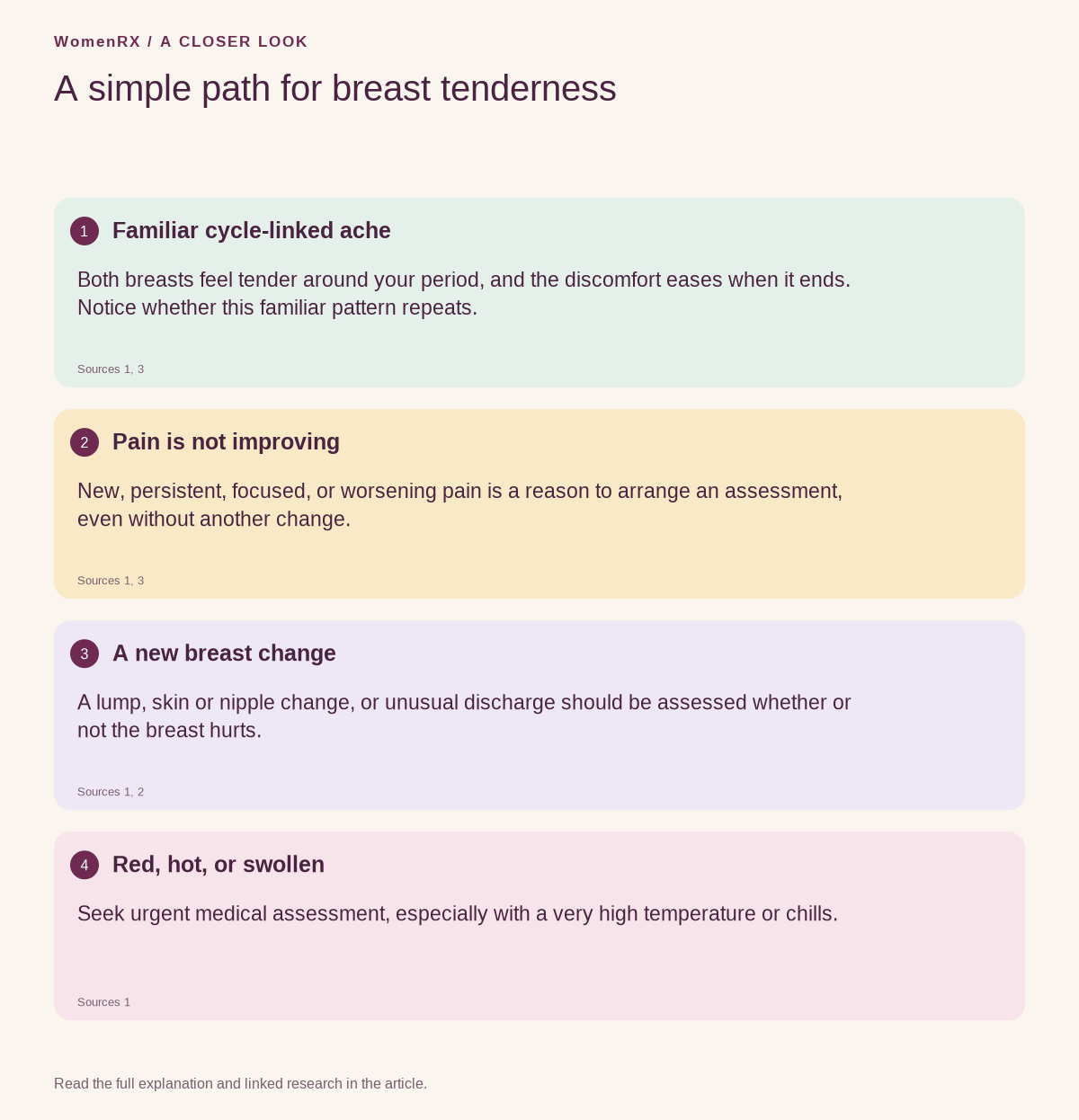
A simple path for breast tenderness
Familiar cycle-linked ache: Both breasts feel tender around your period, and the discomfort eases when it ends. Notice whether this familiar pattern repeats.13
Pain is not improving: New, persistent, focused, or worsening pain is a reason to arrange an assessment, even without another change.13
A new breast change: A lump, skin or nipple change, or unusual discharge should be assessed whether or not the breast hurts.12
Red, hot, or swollen: Seek urgent medical assessment, especially with a very high temperature or chills.1
Read the figure as text
Use the pattern and any accompanying changes to decide whether to observe a familiar ache or arrange assessment.- Familiar cycle-linked ache: Both breasts feel tender around your period, and the discomfort eases when it ends. Notice whether this familiar pattern repeats.13
- Pain is not improving: New, persistent, focused, or worsening pain is a reason to arrange an assessment, even without another change.13
- A new breast change: A lump, skin or nipple change, or unusual discharge should be assessed whether or not the breast hurts.12
- Red, hot, or swollen: Seek urgent medical assessment, especially with a very high temperature or chills.1
More questions, answered
Can breast tenderness come from somewhere other than the breast?
Yes. A neck, shoulder, back, or chest-wall strain can feel like breast pain. A clinician can help distinguish referred or muscular pain from a breast-related cause. 1 3
Does breast pain always need imaging?
No. Imaging decisions depend on the pain pattern and other findings. A review of breast-pain guidance says cycle-linked pain does not require an imaging work-up, while focused pain that is not cycle-related may be evaluated differently. 3
Sources you can check
- Breast pain - NHSAccessed 2026-09-25Return to first citation
- Symptoms of breast cancer in women - NHSAccessed 2026-09-25Return to first citation
- A Review of Breast Pain: Causes, Imaging Recommendations, and Treatment.Sivarajah R, Welkie J, Mack J, Casas RS, Paulishak M, Chetlen AL. · Journal of breast imaging · 2020Return to first citation
- Likelihood of breast cancer among women presenting with breast-related symptoms in primary care, with a focus on isolated mastalgia: a retrospective cohort study.van Ieperen SKL, van de Laar FA, Akkermans RP, A Uijen A. · BMC primary care · 2026Return to first citation
- Identification of Risk Factors for Mastalgia and Its Relationship with Benign or Malignant Breast Diseases.Yigit B, Kilicarslan G, Citgez B. · Sisli Etfal Hastanesi tip bulteni · 2023Return to first citation