Breast tenderness in your 40s: does the timing fit?
A repeating pattern around your period can offer a clue, but breast tenderness alone can’t confirm a hormonal cause or menopause.
Breast tenderness may follow a menstrual pattern: it often begins in the two weeks before a period, affects both breasts, and eases by the time bleeding ends. That pattern can be a clue, not proof that hormones or perimenopause are the cause. If your periods are irregular, record the actual dates and symptoms. A new lump or other breast change deserves attention. 12
Look for a repeating pattern, not a single episode
Breast pain linked to periods often starts up to two weeks before bleeding, grows more noticeable, then eases when the period ends. It commonly affects both breasts and may extend toward the armpit. A similar pattern across more than one cycle can make a menstrual link more plausible, but it still doesn’t prove the cause. Breast pain is common, and pain by itself is unlikely to be a sign of cancer. 1
In your 40s, changing period dates can make this pattern harder to spot. If bleeding is irregular, compare tenderness with when a period actually arrives rather than predicting it from a calendar. The useful question is whether the same relationship keeps showing up, not whether pain happened once near an expected period.
Notice where it hurts and how it behaves
Pain across both breasts that comes and goes with the cycle fits the usual description of period-related breast pain. Pain repeatedly confined to one small area is a different pattern. A review of common breast problems recommends evaluating focal breast pain with diagnostic imaging; a clinician can help decide what assessment is appropriate. 13
Also note whether the tenderness settles after your period or continues. If it doesn’t improve, arrange an evaluation rather than assuming it is part of a cycle. 1
Check medicines and hormones, too
A cycle pattern is only one possible clue. Breast pain has also been associated with oral contraceptives, hormone therapy, some psychotropic medicines, and some cardiovascular medicines. If a medicine or hormone treatment was started or changed around the time the pain began, include that detail when you discuss it. An association doesn’t establish that a particular medicine is the cause. 3
Pregnancy is another possible cause of breast pain, so consider whether it could apply to you rather than treating tenderness as a menopause-specific sign. 1
A quick pattern guide
For a short stretch, make a simple record of four things: when tenderness starts and settles, whether it affects one or both breasts, whether a small area stays sore, and any medicines, hormone treatments, lumps, or visible changes. If periods are irregular, use the dates you actually bleed. This can help distinguish a recurring cycle-related pattern from persistent or localized pain without asking you to diagnose the cause yourself.
A breast lump should be assessed, even if tenderness also seems to track your cycle. Other changes to bring to prompt medical attention include nipple discharge, especially if bloody; dimpling of the breast skin; a rash around the nipple or a newly sunken nipple; and a breast that is red, hot, or swollen. Seek prompt care if those changes come with a very high temperature or feeling feverish or shivery. 12
What the pattern can and can’t tell you
A repeating pre-period pattern is a useful observation, not a test for perimenopause. Breast tenderness can have several possible causes, including medicines and pregnancy, and the timing alone can’t identify which one applies. If pain is persistent, focused in one spot, or accompanied by a new breast change, get it assessed instead of relying on the cycle pattern. 13
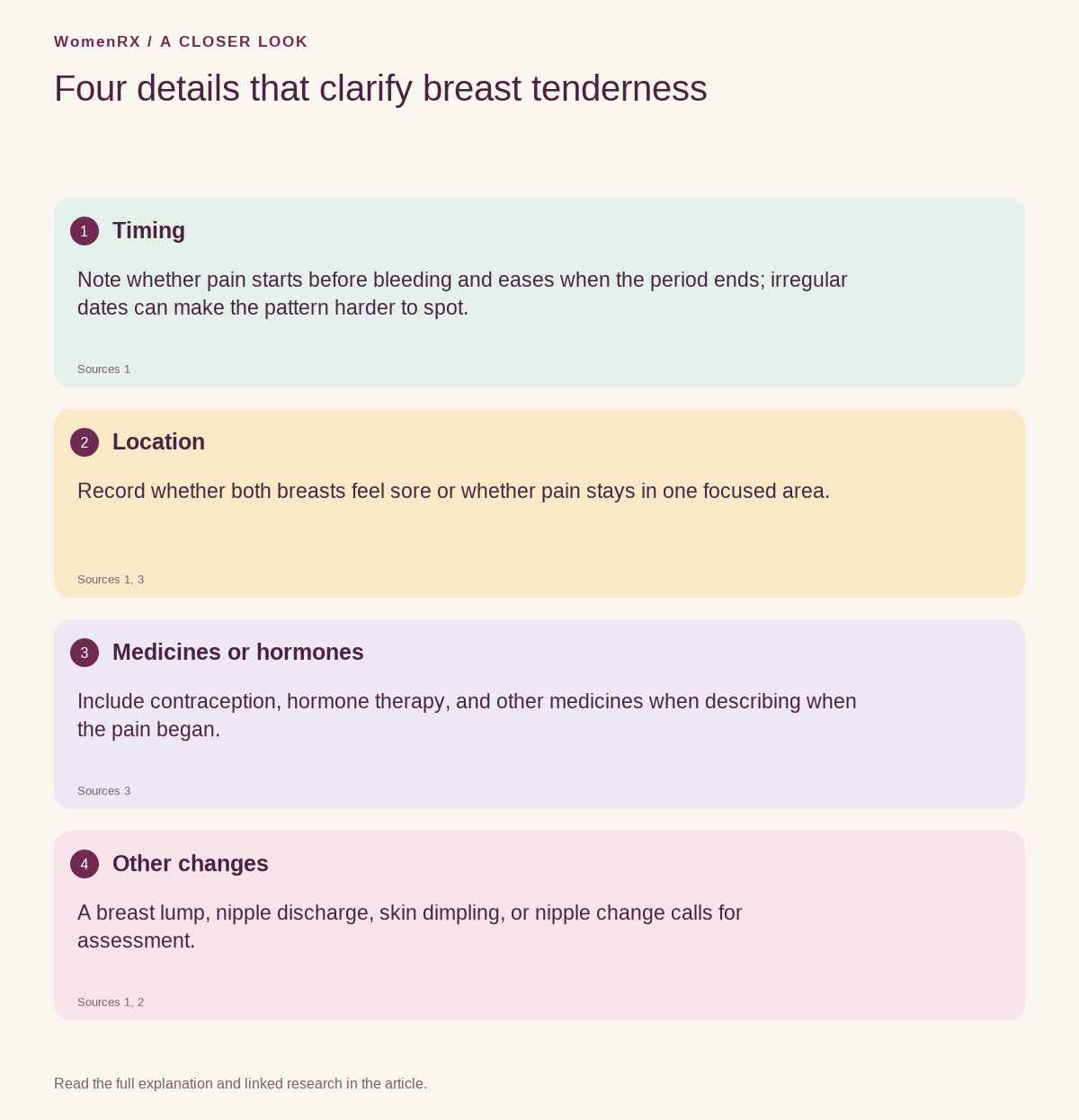
Four details that clarify breast tenderness
Timing: Note whether pain starts before bleeding and eases when the period ends; irregular dates can make the pattern harder to spot.1
Location: Record whether both breasts feel sore or whether pain stays in one focused area.13
Medicines or hormones: Include contraception, hormone therapy, and other medicines when describing when the pain began.3
Other changes: A breast lump, nipple discharge, skin dimpling, or nipple change calls for assessment.12
Read the figure as text
Use these distinctions to describe the pattern and decide whether it seems cycle-linked or needs assessment.- Timing: Note whether pain starts before bleeding and eases when the period ends; irregular dates can make the pattern harder to spot.1
- Location: Record whether both breasts feel sore or whether pain stays in one focused area.13
- Medicines or hormones: Include contraception, hormone therapy, and other medicines when describing when the pain began.3
- Other changes: A breast lump, nipple discharge, skin dimpling, or nipple change calls for assessment.12
More questions, answered
Does tenderness in both breasts mean it’s hormonal?
Not by itself. Tenderness in both breasts that reliably builds before a period and eases when bleeding ends fits the usual pattern of period-related pain, but the pattern is a clue rather than proof of a cause. 1
What if the pain stays in one small area?
Pain confined to a particular area should be discussed with a clinician. A review of common breast problems says focal breast pain should be evaluated with diagnostic imaging. 3
Sources you can check
- Breast pain - NHSAccessed 2026-09-25Return to first citation
- Lumps - NHSAccessed 2026-09-25Return to first citation
- Common Breast Problems.Salzman B, Collins E, Hersh L. · American family physician · 2019Return to first citation