Adenomyosis and Menopause: What May Change?
Period-related symptoms may ease after menopause, but new bleeding or pain deserves a fresh look.
Adenomyosis can cause heavy, painful periods and pelvic pain between periods. As periods stop, period-related symptoms may ease, though adenomyosis can still be present. During perimenopause, bleeding can become less predictable. After 12 months without a period, any vaginal bleeding needs evaluation, even if you already know you have adenomyosis. 41081
The change that matters most is whether you’re still having periods
Adenomyosis occurs when tissue from the uterine lining grows into the muscle of the uterine wall. It can cause heavy bleeding and painful periods. It can also cause pelvic pain, a feeling of heaviness or fullness, bloating, or pain during sex at other points in the cycle. Some people have no symptoms at all. 4
That difference between period-related symptoms and pain that happens at other times is useful when thinking about menopause. Once periods have stopped, menstrual bleeding and period cramps are no longer the same recurring problem. Menstruation-related symptoms of benign gynecologic conditions, including adenomyosis, typically subside after menopause. Pelvic pain and other symptoms aren’t necessarily tied to periods, so less bleeding doesn’t tell you whether they’ll change. Adenomyosis can still be present after menopause. 410
Perimenopause can make the pattern harder to read
During perimenopause, periods may come more or less often, and bleeding may become heavier or lighter. Adenomyosis can also cause heavy, painful periods. If bleeding changes, you cannot tell from the calendar alone which change is responsible; hormonal changes and conditions affecting the uterus can coexist. 849
For example, if your periods have always been painful but are now farther apart, the longer gaps may reflect perimenopause. If those periods have also become much heavier, that change still deserves attention rather than being written off as either menopause or adenomyosis. Bleeding between periods or after sex, increasingly painful or heavy periods, and heavy bleeding that affects daily life are reasons to arrange an evaluation. 348
There’s also a practical wrinkle if you use hormonal contraception to manage adenomyosis: a hormonal IUS or some other methods can make bleeding irregular or stop it altogether. No bleeding while using one of these methods does not, by itself, tell you that menopause has happened. 48
After menopause, bleeding is a different question
Menopause is identified retrospectively, after 12 months without a period. If you then notice vaginal bleeding, even a single spot or pink or brown discharge, arrange a medical evaluation. A previous adenomyosis diagnosis should not be treated as the explanation without checking. Postmenopausal bleeding often has a noncancerous cause, but it can also be a sign of cancer. 618
Possible causes include thinning of the vaginal or uterine lining, polyps, and thickening of the uterine lining. Evaluation may include a pelvic examination, vaginal ultrasound, or a sample of the uterine lining, depending on what needs to be ruled out. 1
An ultrasound can be useful, but it does not always give a clear measurement of the uterine lining. In a study of asymptomatic postmenopausal women, adenomyosis was one of several anatomical reasons the lining could not be adequately seen. That study does not tell us how often this happens in someone being evaluated for bleeding. Its practical lesson is narrower: if a scan cannot show the lining clearly, ask what evaluation can answer the bleeding question. 51
What if the symptom is pain, not bleeding?
Adenomyosis may cause pelvic pain outside periods, but new or worsening pain after menopause should not automatically be assigned to an old diagnosis. Pelvic pain can also come from the bladder, bowel, infection, or other pelvic conditions. Pain that keeps returning or does not go away merits an evaluation. 42
Seek emergency care if pelvic pain is severe or getting worse, or if you feel faint or have heavy vaginal bleeding. Pain with fever, unusual discharge, or trouble peeing or having a bowel movement also needs prompt attention. 2
Managing symptoms while periods continue
If heavy or painful periods are still disrupting your life, waiting for menopause is not the only option. A hormonal IUS is used to make periods lighter and less painful; other hormonal contraception, anti-inflammatory medicines, and tranexamic acid are among the treatments considered for adenomyosis symptoms. Heat may help with pain. The useful comparison is what you most need relief from now, whether you also need contraception, and how you feel about a continuing treatment versus a procedure. 47
A review of perimenopausal gynecologic care describes the tradeoff: symptoms may improve with menopause, but waiting should be balanced against their current effect on your life and against the possibility that another cause of abnormal bleeding needs assessment. You do not have to assume surgery is inevitable, or that a familiar diagnosis explains every new symptom. 94
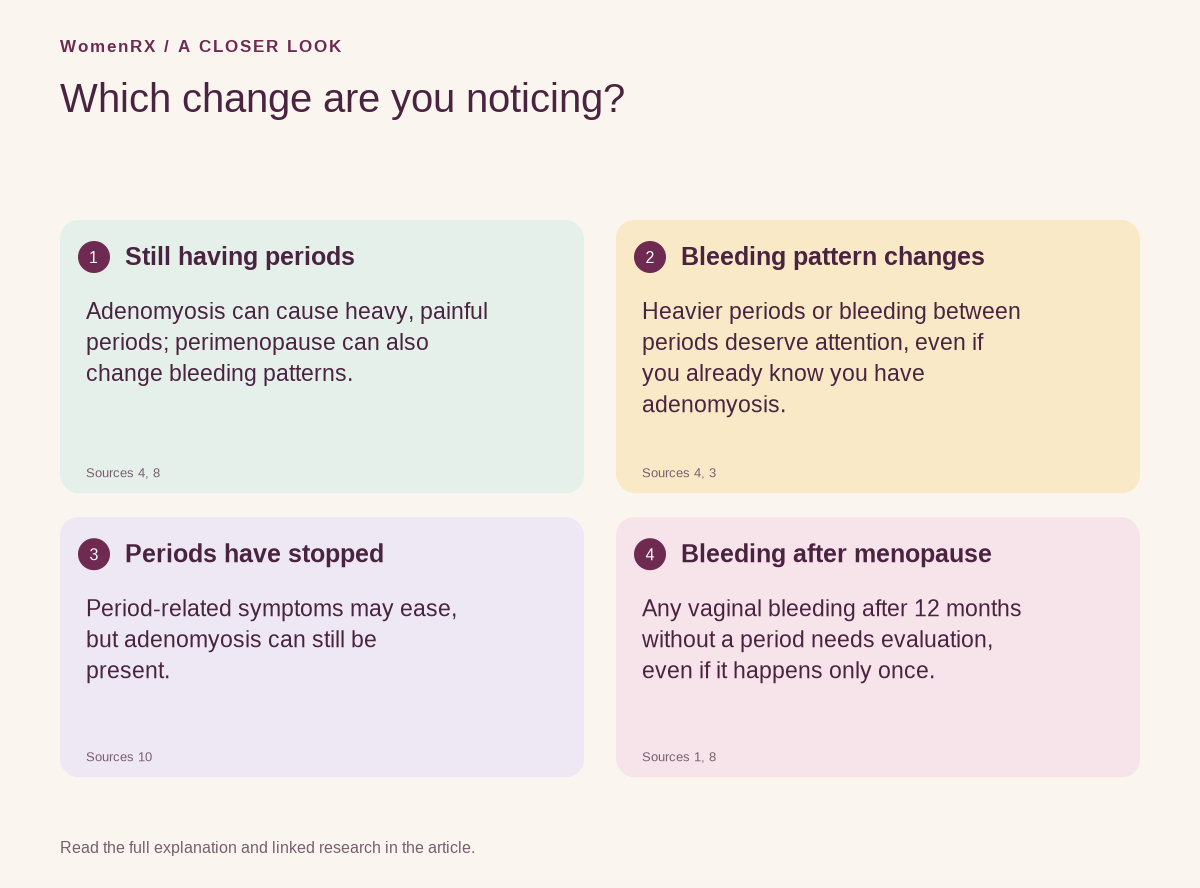
Which change are you noticing?
Still having periods: Adenomyosis can cause heavy, painful periods; perimenopause can also change bleeding patterns.48
Bleeding pattern changes: Heavier periods or bleeding between periods deserve attention, even if you already know you have adenomyosis.43
Periods have stopped: Period-related symptoms may ease, but adenomyosis can still be present.10
Bleeding after menopause: Any vaginal bleeding after 12 months without a period needs evaluation, even if it happens only once.18
Read the figure as text
The meaning of a symptom depends in part on whether periods are continuing or have stopped.- Still having periods: Adenomyosis can cause heavy, painful periods; perimenopause can also change bleeding patterns.48
- Bleeding pattern changes: Heavier periods or bleeding between periods deserve attention, even if you already know you have adenomyosis.43
- Periods have stopped: Period-related symptoms may ease, but adenomyosis can still be present.10
- Bleeding after menopause: Any vaginal bleeding after 12 months without a period needs evaluation, even if it happens only once.18
More questions, answered
Can adenomyosis still be present after menopause?
Yes. The end of periods does not necessarily mean adenomyosis has disappeared. Period-related symptoms often subside, but a change in symptoms does not confirm whether the condition is still present. 10
Sources you can check
- Postmenopausal bleeding - NHSAccessed 2026-09-25Return to first citation
- Pelvic pain - NHSAccessed 2026-09-25Return to first citation
- Irregular periods - NHSAccessed 2026-09-25Return to first citation
- Adenomyosis - NHSAccessed 2026-09-25Return to first citation
- Ability to successfully image endometrium on transvaginal ultrasound in asymptomatic postmenopausal women.Goldstein SR, Khafaga A. · Ultrasound in obstetrics & gynecology : the official journal of the International Society of Ultrasound in Obstetrics and Gynecology · 2021Return to first citation
- Hormone Therapy for the Primary Prevention of Chronic Conditions in Postmenopausal Persons: US Preventive Services Task Force Recommendation Statement.US Preventive Services Task Force, Mangione CM, Barry MJ, Nicholson WK, Cabana M, Caughey AB, Chelmow D, Coker TR, Davis EM, Donahue KE, Jaén CR, Kubik M, Li L, Ogedegbe G, Pbert L... · JAMA · 2022Return to first citation
- Current Medical Therapy for Adenomyosis: From Bench to Bedside.Etrusco A, Barra F, Chiantera V, Ferrero S, Bogliolo S, Evangelisti G, Oral E, Pastore M, Izzotti A, Venezia R, Ceccaroni M, Laganà AS. · Drugs · 2023Return to first citation
- Symptoms of menopause and perimenopause - NHSAccessed 2026-09-25Return to first citation
- Complex benign gynecology in perimenopause: current evidence and future directions.Goren R, Shats M, Ciesielski K, Siedhoff M, Meyer R. · Current opinion in obstetrics & gynecology · 2026Return to first citation
- Management of Common Benign Gynecologic Diseases in Postmenopausal Women.Yu E, Lee H, Joo J, Na Y. · Journal of menopausal medicine · 2024Return to first citation