No Period and a Negative Test: What Next?
When a period is late, the timing of your pregnancy test matters as much as the result.
If pregnancy is possible, check when you took the test: a negative result can be less reliable if you tested too early. Wait a few days and test again if your period still hasn’t arrived. Seek urgent care for pelvic pain with faintness or shoulder-tip pain. If periods remain absent, the timing of an evaluation depends partly on your usual cycle pattern. 815
First, check when you tested
A negative home pregnancy test is useful, but it isn’t equally informative on every day of your cycle. Tests are most reliable from the first day of a missed period. If you don’t know when your period was due, use the date of your last unprotected sex instead: test at least 21 days afterward. Follow the instructions for your particular test, since testing too early or using it incorrectly can make a negative result less reliable. 8
If you tested early and your period still hasn’t come, wait a few days and test again. If a second test is negative but your period remains absent, arrange a medical appointment rather than continuing to rely on home tests alone. Hormones in birth control pills do not prevent a pregnancy test from working, though no contraceptive method is completely effective. 8
Don’t wait to retest if you also have concerning pelvic pain. Pelvic pain with faintness, dizziness, shoulder-tip pain, difficulty breathing, or a high temperature needs urgent assessment. Sudden, severe pelvic pain can have several causes, including some that need urgent treatment. Seek urgent medical assessment for these symptoms or for severe pelvic pain. 14
One late period is different from periods stopping
A cycle isn’t required to arrive on the same date every month. Menstrual cycles can be shorter or longer than the often-cited 28 days, and a change in one cycle doesn’t, by itself, tell you why it happened. Start with what’s normal for you: the first day of your last period, how regularly periods usually arrive, and whether this is one late period or a continuing change. 27
Several details can help make sense of the change without trying to diagnose yourself. Have you had a major change in weight, been under unusual stress, or increased exercise substantially? Have you started or changed hormonal contraception? These can affect bleeding patterns. Thyroid problems and other hormone-related conditions can also be behind irregular periods, so a persistent change deserves more than an assumption that stress is the cause. 75
If your cycles were previously regular, going three months without a period meets a commonly used threshold for evaluating secondary amenorrhea. The definition also uses six months without menstruation for someone who has had at least one previous spontaneous period, including someone without a previously regular pattern. These are evaluation thresholds, not instructions to ignore a troubling change until a deadline: seek care sooner if a second pregnancy test is negative and your period still hasn’t arrived, or if you have severe pain, very heavy bleeding, or another major change in your cycle. 582
An evaluation starts by checking for pregnancy and reviewing your menstrual and health history. Depending on what that history shows, it may include a physical exam, hormone tests, or pelvic imaging. The aim is to find the reason periods have stopped, since the next step differs for a medication-related change, a hormone problem, and other causes. 5
Your life stage changes the context
Soon after childbirth or while breastfeeding: Periods can change after birth and during breastfeeding. Bleeding or spotting in the weeks after delivery isn’t necessarily the return of your usual cycle; postpartum spotting or bleeding can occur off and on for up to six weeks. If pregnancy is possible and you’re unsure when a period would be due, the timing of the pregnancy test still matters. 238
In adolescence: Periods may take a few years to become regular after they first start, so one late cycle may be harder to judge against a usual pattern. A continuing absence of periods is still worth assessing; the three-month threshold applies to previously regular cycles, while the six-month definition includes someone who has had a spontaneous period without establishing a regular pattern. 25
In perimenopause: Periods often become less frequent before they stop, but a missed period alone doesn’t establish menopause. If pregnancy is possible, test according to timing rather than assuming the change is perimenopause. A major change in your usual bleeding pattern also warrants a conversation with a clinician. 682
With hormonal contraception: Some methods can make periods irregular, and certain methods can make bleeding lighter. Note which method you use and whether it has recently changed. That context helps explain the bleeding pattern, but it doesn’t replace a pregnancy test when pregnancy is possible. 748
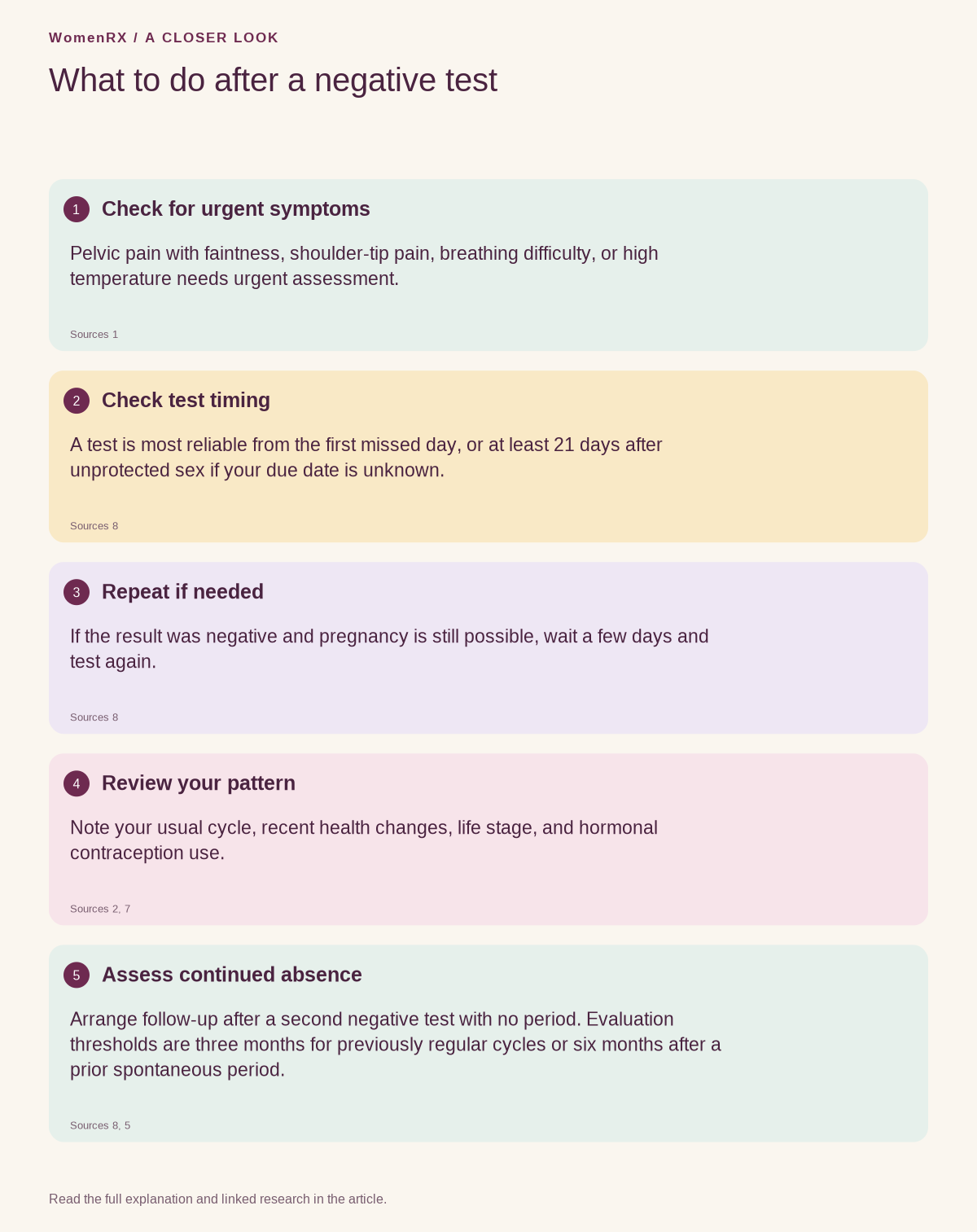
What to do after a negative test
Check for urgent symptoms: Pelvic pain with faintness, shoulder-tip pain, breathing difficulty, or high temperature needs urgent assessment.1
Check test timing: A test is most reliable from the first missed day, or at least 21 days after unprotected sex if your due date is unknown.8
Repeat if needed: If the result was negative and pregnancy is still possible, wait a few days and test again.8
Review your pattern: Note your usual cycle, recent health changes, life stage, and hormonal contraception use.27
Assess continued absence: Arrange follow-up after a second negative test with no period. Evaluation thresholds are three months for previously regular cycles or six months after a prior spontaneous period.85
Read the figure as text
The next step depends on symptoms, when you tested, and whether periods remain absent.- Check for urgent symptoms: Pelvic pain with faintness, shoulder-tip pain, breathing difficulty, or high temperature needs urgent assessment.1
- Check test timing: A test is most reliable from the first missed day, or at least 21 days after unprotected sex if your due date is unknown.8
- Repeat if needed: If the result was negative and pregnancy is still possible, wait a few days and test again.8
- Review your pattern: Note your usual cycle, recent health changes, life stage, and hormonal contraception use.27
- Assess continued absence: Arrange follow-up after a second negative test with no period. Evaluation thresholds are three months for previously regular cycles or six months after a prior spontaneous period.85
Sources you can check
- Pelvic pain - NHSAccessed 2026-09-25Return to first citation
- Menstruation | Period | MedlinePlusAccessed 2026-09-25Return to first citation
- Postpartum Care: MedlinePlusAccessed 2026-09-25Return to first citation
- Period pain - NHSAccessed 2026-09-25Return to first citation
- AmenorrheaNawaz G, Rogol AD, Jenkins SM. · 2024Return to first citation
- Periods - NHSAccessed 2026-09-25Return to first citation
- Irregular periods - NHSAccessed 2026-09-25Return to first citation
- Doing a pregnancy test - NHSAccessed 2026-09-25Return to first citation