Late Period, Negative Test: What Else Affects Timing?
Stress, contraception, breastfeeding, and the approach to menopause can change when bleeding arrives, but a persistent change deserves a closer look.
A late period can reflect stress, substantial weight change, intense exercise, hormonal contraception, breastfeeding, perimenopause, or a condition such as a thyroid disorder or polycystic ovary syndrome. If pregnancy is possible, one negative urine test may not settle the question. If your period is a week late, seek follow-up testing rather than waiting for several missed periods. 1369
A negative pregnancy test may leave you with a practical question: is this cycle simply different, or is your usual pattern changing? Start with the dates. A menstrual cycle runs from the first day of one period to the first day of the next. About 28 days is common, but a cycle doesn't have to be exactly 28 days to be normal. Knowing your usual range is more useful than comparing every month with an app's predicted date. 16
First, keep pregnancy in the picture if it's possible
A missed period can be an early sign of pregnancy. If you tested before your period was due and it still hasn't arrived, don't treat that negative result as the final answer. False-negative urine tests are possible. The American Society for Reproductive Medicine advises that, for someone with usually regular cycles, even a week-late period may call for ruling out pregnancy. If you're at that point and pregnancy is possible, seek follow-up testing; a clinician may use a blood pregnancy test when a urine result remains uncertain. Don't wait for three missed periods to revisit the pregnancy question. 69
If pregnancy isn't possible, or further testing has addressed that question, look at what else has changed. The most useful distinction is between a period that's late compared with an estimate and periods that have become repeatedly irregular or stopped.
What changed around this cycle?
Stress and anxiety, substantial weight loss or gain, and exercising too much are recognized reasons periods may become irregular. That makes them possibilities to consider, not diagnoses to assign yourself. For example, if your training increased sharply or eating has changed alongside a delayed period, those details help put the timing in context. They don't prove why the period is late. 6
Some health conditions can also affect cycle regularity, including thyroid problems and polycystic ovary syndrome, often called PCOS. Irregular periods together with changes such as facial hair growth, weight gain, tiredness, or dry or oily skin are a reason to arrange an assessment rather than assume stress is the whole story. High prolactin is another recognized cause of periods stopping; it isn't something you can identify from a calendar alone. 26
Three contexts that change what “late” means
After childbirth or while breastfeeding: Your period pattern may change after childbirth and during breastfeeding. If you've had sex and miss a period, pregnancy is also possible. Note whether periods have returned at all and whether your feeding pattern has changed. Those details make a late period easier to discuss in context. 17
During perimenopause: In the years before the final menstrual period, cycle length can become more variable and periods may be missed. Menopause is identified retrospectively, after 12 months without a period. A changing pattern in midlife may fit that transition, but it shouldn't automatically explain away troublesome bleeding or pain. 13
While using hormonal contraception: The bleeding pattern depends on the method. The progestogen-only pill, contraceptive injection, and hormonal IUD are among the methods associated with irregular periods; changing contraception can also disturb a familiar pattern. Studies of a particular combined pill describe scheduled bleeding, while research involving a 52-mg hormonal IUD includes users who had gone without bleeding. Those findings aren't a prediction for every method or every person. Write down the method you use and when you started or changed it before comparing this month's bleeding with your old cycle. 4568
When to move from watching to assessment
A single later-than-expected period isn't the same as a sustained change. Arrange care if your normally predictable periods become irregular, especially if you have other symptoms, bleeding between periods, or difficulty getting pregnant. Once pregnancy has been addressed, three consecutive missed periods warrant an assessment rather than continuing to wait for the pattern to correct itself. Very heavy bleeding or severe pain also warrants care without waiting for a third missed period. 1679
A short record can make that conversation more useful: the first day of your last few periods, any pregnancy tests and their dates, your contraception and any changes to it, and relevant changes in exercise, weight, stress, medications, or health. Add symptoms such as pain, bleeding between periods, tiredness, or new facial hair growth. The point isn't to solve the cause on your own. It's to show whether this is one unusual cycle or a new pattern, so the next step can fit what's actually happening. 168
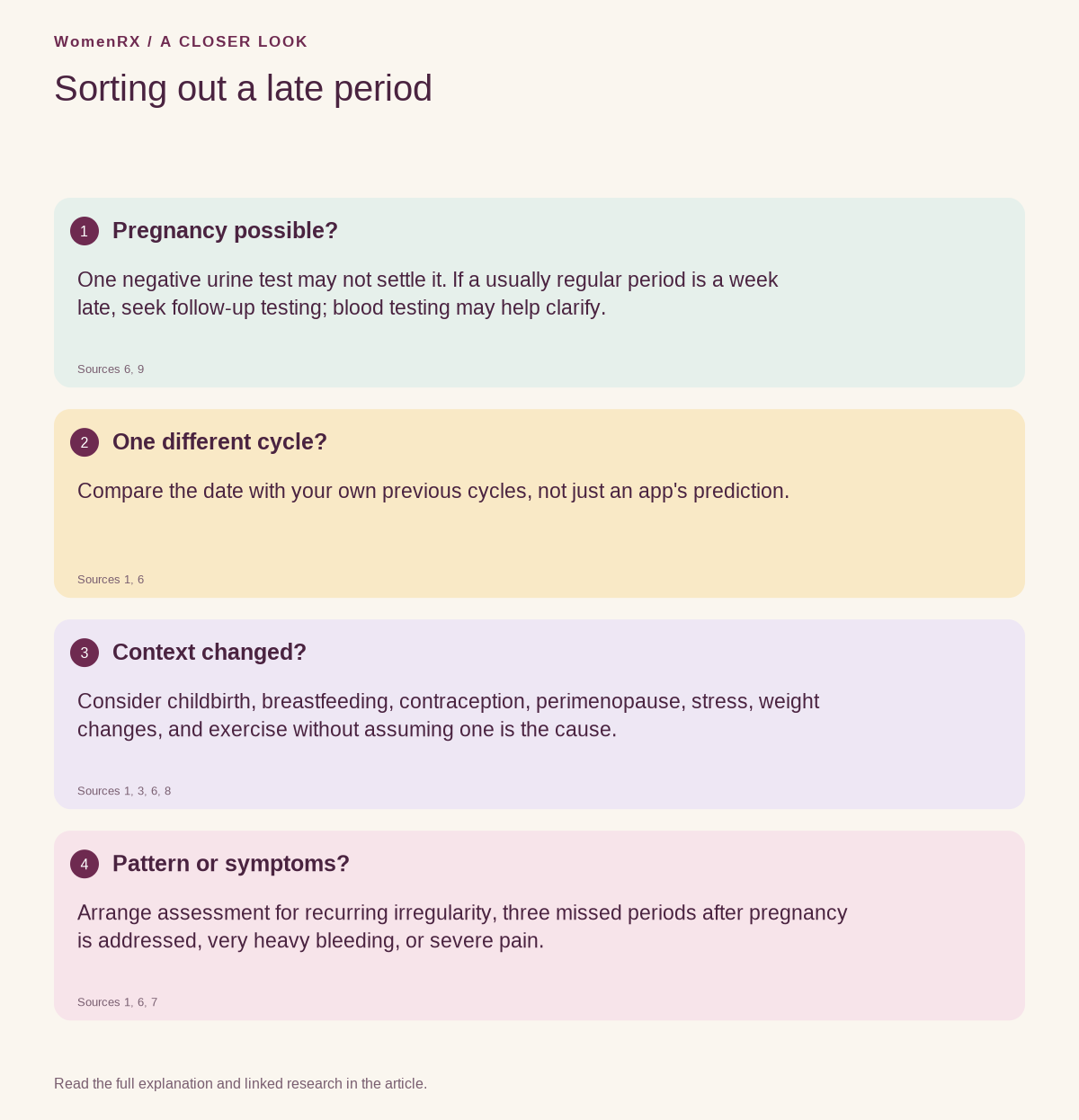
Sorting out a late period
Pregnancy possible?: One negative urine test may not settle it. If a usually regular period is a week late, seek follow-up testing; blood testing may help clarify.69
One different cycle?: Compare the date with your own previous cycles, not just an app's prediction.16
Context changed?: Consider childbirth, breastfeeding, contraception, perimenopause, stress, weight changes, and exercise without assuming one is the cause.1368
Pattern or symptoms?: Arrange assessment for recurring irregularity, three missed periods after pregnancy is addressed, very heavy bleeding, or severe pain.167
Read the figure as text
A path from pregnancy follow-up to the cycle pattern that may need assessment.- Pregnancy possible?: One negative urine test may not settle it. If a usually regular period is a week late, seek follow-up testing; blood testing may help clarify.69
- One different cycle?: Compare the date with your own previous cycles, not just an app's prediction.16
- Context changed?: Consider childbirth, breastfeeding, contraception, perimenopause, stress, weight changes, and exercise without assuming one is the cause.1368
- Pattern or symptoms?: Arrange assessment for recurring irregularity, three missed periods after pregnancy is addressed, very heavy bleeding, or severe pain.167
Sources you can check
- Menstruation | Period | MedlinePlusAccessed 2026-09-25Return to first citation
- Efficacy and safety in the treatment of hyperprolactinemia: A systematic review and network meta-analysis.Fachi MM, de Deus Bueno L, de Oliveira DC, da Silva LL, Bonetti AF. · Journal of clinical pharmacy and therapeutics · 2021Return to first citation
- Hormone Therapy for the Primary Prevention of Chronic Conditions in Postmenopausal Persons: US Preventive Services Task Force Recommendation Statement.US Preventive Services Task Force, Mangione CM, Barry MJ, Nicholson WK, Cabana M, Caughey AB, Chelmow D, Coker TR, Davis EM, Donahue KE, Jaén CR, Kubik M, Li L, Ogedegbe G, Pbert L... · JAMA · 2022Return to first citation
- Treatment of unacceptable bleeding in long-term users of 52-mg levonorgestrel intrauterine device: a prospective observational study.van der Heijden PAHH, Röttgering KA, Oderkerk TJ, Dieleman JP, Lim AC, Bongers MY, Geomini PMAJ. · AJOG global reports · 2025Return to first citation
- Estetrol/drospirenone for combined oral contraception: a systematic review of efficacy, cycle control, and safety.Sánchez-Prieto M, Coll S, Romero-Domínguez M, Avella-Marcos M, Castilla M, Gómez Del Valle M, Franco-Camps S. · Frontiers in endocrinology · 2026Return to first citation
- Irregular periods - NHSAccessed 2026-09-25Return to first citation
- Periods - NHSAccessed 2026-09-25Return to first citation
- Period problems - NHSAccessed 2026-09-25Return to first citation
- Current evaluation of amenorrhea: a committee opinion (2024) | American Society for Reproductive Medicine | ASRMAccessed 2026-09-25Return to first citation