How to Use an Ovulation Test
A positive urine test detects an LH rise that often comes shortly before ovulation, but it predicts ovulation rather than proving it happened.
Follow the start day, collection steps, and result key for your specific kit; urine LH thresholds differ between tests. A positive usually means ovulation may be approaching, often within about one to two days, so it can help you time sex. It doesn’t confirm that an egg was released, and PCOS or irregular cycles can make results harder to interpret. 1 3 4 5
Start with your kit’s schedule
Ovulation predictor kits (OPKs) look for a rise in luteinizing hormone, or LH, in urine. Because the timing of that rise can shift from one cycle to another, testing is usually done daily starting before expected ovulation and continuing until a positive result. Use the start day and testing instructions for your particular kit. Different tests can use different LH thresholds, so interpret the result with that product’s key rather than assuming every brand works the same way. 1 5
If your cycles are fairly predictable, your cycle length and the kit’s instructions can help you choose when to begin. If your cycles vary a lot, a calendar estimate based on your usual cycle length may miss the LH rise or lead to many days of testing. There isn’t one cycle day that reliably fits everyone. Longer or earlier testing may catch a changing surge, but can also mean more cost and effort. 1 3
What a positive result tells you
A positive means the test detected LH at or above its threshold. The rise commonly comes shortly before ovulation, often about one to two days beforehand, making the result a clue that the fertile window may be near. It’s an estimate, not a countdown: ovulation timing varies, and a urine test cannot show that an egg was actually released. 1 4
If you’re having sex to try to conceive, a positive is a useful prompt to have sex that day and, if it works for you, again the next day. Don’t wait for a positive to start trying if you’ve noticed other signs of fertility or are already having sex regularly: the fertile window includes days before ovulation. A Cochrane review found that urine ovulation tests probably improve pregnancy and live-birth chances compared with no ovulation prediction in women under 40 who had been trying for less than 12 months. That’s a group-level finding, not a promise for an individual cycle. 5 6
If you’re planning insemination, ask the clinic coordinating it how to use an OPK with its timing plan. A home result gives an estimate, not a complete insemination timing plan. 1
Why a positive doesn’t confirm ovulation
An LH rise is a signal associated with ovulation, not direct evidence that ovulation occurred. A brief rise can be missed if testing starts late or doesn’t line up with the surge. Research comparing LH tests with ultrasound has also found that the test’s ability to predict ovulation depends on the threshold and when testing happens. 4 5
Confirmation uses different information. In clinical studies, ultrasound can track follicle changes and identify ovulation; blood progesterone can provide additional evidence. Some at-home monitors also measure hormones associated with the days after ovulation, but findings from one monitor in people with regular cycles shouldn’t be treated as proof that a basic LH strip confirms ovulation. 2 7
When cycles or PCOS complicate the picture
With irregular cycles, ovulation may not happen at a consistent point in the cycle, making it harder to know when to start testing. PCOS can add another challenge: LH may be persistently elevated or fluctuate, which can make an LH-based test harder to interpret and can contribute to positive results that don’t correspond to ovulation. That doesn’t mean every positive in someone with PCOS is false; it means the result may be less straightforward. 3
If you repeatedly get positives, never see one, or can’t tell whether the tests match your cycle, consider asking a clinician about a way to assess ovulation that fits your situation. Depending on the question, that may involve blood testing or ultrasound rather than relying on LH strips alone. 7
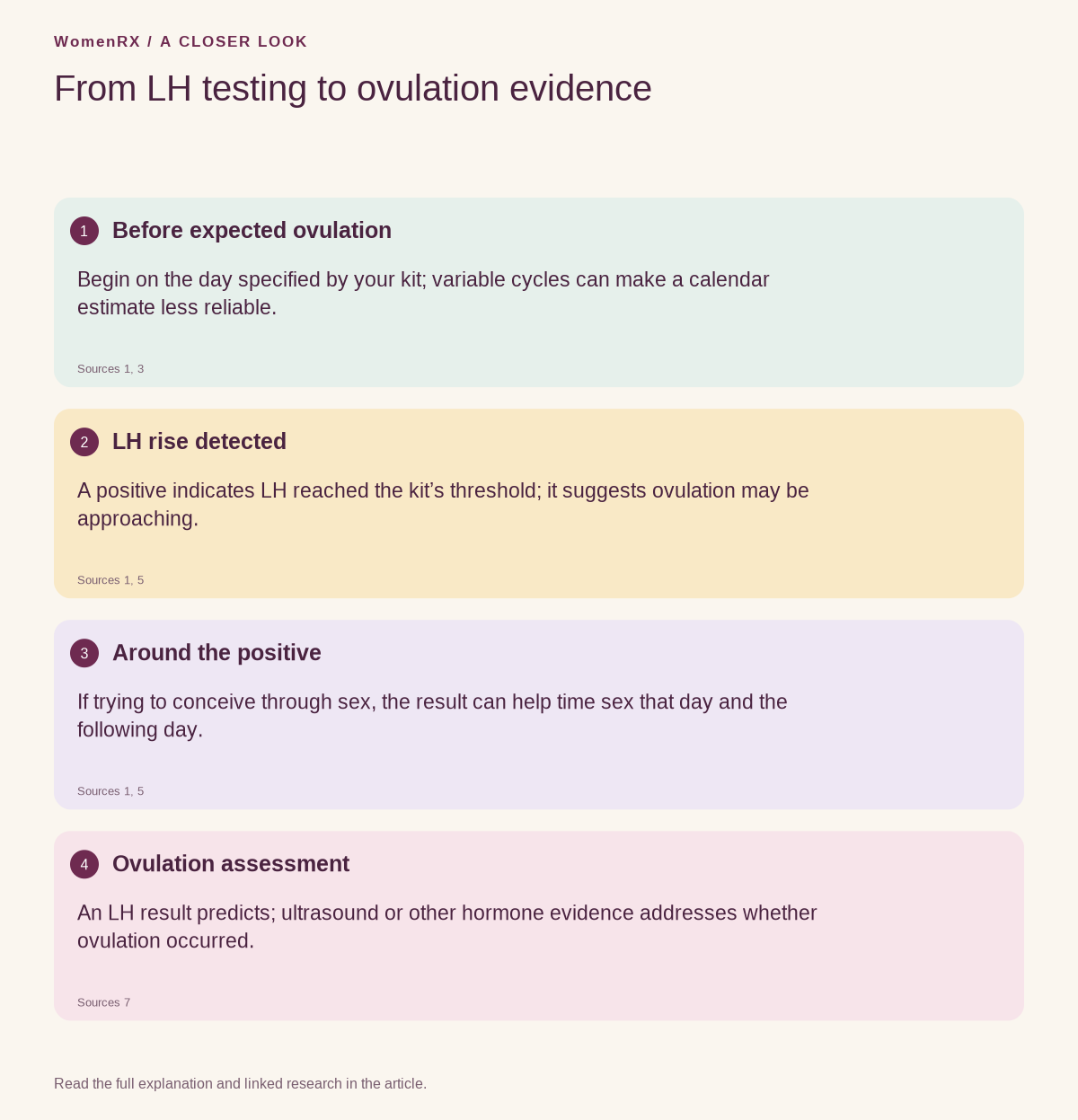
From LH testing to ovulation evidence
Before expected ovulation: Begin on the day specified by your kit; variable cycles can make a calendar estimate less reliable.13
LH rise detected: A positive indicates LH reached the kit’s threshold; it suggests ovulation may be approaching.15
Around the positive: If trying to conceive through sex, the result can help time sex that day and the following day.15
Ovulation assessment: An LH result predicts; ultrasound or other hormone evidence addresses whether ovulation occurred.7
Read the figure as text
The sequence shows what a urine LH test can predict, how to use a positive when trying to conceive, and why confirmation is a separate question.- Before expected ovulation: Begin on the day specified by your kit; variable cycles can make a calendar estimate less reliable.13
- LH rise detected: A positive indicates LH reached the kit’s threshold; it suggests ovulation may be approaching.15
- Around the positive: If trying to conceive through sex, the result can help time sex that day and the following day.15
- Ovulation assessment: An LH result predicts; ultrasound or other hormone evidence addresses whether ovulation occurred.7
More questions, answered
Does a positive OPK mean I’m ovulating right now?
Not necessarily. It detects an LH rise that often precedes ovulation; it doesn’t show that an egg has been released. The timing can vary, and the test’s threshold affects what counts as positive. 1 5
Can I use an OPK if I have PCOS?
You can use one, but persistent or fluctuating LH levels may make results harder to interpret. A positive may not reliably indicate that ovulation followed, so repeated uncertainty is a reason to ask about other ways to assess ovulation. 3 7
Sources you can check
- Quantification of urinary total luteinizing hormone immunoreactivity may improve the prediction of ovulation time.Demir A, Hero M, Holopainen E, Juul A. · Frontiers in endocrinology · 2022Return to first citation
- Validating ovulation prediction and confirmation with the Mira monitor: blinded ultrasound and serum hormone comparison.Bouchard TP, Bedaiwy M, Talhouk A, Nakhuda G, Yong PJ, Doyle-Baker PK. · Reproductive biomedicine online · 2026Return to first citation
- Digitally Enabled AI-Interpreted Salivary Ferning-Based Ovulation Prediction: Feasibility Study.Peebles E, Finlay W, Nguyen TM, Barrett S, Thirumalaraju P, Kanakasabapathy MK, Kandula H, Sarcione C, James KE, Shafiee H, Mahalingaiah S. · Journal of medical Internet research · 2025Return to first citation
- Identification of the LH surge by measuring intact and total immunoreactivity in urine for prediction of ovulation time.Demir A, Hero M, Alfthan H, Passioni A, Tapanainen JS, Stenman UH. · Hormones (Athens, Greece) · 2022Return to first citation
- Urinary Luteinizing Hormone Tests: Which Concentration Threshold Best Predicts Ovulation?Leiva RA, Bouchard TP, Abdullah SH, Ecochard R. · Frontiers in public health · 2017Return to first citation
- Timed intercourse for couples trying to conceive.Gibbons T, Reavey J, Georgiou EX, Becker CM. · The Cochrane database of systematic reviews · 2023Return to first citation
- Confirmation of human ovulation in assisted reproduction using an adhesive axillary thermometer (femSense®).Weiss G, Strohmayer K, Koele W, Reinschissler N, Schenk M. · Frontiers in digital health · 2022Return to first citation