How to Track Ovulation and Estimate Your Fertile Window
Cervical mucus and LH tests can help you look ahead; waking temperature is more useful for looking back.
The fertile window runs from approximately five days before ovulation to several hours afterward. Changes in cervical mucus can help you recognize it may be approaching, while a positive urine LH test is a near-term clue, not proof that ovulation happened. Waking-temperature changes tend to appear afterward, so they’re more useful for reviewing a pattern. Cycle dates offer an estimate, not a precise forecast. 145
The fertile window runs from approximately five days before ovulation to several hours afterward. Tracking is most useful when it helps you act before or around ovulation, rather than promising an exact ovulation day. 4
Four clues, with different jobs
| Sign or method | What it can tell you | Effort and common limitation |
|---|---|---|
| Cervical mucus | Changes in cervical mucus can signal the fertile part of the cycle is approaching. | Observe the sensation or appearance regularly. Interpretation is subjective, and mucus alone can be hard to read. 15 |
| Urine LH test | A positive test can give a near-term signal: one study found the first positive test was most useful for predicting ovulation within 24 hours. | Requires urine testing. A result can be missed or misleading; an LH surge is a clue, not proof that ovulation occurred. 15 |
| Waking temperature | A temperature change can support the impression that ovulation has already happened. | Requires consistent, repeated measurements. Temperature usually changes after ovulation, and environmental factors can complicate readings. 1 |
| Cycle dates | Past cycle lengths can be used to estimate when ovulation might occur. | Requires recording dates, and the estimate can be off when cycles vary. One calendar algorithm performed worse for participants with irregular cycles. 2 |
Cervical mucus: an early clue, not a date stamp
As the cycle approaches ovulation, estrogen-related changes can affect cervical mucus. Those changes may help you recognize that the fertile window is near. But judging mucus involves personal observation, and research describes it as subjective. Treat it as a useful clue, not a precise way to name the day of ovulation. 15
LH tests: a heads-up, not confirmation
Urine ovulation tests detect a rise in luteinizing hormone (LH). A positive result is associated with ovulation soon, and one study found that predicting within 24 hours worked best when using the first single positive test. But the result doesn’t confirm that an egg was released. False readings can occur, and relying on LH alone to decide the fertile window has ended can be misleading. 15
If you’re using a test to time intercourse, combine it with what your body is showing rather than waiting for a perfect prediction. A Cochrane review found that, among couples trying to conceive, using urine ovulation tests to time intercourse probably improved pregnancy and live-birth outcomes compared with intercourse without ovulation prediction. That’s a benefit on average, not a guarantee for an individual. 4
Waking temperature: better for looking back
Ordinary basal, or waking, temperature isn’t a strong early warning for the current fertile window. The temperature change may not appear until one or two days after ovulation, so it’s better understood as supporting a retrospective pattern than as a way to anticipate ovulation in time. Recording it consistently takes effort, and environmental conditions can affect readings. 1
A study of a finger-worn tracker that estimates ovulation from physiology is a different kind of tracking. Its findings shouldn’t be taken as proof that a regular waking-temperature chart predicts ovulation equally well. 12
Cycle dates: a starting estimate
Calendar methods use cycle history to estimate ovulation. They can provide a broad starting point, but they don’t directly detect an LH rise, mucus changes, or ovulation itself. In a study comparing a physiology-based wearable estimate with a calendar algorithm, the calendar estimate was less accurate in participants with irregular cycles. That comparison doesn’t establish that every app or calendar performs the same way. 2
Put the clues together without chasing certainty
For example, if you notice changes in cervical mucus, you can treat it as a reason to try intercourse during the coming days rather than wait for an exact ovulation date. An LH test can add a near-term clue for timing intercourse, but a positive result neither proves ovulation nor means you should ignore mucus. A later temperature shift can help you review what may have happened. If cycle dates are irregular, avoid treating a calendar estimate as a precise schedule. 1245
Your circumstances can change what a cycle-date estimate means. With irregular cycles, past dates are a less dependable forecast. 2 Some hormonal contraceptives work by stopping ovulation, so their use changes what an ovulation forecast can mean. 6
After childbirth, if your periods have not returned, you have no recent cycle dates for a calendar estimate. Once they resume, varying cycle lengths can make that estimate less dependable. Mucus changes and LH tests may offer clues within a current cycle, but neither confirms ovulation. 1235 Research on using fertility-awareness methods to prevent pregnancy postpartum does not establish how accurately these signs time conception. 3
If you are in perimenopause and your cycle lengths vary, treat calendar dates as a rough estimate rather than a schedule. Mucus changes and LH tests may offer clues within a current cycle, but a positive LH test still does not confirm ovulation. 125
No single sign pinpoints ovulation with certainty. The practical distinction is that mucus and LH tests can help you look ahead, while waking temperature is more useful for looking back. Use the method you can sustain, and treat the result as an estimate rather than a promise.
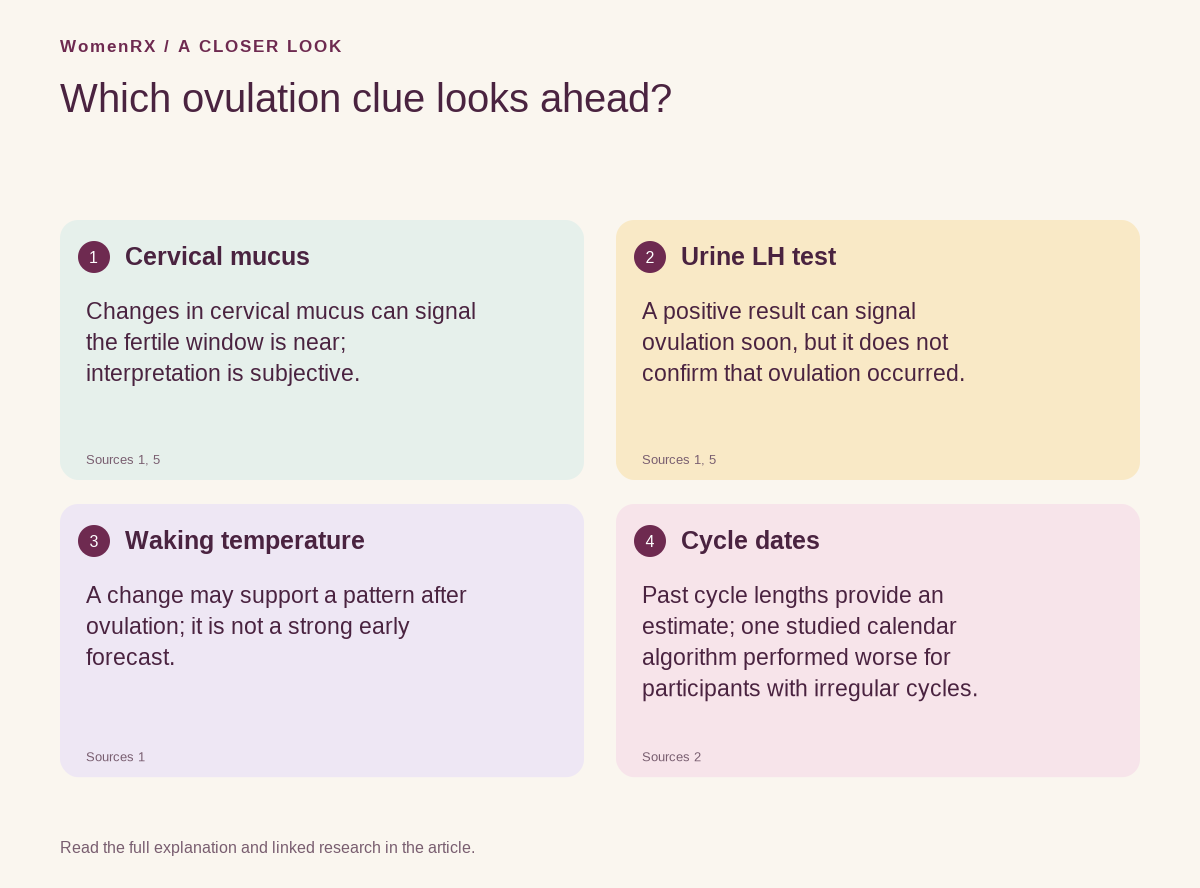
Which ovulation clue looks ahead?
Cervical mucus: Changes in cervical mucus can signal the fertile window is near; interpretation is subjective.15
Urine LH test: A positive result can signal ovulation soon, but it does not confirm that ovulation occurred.15
Waking temperature: A change may support a pattern after ovulation; it is not a strong early forecast.1
Cycle dates: Past cycle lengths provide an estimate; one studied calendar algorithm performed worse for participants with irregular cycles.2
Read the figure as text
The signs differ in timing: some may help you anticipate the fertile window, while temperature is more useful for reviewing a pattern afterward.- Cervical mucus: Changes in cervical mucus can signal the fertile window is near; interpretation is subjective.15
- Urine LH test: A positive result can signal ovulation soon, but it does not confirm that ovulation occurred.15
- Waking temperature: A change may support a pattern after ovulation; it is not a strong early forecast.1
- Cycle dates: Past cycle lengths provide an estimate; one studied calendar algorithm performed worse for participants with irregular cycles.2
More questions, answered
Does a positive ovulation test confirm that I ovulated?
No. It detects an LH rise associated with ovulation soon, but it doesn’t prove ovulation occurred. Waking-temperature patterns may offer retrospective support, though they aren’t a precise forecast. 15
Can I rely on a calendar app if my cycles are irregular?
Be cautious about treating its date as precise. A study of one calendar algorithm found it performed worse in participants with irregular cycles; that result doesn’t tell us how every app performs. 2
Sources you can check
- The effectiveness of cervical mucus electrical impedance compared to basal body temperature to determine fertility window.Tabbaa S, Hambright S, Sikes KJ, Levy G, Rydfors J. · Contraception and reproductive medicine · 2024Return to first citation
- Oura Ring as a Tool for Ovulation Detection: Validation Analysis.Thigpen N, Patel S, Zhang X. · Journal of medical Internet research · 2025Return to first citation
- Effectiveness of fertility awareness-based methods for pregnancy prevention during the postpartum period.Redmond JJ, Jensen ET, Stanford JB, Greene ME, Kennedy E, Urrutia RP. · Contraception · 2022Return to first citation
- Timed intercourse for couples trying to conceive.Gibbons T, Reavey J, Georgiou EX, Becker CM. · The Cochrane database of systematic reviews · 2023Return to first citation
- Urinary Luteinizing Hormone Tests: Which Concentration Threshold Best Predicts Ovulation?Leiva RA, Bouchard TP, Abdullah SH, Ecochard R. · Frontiers in public health · 2017Return to first citation
- Periods and fertility in the menstrual cycle - NHSAccessed 2026-09-25Return to first citation