How to Estimate Your Daily Energy Needs
An energy-needs estimate is a starting point, not a precise calorie prescription; your weight trend and activity help put it in context.
You can estimate resting energy needs with an equation using age, weight, and height, then multiply that estimate by a physical activity level (PAL) to approximate total daily energy expenditure (TDEE). To choose a PAL, use a calculator that shows its activity assumption and base it on your usual full day, not exercise alone. A hypothetical example shows how the multiplication works; the result is still only an estimate. 3 4
What a daily energy estimate is measuring
TDEE is the energy your body uses across a day. It includes energy used at rest, the cost of digesting food, and energy used in activity. Resting energy expenditure (REE) is only one part of that total. A common estimation approach predicts REE from personal characteristics, then accounts for activity to estimate daily needs. 1 3
That distinction matters if a calculator gives you one neat number. It is a model-based estimate, not a direct measurement of what your body uses each day. In reference methods, daily energy needs are estimated from resting needs and a physical activity level. Activity level is itself an approximation, and everyday movement can vary from day to day. 3
A practical way to make the estimate
One published option for estimating REE is the Mifflin equation. For the female version listed in a study of prediction equations, use your weight in kilograms, height in centimeters, and age in years:
REE (kcal/day) = 9.99 × weight (kg) + 6.25 × height (cm) − 4.92 × age (years) − 161. 4
For a purely illustrative calculation, someone who weighs 70 kg, is 165 cm tall, and is 40 years old gets an estimated REE of about 1,373 kcal/day. That is the estimate for resting energy expenditure, not her total daily needs.
To estimate TDEE, multiply the REE result by a physical activity level (PAL): TDEE ≈ REE × PAL. A practical way to choose a PAL is to use a calculator that displays its activity setting or multiplier, then select the option that best reflects your usual whole day: time spent resting or sitting, moving around, and doing planned exercise. Don’t base it on workouts alone. PAL can also be estimated from time spent at different activity levels across the day; it remains an approximation, not a direct measurement of your exact energy use. 3
To complete the example, suppose a calculator uses a PAL of 1.5 for the person's typical activity. This is a hypothetical factor for showing the arithmetic, not a recommended PAL for you: 1,373 × 1.5 ≈ 2,060 kcal/day. A calculator that shows its activity assumption makes this step easier to interpret. If it gives only a final number, you may not know which activity assumption shaped it.
Why your estimate may not match your body
Equations use factors such as age, weight, height, and, in some formulas, a sex category. They describe patterns in groups of people, so an individual result can differ from actual energy expenditure. A scoping review of energy-reference methods found that estimating requirements is challenging because existing methods are not fully accurate or precise and multiple factors influence the result. 3 4
The difference is especially clear in a study of adults with severe obesity: researchers compared 11 REE prediction equations with indirect calorimetry in 780 participants, including 632 women and 148 men. No equation was within 10% of measured REE for more than 67.8% of the sample, and no single equation performed best in every subgroup. These findings apply to REE prediction in that study population, not to every adult or to TDEE directly. They do show why a calculator result should not be mistaken for an exact personal measurement. 4
Your needs can also shift. Body composition affects energy expenditure, and changes in body weight and activity can change the relationship between resting needs and total daily expenditure. So even a useful estimate may become less representative after a substantial change in routine or body weight. 1
Use the number as a starting point, then check the pattern
If you use an estimate, first treat it as a rough reference rather than a target you must hit exactly. Then compare it with what happens over time:
- Broadly stable weight: Your usual intake and expenditure may be near balance over that period. If your usual intake is roughly the estimate, the number may be a reasonable maintenance starting point.
- A sustained upward trend: Your usual intake may be above your expenditure. If you're eating roughly the estimated amount, the estimate may be higher than your current maintenance needs.
- A sustained downward trend: Your usual intake may be below your expenditure. If you're eating roughly the estimated amount, the estimate may be lower than your current maintenance needs.
- A meaningful activity change: Recalculate with an activity level that fits your current routine, then use the weight pattern to judge the new estimate. Activity contributes to total expenditure. 1 3
A single weigh-in cannot tell you whether an estimate is accurate. Look for a repeated pattern rather than making a decision from one reading. For example, if someone’s routine becomes more active and their weight trend shifts, it makes sense to reassess the estimate rather than assume the original number still fits. This is a way to interpret the estimate, not a precise formula for calculating a calorie adjustment.
Pregnancy and lactation call for a different purpose
Standard nonpregnant-adult estimates do not account for the additional energy needs of pregnancy or lactation. Reference methods treat these life stages separately, so an ordinary adult calculator number should not be assumed to represent your needs during either one. 2 3
Pregnancy guidance may add energy needs associated with pregnancy to the baseline needs of a nonpregnant woman, while lactation also has distinct energy requirements. The available guidance does not make a general calculator a substitute for individualized pregnancy or postpartum nutrition planning. If you are pregnant or breastfeeding, use a life-stage-specific approach rather than relying on a standard adult estimate. 2 3
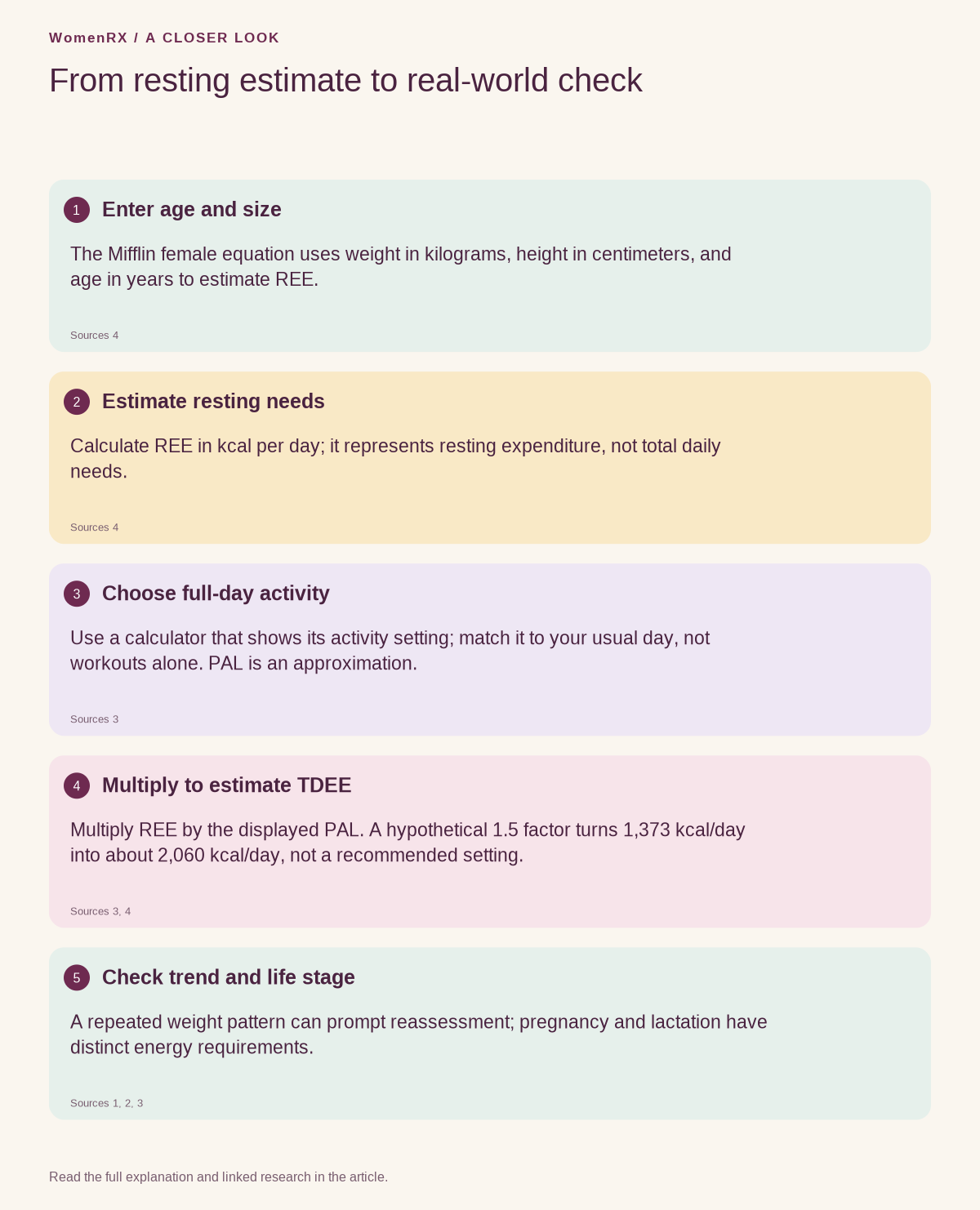
From resting estimate to real-world check
Enter age and size: The Mifflin female equation uses weight in kilograms, height in centimeters, and age in years to estimate REE.4
Estimate resting needs: Calculate REE in kcal per day; it represents resting expenditure, not total daily needs.4
Choose full-day activity: Use a calculator that shows its activity setting; match it to your usual day, not workouts alone. PAL is an approximation.3
Multiply to estimate TDEE: Multiply REE by the displayed PAL. A hypothetical 1.5 factor turns 1,373 kcal/day into about 2,060 kcal/day, not a recommended setting.34
Check trend and life stage: A repeated weight pattern can prompt reassessment; pregnancy and lactation have distinct energy requirements.123
Read the figure as text
Follow the calculation from personal details to an approximate TDEE, including how to choose an activity assumption, then consider the weight trend and whether activity or life stage has changed.- Enter age and size: The Mifflin female equation uses weight in kilograms, height in centimeters, and age in years to estimate REE.4
- Estimate resting needs: Calculate REE in kcal per day; it represents resting expenditure, not total daily needs.4
- Choose full-day activity: Use a calculator that shows its activity setting; match it to your usual day, not workouts alone. PAL is an approximation.3
- Multiply to estimate TDEE: Multiply REE by the displayed PAL. A hypothetical 1.5 factor turns 1,373 kcal/day into about 2,060 kcal/day, not a recommended setting.34
- Check trend and life stage: A repeated weight pattern can prompt reassessment; pregnancy and lactation have distinct energy requirements.123
More questions, answered
Does an estimate account for exercise?
Usually, activity is incorporated after resting energy expenditure is estimated, often through a general activity level. Choose a calculator setting that reflects your usual full day, including everyday movement as well as workouts; activity categories are still approximate. 3
Is a calorie calculator more accurate for women?
Not necessarily. Some equations use a sex category, but that alone doesn’t establish that a calculator is more accurate for women. In a study of adults with severe obesity, equations were tested in 632 women and 148 men; no single equation performed best in every subgroup. The study did not establish a general accuracy advantage for women. 4
Sources you can check
- The Physiology Of the WEight Reduced State (POWERS) study: assessing energy balance.Rosenbaum M, Allison KC, Laughlin MR, Whyte K, Jakicic JM, Mayer LES, Ashby-Thompson M, Hayes MR, Speakman J, Leibel RL, Das SK, Gallagher D, Roberts SB, POWERS Consortium. · International journal of obesity (2005) · 2025Return to first citation
- The Dietary Reference Intakes for Japanese (2025): Overview and Future Directions for the Pregnant and Lactating Women's Section.Kasuga Y, Sugiyama T, Sasaki S, Asakura K. · The journal of obstetrics and gynaecology research · 2026Return to first citation
- Energy - a scoping review for the Nordic Nutrition Recommendations 2023 project.Cloetens L, Ellegård L. · Food & nutrition research · 2023Return to first citation
- Comparison of Resting Energy Expenditure Prediction Equations and Indirect Calorimetry Among Adults with Severe Obesity.Rather SW, Lawson PS, Larsen JD, Braathen DL, Mabey JG, LeCheminant JD, Adams TD, Hunt SC, Davidson LE. · Current developments in nutrition · 2025Return to first citation