TDEE Calculator for Women: Estimate Your Daily Energy Needs
See how age, height, weight, and everyday activity change an estimate, with the calculation explained.
Your daily energy estimate depends on body size, age and activity. This calculator uses published adult female energy-requirement equations and shows four activity scenarios. Use the result as a starting point for maintaining weight. It is an estimate of daily needs, not a measurement of your metabolism or an automatic weight-loss target. 16
Your daily energy estimate
For women age 19 or older. Choose your units, then compare four activity scenarios. Your entries stay in this page.
Start with your usual day
Enter your age, height and weight in the calculator. Then compare the activity scenarios. The equations use years, centimeters and kilograms, and this version covers women age 19 or older who are not pregnant or breastfeeding. Pregnancy and lactation have separate energy calculations. 14
Activity includes movement across a whole day. Health Canada's examples are more specific than “I work out sometimes”:
| Category | Example daily activity pattern |
|---|---|
| Inactive | Ordinary daily tasks, including some walking |
| Low active | Daily tasks plus 60 to 80 minutes walking at 5 to 7 km/h |
| Active | Daily tasks plus 30 to 50 minutes walking, 45 minutes moderate cycling and 40 minutes doubles tennis |
| Very active | Daily tasks plus 45 minutes moderate cycling, 25 minutes jogging and 60 minutes doubles tennis |
These are examples to help interpret the categories, not a suggested exercise schedule. 14
If you are between categories, compare both results if one label does not describe your routine well. It can help to think separately about workdays and days off, then choose the scenario that best resembles the pattern you repeat.
A worked example
For a woman age 45, height 165 cm, and weight 80 kg, the four estimates round to:
| Activity category | Estimated kcal per day |
|---|---|
| Inactive | 2,150 |
| Low active | 2,320 |
| Active | 2,460 |
| Very active | 2,700 |
The inactive calculation is 584.90 - (7.01 × 45) + (5.72 × 165) + (11.71 × 80) = 2,150.05. Rounding avoids making the result look more precise than an estimate can be. Each activity category uses its own published equation. 16
That spread is useful. With the same age and measurements, the activity assumption changes the answer substantially. You can inspect the assumptions instead of treating a single result as a verdict on what you should eat.
Use the estimate alongside what actually happens
Body-weight stability, gain or loss helps indicate whether energy intake matches needs. A calculated number is a starting hypothesis to compare with that real-world pattern. 14
Keep the comparison consistent. A note with the estimate, your usual activity and your weight pattern is easier to revisit than a succession of unrelated calculator results. If your routine changes, calculate again with the new inputs. You do not need to change several assumptions at once just to make a number fit your expectations.
If you want to model a weight-change goal and a time frame, NIDDK's Body Weight Planner is a separate tool designed for that purpose. It models both reaching a goal and maintaining it afterward. It is for adults and excludes pregnancy and breastfeeding. 15
What this version leaves out
This page has no field for cycle day or menopause stage and applies no extra hormone multiplier. You can see every input it uses. That transparency matters more than attaching an unexplained adjustment to a life stage.
The calculator also does not choose a calorie deficit, set a deadline or diagnose why weight has changed. Its job is narrower and useful: make the starting estimate visible, show how activity affects it, and give you a calculation you can revisit.
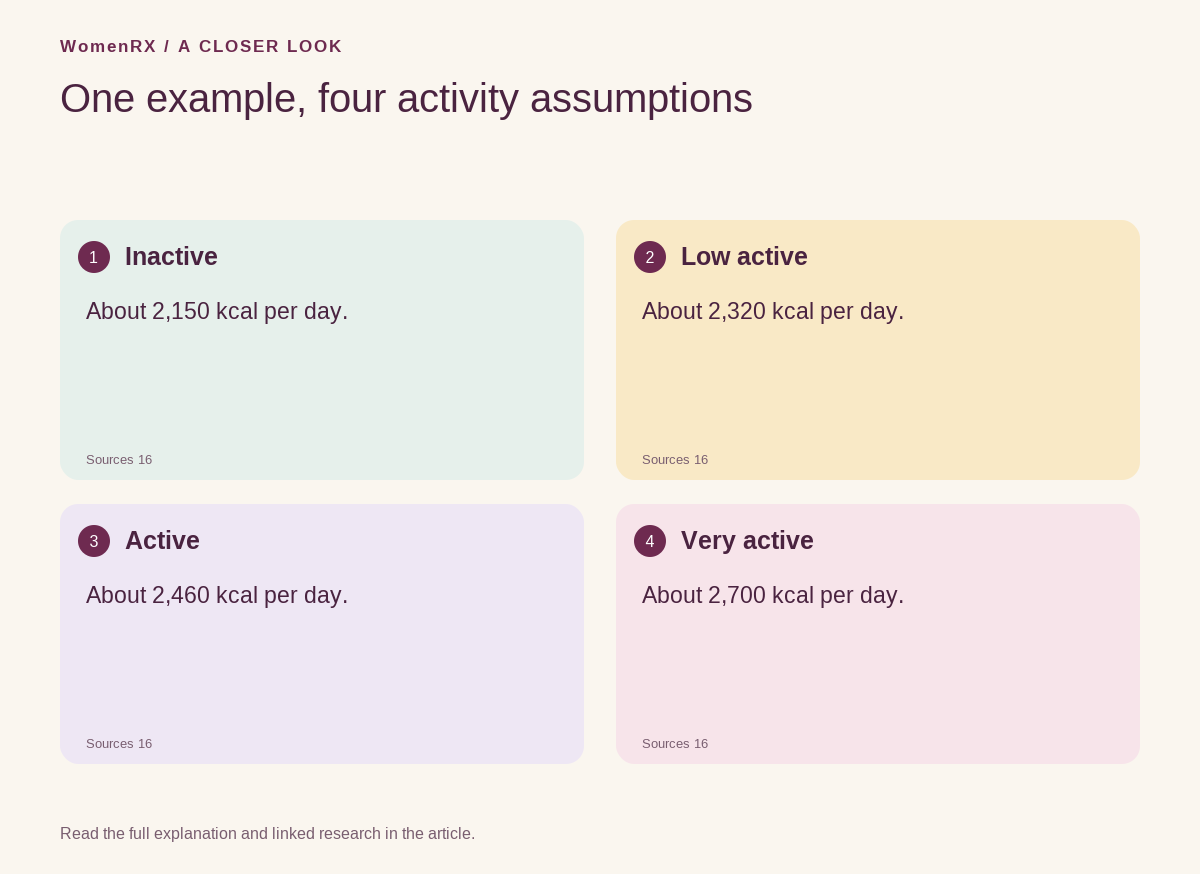
One example, four activity assumptions
Inactive: About 2,150 kcal per day.16
Low active: About 2,320 kcal per day.16
Active: About 2,460 kcal per day.16
Very active: About 2,700 kcal per day.16
Sources you can check
- Health Canada: Dietary Reference Intake energy equationsAccessed 2026-09-26Return to first citation
- NIDDK: About the Body Weight PlannerAccessed 2026-09-26Return to first citation
- National Academies, 2023: adult energy equations, Table 5-16Accessed 2026-09-26Return to first citation