What a Calorie Deficit Calculator Can Tell You
A calorie calculator can give you a starting estimate, but its daily target isn’t a measurement of your metabolism.
A calorie calculator predicts energy use from details you enter; it doesn’t measure your metabolism. If a tool subtracts a chosen amount from its daily estimate to suggest a weight-loss target, that target is another calculation, not a personal prescription. Check which number you’re seeing, and treat it as a rough starting point. 35
Know which number you’re looking at
A calculator may show resting energy expenditure, total daily energy expenditure, or a calorie target for weight loss. They aren’t interchangeable. Resting expenditure is the energy your body uses at rest. Total expenditure also reflects activity and the energy used to process food. If a tool proposes a deficit by subtracting from estimated total expenditure, the resulting target is a calculation, not a separate measurement. 45
That distinction matters when a result looks surprisingly low. If the number is labeled resting, it isn’t an estimate of everything you use during a normal day. If it’s labeled maintenance, the calculator is estimating the intake that would balance expenditure at a stable body weight. A weight-loss target may add a further assumption about eating below that estimate. 51
How your details become an estimate
Common predictive equations use details such as age, height, weight, and sex. Some estimate energy used at rest and then account for activity; others estimate total daily expenditure directly. A calculator asking you to choose an activity level is asking you to describe something that can be hard to capture in a single category. 35
Even accurate entries can’t make the output exact. Two people with similar height and weight can differ in body composition, which can affect energy used at rest. Activity adds another source of variation to total daily expenditure. 35
This isn’t just a matter of a calculator choosing the “wrong” formula. In a study of 56 relatively lean adults with varied, often high activity levels, researchers compared predictions from ten models with total expenditure measured using doubly labeled water. Even the model that performed best for the group predicted within 10% of the measured value for only about 43% of participants. The study included 27 women and 29 men; its result illustrates individual uncertainty, not the accuracy of every calculator. 5
What to do with a result
First, check whether the displayed number means resting, maintenance, or weight loss. Then ask whether the calculator’s assumptions resemble your life. For example, choosing “lightly active” may be a poor description if your days alternate between a desk job and long, physically demanding shifts. Changing that selection changes the estimate; it doesn’t reveal which selection measures you correctly. Activity is a variable part of daily expenditure and is difficult to predict precisely. 5
For a nonpregnant adult considering weight loss, the result can help frame a question about energy balance. It can’t establish that a particular intake is right for you or promise a particular rate of weight change. Body weight is influenced by more than the numbers entered into an equation, including activity, health conditions, and medicines. 15
When an adult weight-loss target is the wrong shortcut
Pregnancy: Pregnancy isn’t the time to use a generic calorie-deficit target as a diet plan. Weight change and nutrition needs during pregnancy call for advice tailored to the pregnancy, and a calorie number alone cannot tell you whether you’re meeting pregnancy-specific nutrient needs. 62
Breastfeeding: Breastfeeding generally increases calorie needs, but the additional amount varies with factors including activity and whether you’re exclusively breastfeeding or also using formula. A generic deficit may miss those needs. If you want to change your weight while breastfeeding, seek nutrition advice that accounts for how you’re feeding your baby and your own health. 7
Adolescence or a history of disordered eating: The adult expenditure estimates discussed here aren’t a weight-loss plan for a teenager. If you’re under 18 and have questions about your weight or nutrition, get advice suited to your age rather than adopting an adult calculator target. 35 If calorie numbers have made eating harder for you before, you can leave the calculator aside. You don’t need a calorie target to take your health seriously.
The useful boundary is simple: a calculator can organize an estimate, but it can’t measure your day-to-day energy use or decide whether pursuing a deficit fits your situation. 5
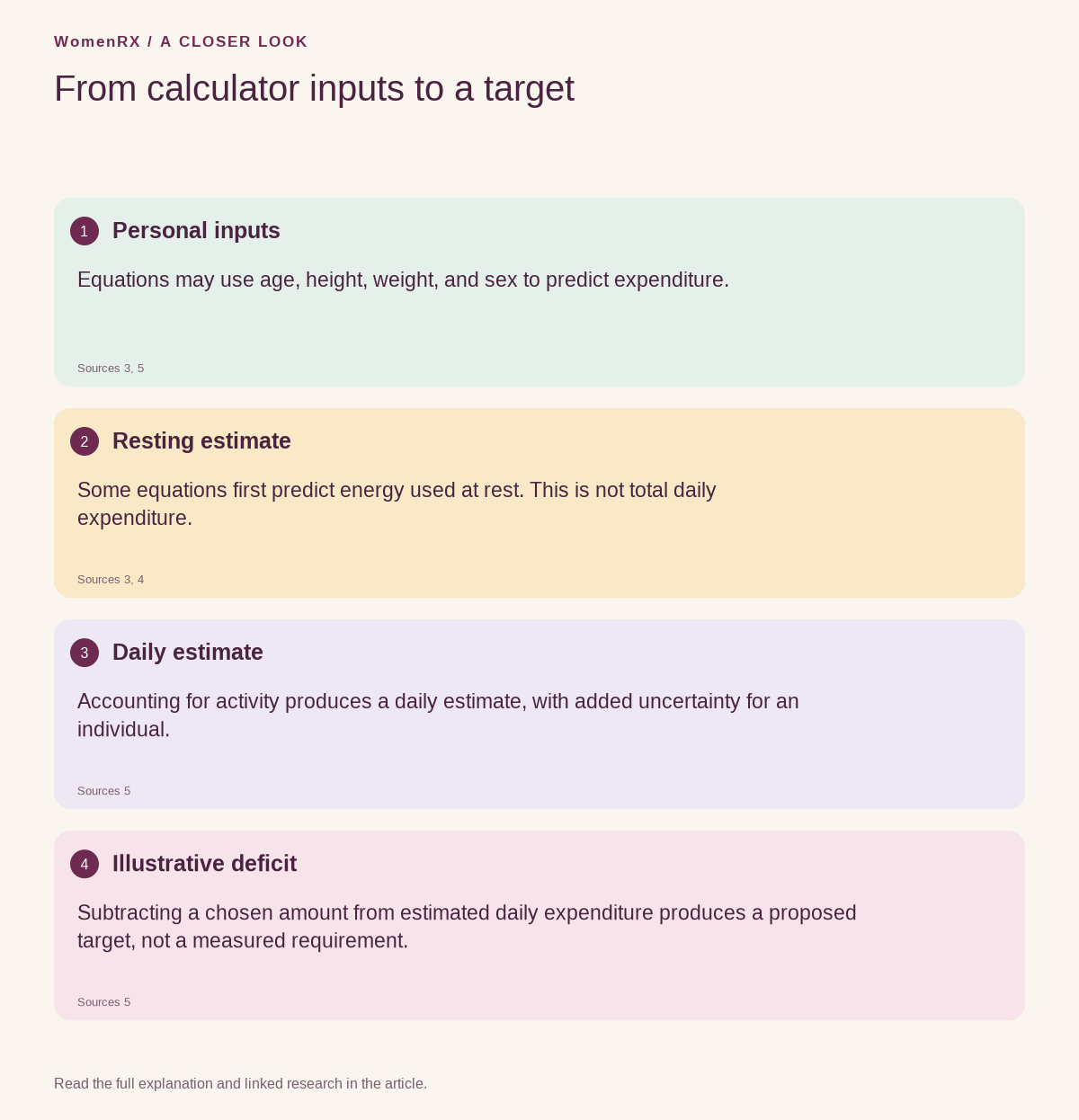
From calculator inputs to a target
Personal inputs: Equations may use age, height, weight, and sex to predict expenditure.35
Resting estimate: Some equations first predict energy used at rest. This is not total daily expenditure.34
Daily estimate: Accounting for activity produces a daily estimate, with added uncertainty for an individual.5
Illustrative deficit: Subtracting a chosen amount from estimated daily expenditure produces a proposed target, not a measured requirement.5
Read the figure as text
Each step adds an assumption; none turns the result into a measurement of your personal calorie needs.- Personal inputs: Equations may use age, height, weight, and sex to predict expenditure.35
- Resting estimate: Some equations first predict energy used at rest. This is not total daily expenditure.34
- Daily estimate: Accounting for activity produces a daily estimate, with added uncertainty for an individual.5
- Illustrative deficit: Subtracting a chosen amount from estimated daily expenditure produces a proposed target, not a measured requirement.5
More questions, answered
Is resting metabolism the same as maintenance calories?
No. Resting expenditure covers energy used at rest; a maintenance estimate aims to account for total daily expenditure, including activity. Check the label before interpreting the number. 45
Sources you can check
- Obesity: MedlinePlusAccessed 2026-09-25Return to first citation
- Dietary Supplements and Life Stages: Pregnancy - Health Professional Fact SheetAccessed 2026-09-25Return to first citation
- [Resting Energy Expenditure Assessment in Adults with Obesity: Limitations of Commonly Used Predictive Equations].Averkina AA, Rafaelyan MG, Vasyukova OV, Guseinova RM, Okorokov PL, Burmitskaya YV, Romanova VA, Kopytina DA, Atavina-Ermakova EP, Mokrysheva NG. · Problemy endokrinologii · 2026Return to first citation
- Energy Expenditure in Upper Gastrointestinal Cancers: a Scoping Review.Hanna L, Porter J, Bauer J, Nguo K. · Advances in nutrition (Bethesda, Md.) · 2023Return to first citation
- Validity of predictive equations for total energy expenditure against doubly labeled water.Prado-Nóvoa O, Howard KR, Laskaridou E, Zorrilla-Revilla G, Reid GR, Marinik EL, Davy BM, Stamatiou M, Hambly C, Speakman JR, Davy KP. · Scientific reports · 2024Return to first citation
- Weight gain in pregnancy - NHSAccessed 2026-09-25Return to first citation
- Maternal Diet and Breastfeeding | Breastfeeding special circumstances | CDCAccessed 2026-09-25Return to first citation