What a Weight-Loss Protein Calculator Can Tell You
A protein calculator can show how a reference translates into grams, but it can’t decide which reference fits your health and goals.
A protein calculator multiplies a body weight by a chosen grams-per-kilogram reference. That makes the math transparent, not personal: weight-loss research doesn’t establish one target for every adult. Age and health context affect how you interpret the result. If you have chronic kidney disease, a general calculator cannot settle your intake. 57 Adult weight-loss trials don’t set pregnancy- or breastfeeding-specific targets either. 34
Start with the number behind the number
A useful calculator should show two things: the weight it used and the protein reference it multiplied that weight by. If the reference is expressed as grams per kilogram of body weight per day, changing either input changes the answer. The result is an estimate under those assumptions, not a measure of what your body needs.
For example, a 2026 commentary describes the 2025-2030 Dietary Guidelines for Americans as recommending 1.2-1.6 grams per kilogram per day. Enter 70 kg (about 154 pounds), and that range works out to 84-112 grams per day. Use 80 kg instead, and the same multiplication gives 96-128 grams. The arithmetic is straightforward; choosing the weight and reference that belong in your calculation is the harder part. The commentary’s authors also question whether weight-loss studies justify applying one higher-protein range to everyone. 7
This is why a result without its method is hard to use. A tool that says “112 grams” but doesn’t disclose its weight input or reference leaves you unable to tell whether a different result reflects different math or a different assumption.
Weight loss and protein are related, but not interchangeable
You might be thinking about protein because you want to lose weight without losing as much muscle. That’s a more specific question than “How much protein causes weight loss?” In a systematic review of 20 randomized trials involving adults older than 50 who were deliberately losing weight, higher-protein diets were associated with more lean mass retained and more fat mass lost than lower-protein diets. The review grouped diets using protein as a share of energy intake or a grams-per-kilogram threshold. Those study cutoffs aren’t, by themselves, a personal prescription, and the findings do not establish a protein target specifically for women. 3
A separate review looked at advice to follow higher-protein, lower-carbohydrate diets in adult weight-loss studies with at least 12 months of follow-up. Across 32 studies involving 3,492 people, the average advantages in weight and fat loss were small, each equivalent to about 0.4 kg compared with the comparison diets. Because the diet advice changed carbohydrate as well as protein, that result doesn’t isolate what protein alone accomplished. More protein, in other words, is not a guarantee of more weight loss. 4
Which details change how useful the estimate is?
Body weight changes the math. A grams-per-kilogram calculator gives a larger number when you enter a larger weight, even if the reference stays the same. It can show that calculation, but it can’t determine from weight alone whether that reference suits you. 7
Age changes the question you may be trying to answer. If preserving lean mass during weight loss is a priority, the review of adults older than 50 is relevant evidence. It still does not identify the right intake for every older woman. Research on community-dwelling adults over 50 living with multiple long-term conditions found too little evidence to determine how protein intake affected body composition and physical function in that group. 36
Activity needs an explained rule, not a mystery adjustment. An activity box may change a calculator’s output, but the weight-loss reviews cited here do not establish a specific activity multiplier for an individual protein target. If a tool raises your number because you selected “active,” look for the reference and calculation it used. Otherwise, treat that extra precision as an unexplained assumption. 34
Health context can make a general result less applicable. Protein intake in chronic kidney disease (CKD) is not settled by a standard weight-loss calculator. A review of six longitudinal studies in community-dwelling adults 65 and older found insufficient evidence to determine how protein intake affected kidney function over time in people with normal kidney function or nondialysis CKD. CKD can also have no early symptoms; blood and urine tests, rather than how you feel, help establish whether it’s present. 125 For community-dwelling adults 65 and older with nondialysis CKD, this review does not establish a protein target, so a general weight-loss calculator cannot settle their intake. The review does not address younger adults with CKD or people on dialysis. If you have CKD, ask your kidney care clinician for individualized protein guidance rather than use the calculator result as a target. 5
Pregnancy and breastfeeding present a different boundary: the adult weight-loss reviews above don’t establish protein targets for either stage. A number calculated from those studies is therefore not a pregnancy- or breastfeeding-specific estimate or a target for either stage. 34
The most useful way to read a calculator result is as a sentence you can check: “Using this weight and this reference, the estimate is this many grams per day.” If the tool won’t show you that sentence, it hasn’t shown you enough to judge the number.
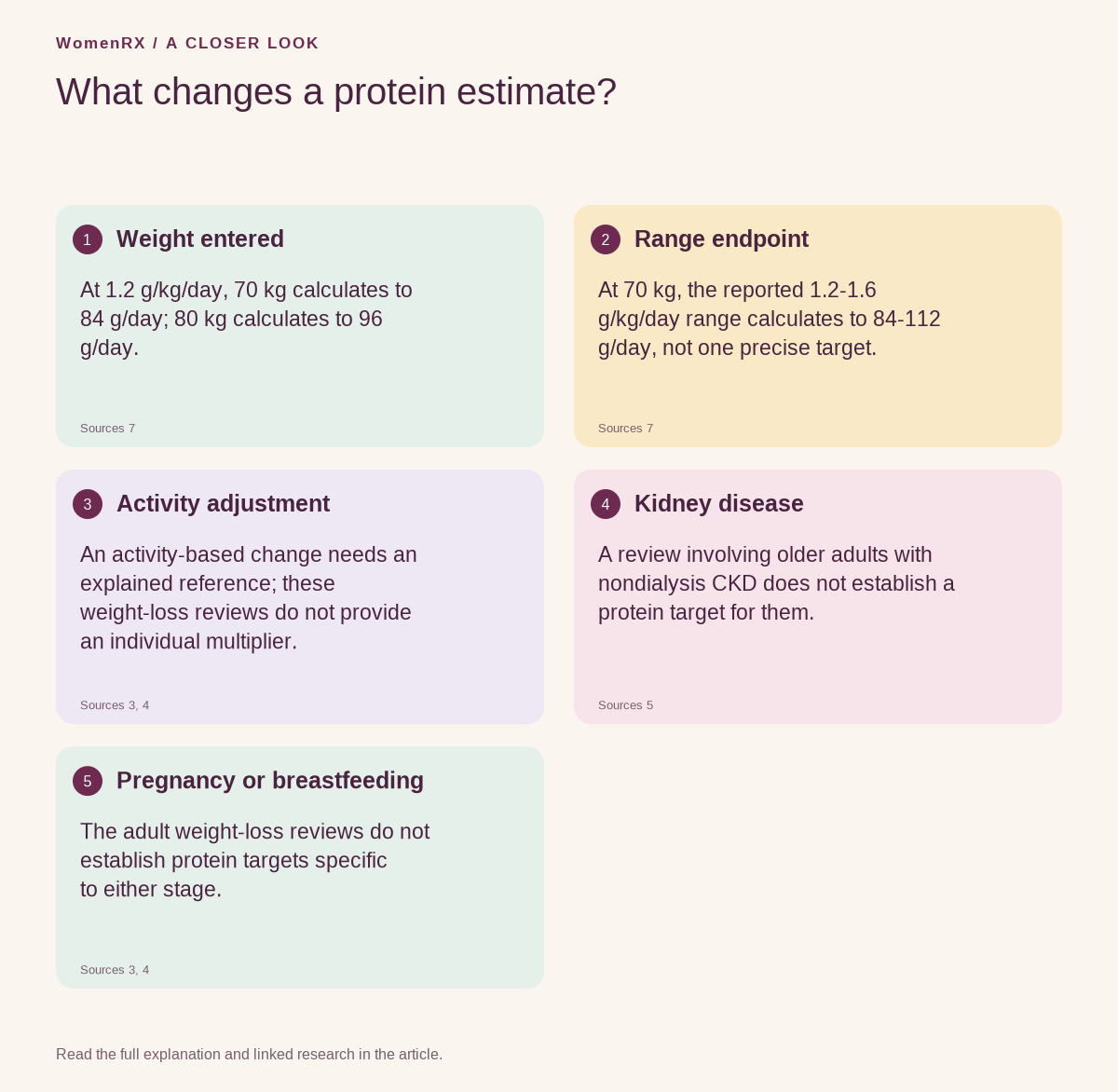
What changes a protein estimate?
Weight entered: At 1.2 g/kg/day, 70 kg calculates to 84 g/day; 80 kg calculates to 96 g/day.7
Range endpoint: At 70 kg, the reported 1.2-1.6 g/kg/day range calculates to 84-112 g/day, not one precise target.7
Activity adjustment: An activity-based change needs an explained reference; these weight-loss reviews do not provide an individual multiplier.34
Kidney disease: A review involving older adults with nondialysis CKD does not establish a protein target for them.5
Pregnancy or breastfeeding: The adult weight-loss reviews do not establish protein targets specific to either stage.34
Read the figure as text
Compare how the entered weight and endpoints of one reported range change the arithmetic, then see which assumptions the calculation cannot resolve.- Weight entered: At 1.2 g/kg/day, 70 kg calculates to 84 g/day; 80 kg calculates to 96 g/day.7
- Range endpoint: At 70 kg, the reported 1.2-1.6 g/kg/day range calculates to 84-112 g/day, not one precise target.7
- Activity adjustment: An activity-based change needs an explained reference; these weight-loss reviews do not provide an individual multiplier.34
- Kidney disease: A review involving older adults with nondialysis CKD does not establish a protein target for them.5
- Pregnancy or breastfeeding: The adult weight-loss reviews do not establish protein targets specific to either stage.34
More questions, answered
Is a research study’s protein cutoff the amount I should aim for?
No. A cutoff used to compare higher- and lower-protein diets tells you how researchers grouped those diets. It does not, on its own, establish your individual requirement or account for your health circumstances. 36
Sources you can check
- Chronic Kidney Disease | Kidney Disease | CKD | MedlineplusAccessed 2026-09-25Return to first citation
- Chronic kidney disease - Diagnosis - NHSAccessed 2026-09-25Return to first citation
- Effects of dietary protein intake on body composition changes after weight loss in older adults: a systematic review and meta-analysis.Kim JE, O'Connor LE, Sands LP, Slebodnik MB, Campbell WW. · Nutrition reviews · 2016Return to first citation
- Long term weight maintenance after advice to consume low carbohydrate, higher protein diets--a systematic review and meta analysis.Clifton PM, Condo D, Keogh JB. · Nutrition, metabolism, and cardiovascular diseases : NMCD · 2014Return to first citation
- Association Between Dietary Protein Intake and Kidney Function in Community-Dwelling Older Adults: A Systematic Review.Al Qannas F, Nurgozhina M, Owen A, Gasevic D, Polkinghorne KR, Bongetti E, Chen Y, Wild H. · Nutrition reviews · 2026Return to first citation
- Evidence on protein intake on lean body mass and function in community-dwelling adults aged 50 years and over living with multiple long-term conditions: Systematic review.Ahmed S, MacKenzie A, Eost-Telling C, French C, Christie RA, Karami A, Todd C, Vardy E, Burden S, Money A. · Clinical nutrition ESPEN · 2026Return to first citation
- Perspectives on the Protein Recommendations in the 2025-2030 Dietary Guidelines for Americans.Pasiakos SM, Davis TA, Klurfeld DM, Neuhouser ML, Rodriguez NR, Tomé D. · The Journal of nutrition · 2026Return to first citation