Protein During Weight Loss: Appetite, Muscle, and Meals
Protein may help you feel less hungry and retain more lean mass during weight loss, but neither finding means more is always better.
Protein matters for maintaining body tissues, and eating more than the standard allowance modestly reduced lean-mass loss in a review of calorie-restricted trials. A separate snack-bar trial found lower hunger ratings with whey protein than with a control bar, but didn’t establish greater weight loss. Build meals around protein foods you enjoy rather than treating one intake target as right for everyone. 1 11 9
Protein helps your body build and maintain tissues. During weight loss, the useful question isn’t simply whether protein makes the scale move faster. It’s whether your meals help you feel satisfied and retain lean mass while you lose weight. Those are different outcomes, and the research doesn’t answer each one equally well. 1 9 11
Weight on the scale isn’t the whole result
A scale can’t tell you whether a change came from fat, muscle, bone, or water. That matters because losing weight and preserving muscle aren’t identical goals. 2
A 2020 systematic review compared protein intakes above the recommended dietary allowance, or RDA, with intake at the RDA in randomized studies of apparently healthy adults. Across 14 comparisons involving calorie restriction, the higher-protein groups retained an average of 0.36 kg more whole-body lean mass. That’s a modest difference across studies, not a guarantee for any one person or proof that every higher intake has the same effect. The review did not report a women-specific result in its abstract. 11
“Lean mass” also isn’t a direct synonym for skeletal muscle. Depending on how it’s measured, changes can reflect water and other non-muscle tissues. A lean-mass estimate alone doesn’t tell you whether strength or function changed. 3
Resistance training belongs in this picture, but its effect shouldn’t be credited to protein. A separate 2026 review pooled 20 randomized trials with 15,782 adults with overweight or obesity. It estimated that lean mass accounted for 26.2% of weight lost with lifestyle interventions and 17.5% with lifestyle interventions that included resistance training. These are pooled estimates across different interventions, not a direct test of protein intake or a promise about the share you would lose. 5
One small, tightly controlled trial offers a reminder not to assume that more protein automatically means more weight loss. Seventeen men with overweight or obesity followed isocaloric diets for five weeks. The group eating less protein, with more carbohydrate instead, lost 2.0 kg on average, while the higher-protein group maintained its starting weight. Lean body mass in the lower-protein group tended to decrease, but that finding was not conclusive. This short study involved men eating isocaloric diets, not a typical calorie-restricted weight-loss program; it doesn’t establish that lowering protein is a sound general strategy. 4
Does protein change appetite during weight loss?
In a 12-week randomized trial of 125 adults with overweight or obesity, people assigned whey-protein snack bars reported less hunger, desire to eat, and anticipated food consumption than those assigned isocaloric control bars. Bars containing inulin-type fructans, with or without whey, also improved those ratings. The result suggests that the kind of snack you choose can affect how hungry you feel, but a hunger rating isn’t the same as measuring how much someone later eats or how much weight they lose. The trial abstract does not report results separately for women. 9
A different 12-week trial tested a higher-dairy-and-calcium diet against a lower-dairy-and-calcium diet during calorie restriction in adults with metabolic syndrome. The higher-dairy group felt more satisfied, but the groups lost similar amounts of weight. Because both dairy and calcium changed, that finding can’t be assigned to protein alone. Taken together, these trials offer a reason to pay attention to how satisfying a protein-containing food is for you, not a reason to expect protein to switch off hunger or produce extra weight loss. 8 9
The five-week protein-comparison trial’s reported findings do not include a hunger outcome, so its weight result cannot settle the appetite question. 4
Make protein part of meals you already like
Protein needs vary with age, health, and activity level, and MedlinePlus notes that most Americans get enough protein. That makes a universal “more is better” message a poor fit. 1
Try looking at the meals where you’d welcome a more substantial protein food. For example, breakfast could be yogurt with nuts and fruit; lunch could pair beans with rice and vegetables; dinner could include fish, chicken, or beans alongside vegetables and a grain. Dairy, meat, nuts, grains, and beans are all protein sources. These are ways to put the research into everyday food choices, not tested weight-loss formulas or a prescribed intake. 1
If you eat mostly plant proteins, include different kinds across the day. MedlinePlus recommends variety because most plant proteins don’t provide all the amino acids your body needs on their own. You don’t need to turn every meal into a protein calculation. 1
The tradeoff is worth keeping clear: a food that leaves you satisfied may make meals easier to live with, while lean-mass preservation is a separate outcome. Neither an appetite rating nor a lower number on the scale tells the whole story. 2 9 11
When your life stage changes the question
The lean-mass review covers adults but doesn’t give a women-specific result in its abstract. The five-week isocaloric trial enrolled only men, so its weight finding shouldn’t be treated as a result in women. 11 4
In pregnancy, the priority is meeting the full range of nutritional needs, not borrowing a protein target from adult weight-loss studies. NIH guidance emphasizes obtaining recommended amounts of nutrients for a healthy pregnancy; those adult weight-loss findings don’t establish a pregnancy-specific approach. They also don’t provide a protein target for breastfeeding. 7 4 11
For older adults, preserving muscle and strength deserves particular attention. Some older adults need more protein even though they may need fewer calories. In one six-month trial of adults with obesity whose average age was about 70 and who were predominantly women, a higher-protein weight-loss program reduced weight largely through fat loss compared with a weight-stability group. Because it did not compare two protein intakes during weight loss, it can’t tell us how much of that result came from protein. Sudden, unintended weight loss is a different situation and should be checked rather than treated as routine dieting progress. 6 10 2
Protein research, outcome by outcome
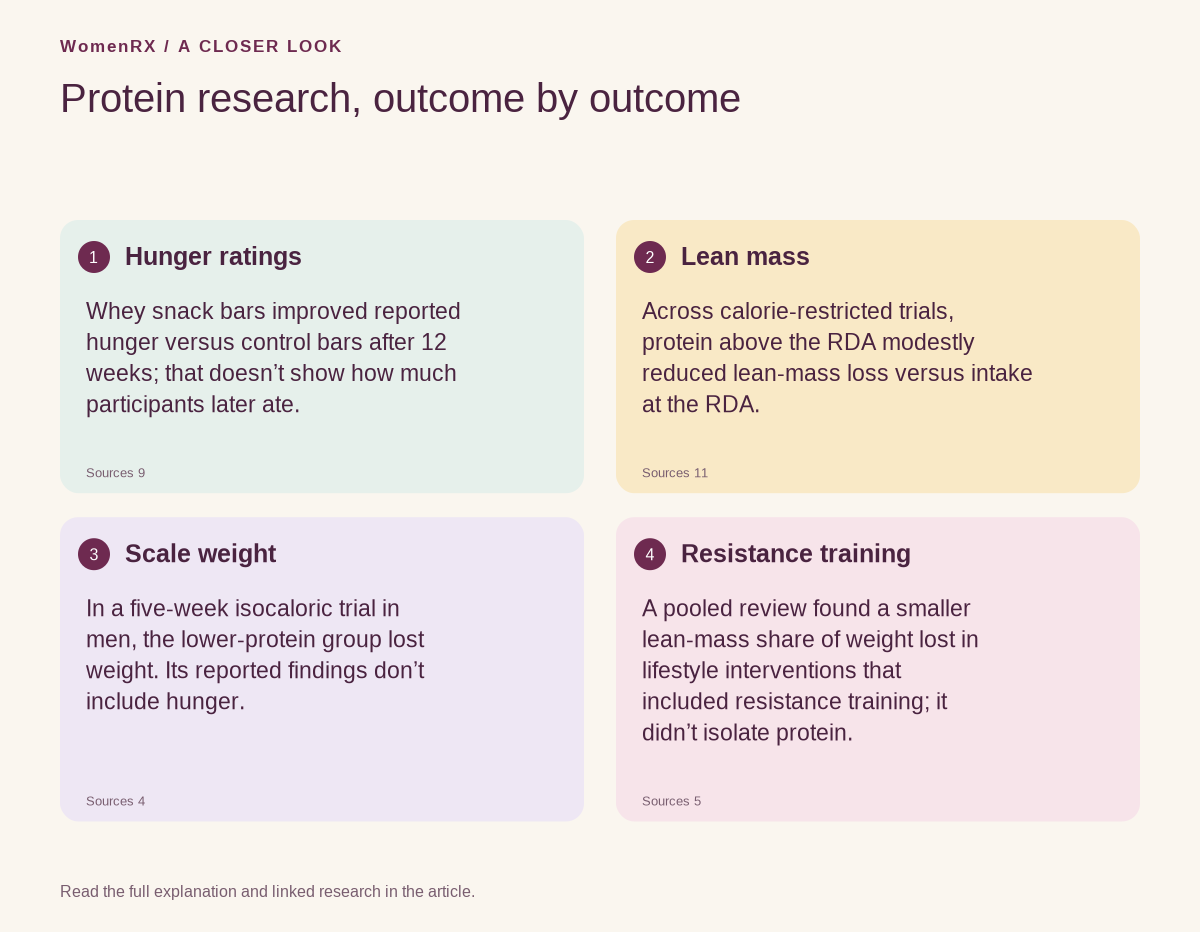
Hunger ratings: Whey snack bars improved reported hunger versus control bars after 12 weeks; that doesn’t show how much participants later ate.9
Lean mass: Across calorie-restricted trials, protein above the RDA modestly reduced lean-mass loss versus intake at the RDA.11
Scale weight: In a five-week isocaloric trial in men, the lower-protein group lost weight. Its reported findings don’t include hunger.4
Resistance training: A pooled review found a smaller lean-mass share of weight lost in lifestyle interventions that included resistance training; it didn’t isolate protein.5
Read the figure as text
Feeling less hungry, retaining lean mass, and losing weight are different results. Each comes from a different kind of comparison.- Hunger ratings: Whey snack bars improved reported hunger versus control bars after 12 weeks; that doesn’t show how much participants later ate.9
- Lean mass: Across calorie-restricted trials, protein above the RDA modestly reduced lean-mass loss versus intake at the RDA.11
- Scale weight: In a five-week isocaloric trial in men, the lower-protein group lost weight. Its reported findings don’t include hunger.4
- Resistance training: A pooled review found a smaller lean-mass share of weight lost in lifestyle interventions that included resistance training; it didn’t isolate protein.5
More questions, answered
Does research point to one protein target during weight loss?
No universal target follows from these studies. The lean-mass review compared intake above the RDA with intake at the RDA, while protein needs also vary with age, health, and activity. Its average benefit doesn’t identify the right amount for every woman or every meal. 11 1
Can the scale tell me whether I’m preserving muscle?
Not by itself. Body weight includes fat, muscle, bone, and water. Even a whole-body lean-mass estimate isn’t a direct measure of skeletal muscle or strength. 2 3
Sources you can check
- Dietary Proteins: MedlinePlusAccessed 2026-09-25Return to first citation
- Body Weight: MedlinePlusAccessed 2026-09-25Return to first citation
- Sparing Muscle While Losing Fat: A Narrative Review of Ketogenic Diets and Lean Mass Preservation During Weight Loss.Caturano A, Mocini E, Titi L, Leva F, Cannavaro D, Tarsitano MG, Conte C. · Nutrients · 2026Return to first citation
- Dietary Protein Reduction During Isocaloric Conditions Reduces Body Weight in Men With Overweight or Obesity.Lyster AE, Frederiksen AS, Jensen JK, Lundsgaard A, Andersen NR, Jørgensen KS, Weber D, Nachtigall L, Richter EA, Fritzen AM, Kiens B. · Obesity (Silver Spring, Md.) · 2026Return to first citation
- Lean Mass Changes With Incretin Therapy Versus Lifestyle Intervention: A Systematic Review and Meta-Analysis of Randomised Controlled Trials.Eisa N, Barood O. · Diabetes, obesity & metabolism · 2026Return to first citation
- Nutrition for Older Adults: MedlinePlusAccessed 2026-09-25Return to first citation
- Dietary Supplements and Life Stages: Pregnancy - Health Professional Fact SheetAccessed 2026-09-25Return to first citation
- Effect of a dairy- and calcium-rich diet on weight loss and appetite during energy restriction in overweight and obese adults: a randomized trial.Jones KW, Eller LK, Parnell JA, Doyle-Baker PK, Edwards AL, Reimer RA. · European journal of clinical nutrition · 2013Return to first citation
- Inulin-type fructans and whey protein both modulate appetite but only fructans alter gut microbiota in adults with overweight/obesity: A randomized controlled trial.Reimer RA, Willis HJ, Tunnicliffe JM, Park H, Madsen KL, Soto-Vaca A. · Molecular nutrition & food research · 2017Return to first citation
- Effect of an Energy-Restricted, Nutritionally Complete, Higher Protein Meal Plan on Body Composition and Mobility in Older Adults With Obesity: A Randomized Controlled Trial.Beavers KM, Nesbit BA, Kiel JR, Sheedy JL, Arterburn LM, Collins AE, Ford SA, Henderson RM, Coleman CD, Beavers DP. · The journals of gerontology. Series A, Biological sciences and medical sciences · 2019Return to first citation
- Protein Intake Greater than the RDA Differentially Influences Whole-Body Lean Mass Responses to Purposeful Catabolic and Anabolic Stressors: A Systematic Review and Meta-analysis.Hudson JL, Wang Y, Bergia Iii RE, Campbell WW. · Advances in nutrition (Bethesda, Md.) · 2020Return to first citation