Protein for Weight Loss: What Matters Beyond the Number
More protein may help with fullness and lean-mass retention, but it doesn’t cause weight loss on its own.
Increasing protein can be useful if it makes meals more filling or helps you maintain lean mass while losing weight. It isn’t a guarantee of weight loss: that still depends on taking in less energy than you use, and long-term results depend partly on whether the eating pattern is sustainable. The evidence doesn’t establish a separate protein rule for women. 2 3 4
What protein may help with
Protein can make a meal feel more filling. In reviews of feeding studies, higher-protein meals produced a modest increase in reported fullness, but did not reliably reduce how much people ate at their next eating occasion. Feeling fuller is a possible advantage, not proof that protein will automatically lower your daily food intake. 4
Protein may also help preserve lean mass during weight loss. Reviews of shorter, controlled studies found that higher-protein diets paired with energy restriction tended to produce greater weight and fat loss, along with better lean-mass retention, than lower-protein diets. That’s a comparison between eating patterns, not evidence that protein alone causes fat loss or prevents every loss of muscle. 3 4
For weight to come off, energy intake still has to be lower than energy used. A higher-protein approach is most useful when it helps you maintain that difference without making meals feel too hard to stick with. 3
Decide whether a change would help you
Start with your current meals, not a target calculator:
- If meals already keep you satisfied and include protein regularly, there may be no compelling reason to make a large change just for weight loss. Most Americans get enough protein, though individual needs vary with health, age, and activity. 1
- If you’re often hungry soon after meals, try making an existing meal more satisfying by including a protein food, rather than automatically adding a shake or snack on top. Think of this as a practical experiment: notice whether the meal keeps you satisfied and fits your day.
- If your preferred plan feels restrictive, choose protein foods you actually enjoy. A short crossover trial in 20 men with obesity found similar appetite ratings and weight loss on vegetarian soy-based and meat-based higher-protein diets over two weeks. That’s encouraging for choice, but the study was small and brief, and it doesn’t settle how all protein sources compare over time. 2
- If a higher-protein plan crowds out foods or routines you value, it may not be the best tradeoff. Increasing protein means changing the balance of what you eat, and long-term studies have had mixed results; review authors point to adherence as one reason outcomes differ. 3 4
Protein foods include meat, dairy, nuts, beans, and some grains. You don’t have to rely on one kind of food or on supplements to make a meal more protein-rich. 1 A review of whey supplements found that their effects for people with overweight or obesity remained inconclusive, so a powder isn’t a proven shortcut to weight loss. 5
Is there a different rule for women?
These findings don’t establish a separate protein target for women. Broad reviews discuss higher-protein weight-loss diets without reporting a women-specific result in the available summaries, while one short appetite trial enrolled only men with obesity. That means the trial can’t tell us directly whether the same appetite effects apply to women. 2 3 4
Pregnancy and breastfeeding are not answered by this weight-loss evidence, so it shouldn’t be used to set a protein target for those stages. And if you’ve been told to limit protein because of a health condition, don’t increase it on the basis of weight-loss studies; protein needs vary with health. 1
The useful question isn’t only “How much?”
Ask whether a protein change makes your meals more satisfying, preserves foods that matter to you, and feels manageable over time. If the answer is yes, it may be a helpful part of your approach. If it means forcing down foods you dislike or building a plan you can’t maintain, the number is unlikely to make that tradeoff worthwhile.
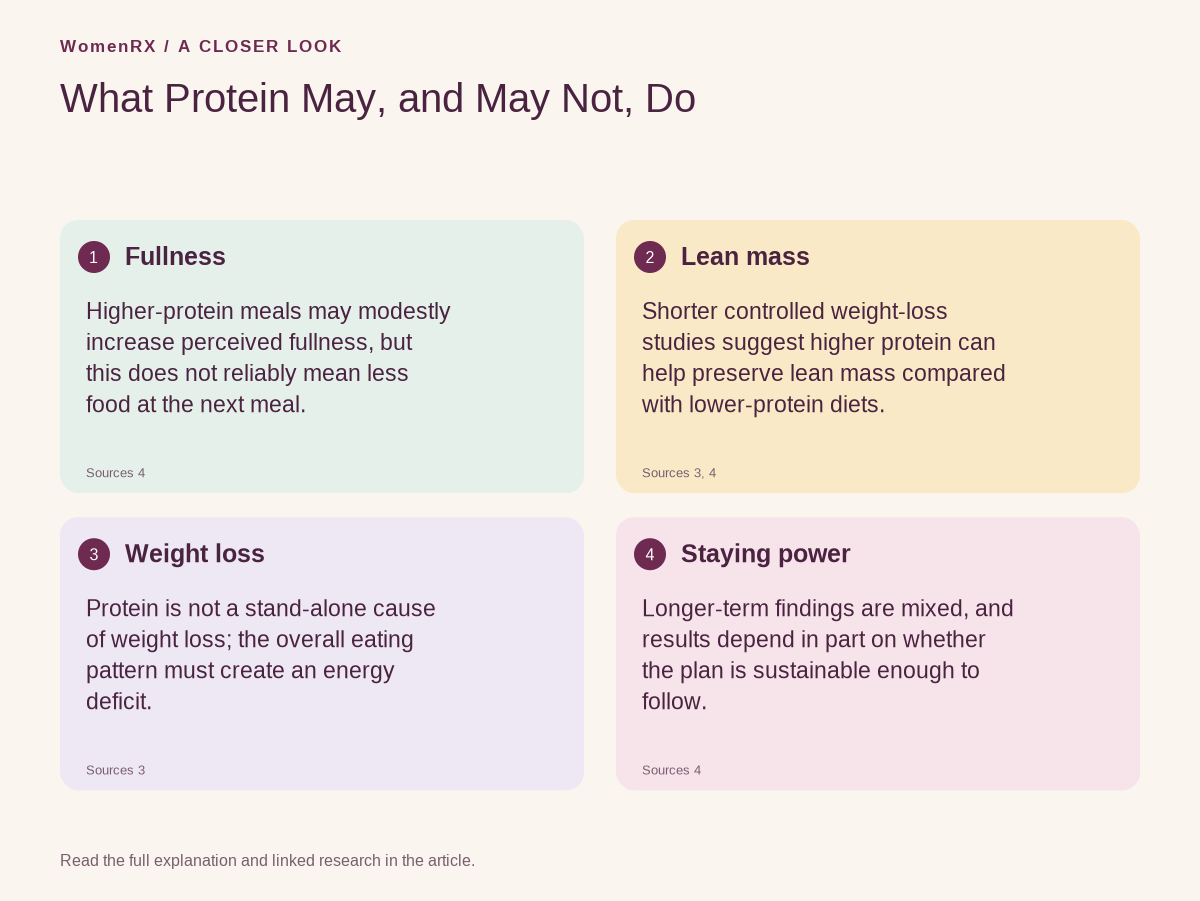
What Protein May, and May Not, Do
Fullness: Higher-protein meals may modestly increase perceived fullness, but this does not reliably mean less food at the next meal.4
Lean mass: Shorter controlled weight-loss studies suggest higher protein can help preserve lean mass compared with lower-protein diets.34
Weight loss: Protein is not a stand-alone cause of weight loss; the overall eating pattern must create an energy deficit.3
Staying power: Longer-term findings are mixed, and results depend in part on whether the plan is sustainable enough to follow.4
Read the figure as text
Separate possible reasons to include more protein from outcomes that depend on the whole eating pattern.- Fullness: Higher-protein meals may modestly increase perceived fullness, but this does not reliably mean less food at the next meal.4
- Lean mass: Shorter controlled weight-loss studies suggest higher protein can help preserve lean mass compared with lower-protein diets.34
- Weight loss: Protein is not a stand-alone cause of weight loss; the overall eating pattern must create an energy deficit.3
- Staying power: Longer-term findings are mixed, and results depend in part on whether the plan is sustainable enough to follow.4
More questions, answered
Do I need a protein shake to lose weight?
No. Protein foods include meat, dairy, nuts, beans, and some grains. Research on whey supplements in people with overweight or obesity has not established a clear weight-loss benefit, so a shake isn’t a required shortcut. 1 5
Can eating more protein guarantee I’ll lose weight?
No. Higher-protein eating may support fullness and lean-mass retention during weight loss, but body weight loss still requires taking in less energy than you use. 3 4
Sources you can check
- Dietary Proteins: MedlinePlusAccessed 2026-09-25Return to first citation
- Appetite control and biomarkers of satiety with vegetarian (soy) and meat-based high-protein diets for weight loss in obese men: a randomized crossover trial.Neacsu M, Fyfe C, Horgan G, Johnstone AM. · The American journal of clinical nutrition · 2014Return to first citation
- A brief review of higher dietary protein diets in weight loss: a focus on athletes.Phillips SM. · Sports medicine (Auckland, N.Z.) · 2014Return to first citation
- The role of protein in weight loss and maintenance.Leidy HJ, Clifton PM, Astrup A, Wycherley TP, Westerterp-Plantenga MS, Luscombe-Marsh ND, Woods SC, Mattes RD. · The American journal of clinical nutrition · 2015Return to first citation
- Effects of whey protein supplementation on adiposity, body weight, and glycemic parameters: A synthesis of evidence.Giglio BM, Lobo PCB, Pimentel GD. · Nutrition, metabolism, and cardiovascular diseases : NMCD · 2023Return to first citation