What Walnuts Add to a Meal, Beyond Protein
An ounce of walnuts brings mostly fat, plus some protein and fiber, making it a useful addition rather than the protein centerpiece of a meal.
A practical portion is 28 grams, about one ounce. USDA food-composition data estimate that it provides 18.3 grams of fat, 4.3 grams of protein, 1.9 grams of fiber, and 183 calories. Walnuts are a way to add unsaturated fat, including the plant omega-3 ALA, but they aren’t a concentrated protein food. Walnuts are tree nuts that can cause food allergy, sometimes seriously. 6421
What’s in an ounce?
Think of walnuts as the rich addition to a meal, not its main protein source. In 28 grams of edible English walnuts, USDA reference data estimate 18.3 grams of fat and 4.3 grams of protein. That same portion has about 1.9 grams of fiber and 183 calories. These are food-composition estimates, so a particular package may differ. 6
The distinction matters when you’re deciding what to eat, not just reading a nutrient list. For example, walnuts can add crunch to oatmeal or a salad. If you’re building a meal around protein, though, the walnuts are better treated as an addition to another protein-containing food than as the main source. An ounce contains more than four times as many grams of fat as protein. 6
Walnuts’ fat is part of their appeal. Nuts are rich in unsaturated fatty acids, and walnuts provide alpha-linolenic acid, or ALA, a plant omega-3 fat. ALA isn’t the same as the long-chain omega-3 fats DHA and EPA found in seafood, so walnuts shouldn’t be treated as an interchangeable source of those nutrients. 42
Is an ounce the “right” amount?
An ounce is a useful reference point, not a required serving. It lets you see what walnuts contribute before you add them to a snack or meal. For example, you might scatter some over yogurt when you want texture and richness, or use them in place of another topping. Whether you want the full ounce depends on the rest of what you’re eating and your appetite.
There’s a wrinkle in the calorie number, but it doesn’t make portions irrelevant. In a small controlled feeding study of 18 healthy adults, researchers compared diets with and without 42 grams of walnuts a day while adjusting other foods to keep the diets isocaloric. They calculated that a 28-gram serving supplied 146 calories of metabolizable energy, compared with 185 calories predicted by the conventional calculation used in that study. A review of human and laboratory studies found that the energy available from several types of nuts can be lower than standard predictions, partly because some fat remains enclosed within nut cells. These findings help explain why a calculated calorie value and energy absorbed by the body may differ; they aren’t a reason to subtract a fixed number of calories from every serving you eat. 35
What can walnuts do for heart health?
Walnuts can fit into a heart-conscious eating pattern, but eating them doesn’t guarantee disease prevention. A review reports that trials of various nuts have found cholesterol-lowering effects. It also discusses a trial in which a Mediterranean diet supplemented with mixed nuts was associated with fewer cardiovascular events than the comparison diet. That mix included walnuts, almonds, and hazelnuts, so the result can’t be credited to walnuts alone. 4
That distinction applies to women, too. The review reports associations between nut consumption and lower coronary heart disease incidence in both sexes, but an association across different nuts isn’t proof of a walnut-specific benefit for an individual woman. The useful takeaway is about the eating pattern: walnuts are one option for adding unsaturated fat to foods you already enjoy, not a treatment or a stand-alone heart-health plan. 4
When walnuts aren’t a good choice
Walnuts are tree nuts and can cause food allergy, which may be serious. If you think you may have a food allergy, see a doctor. A severe allergic reaction needs emergency help. 1
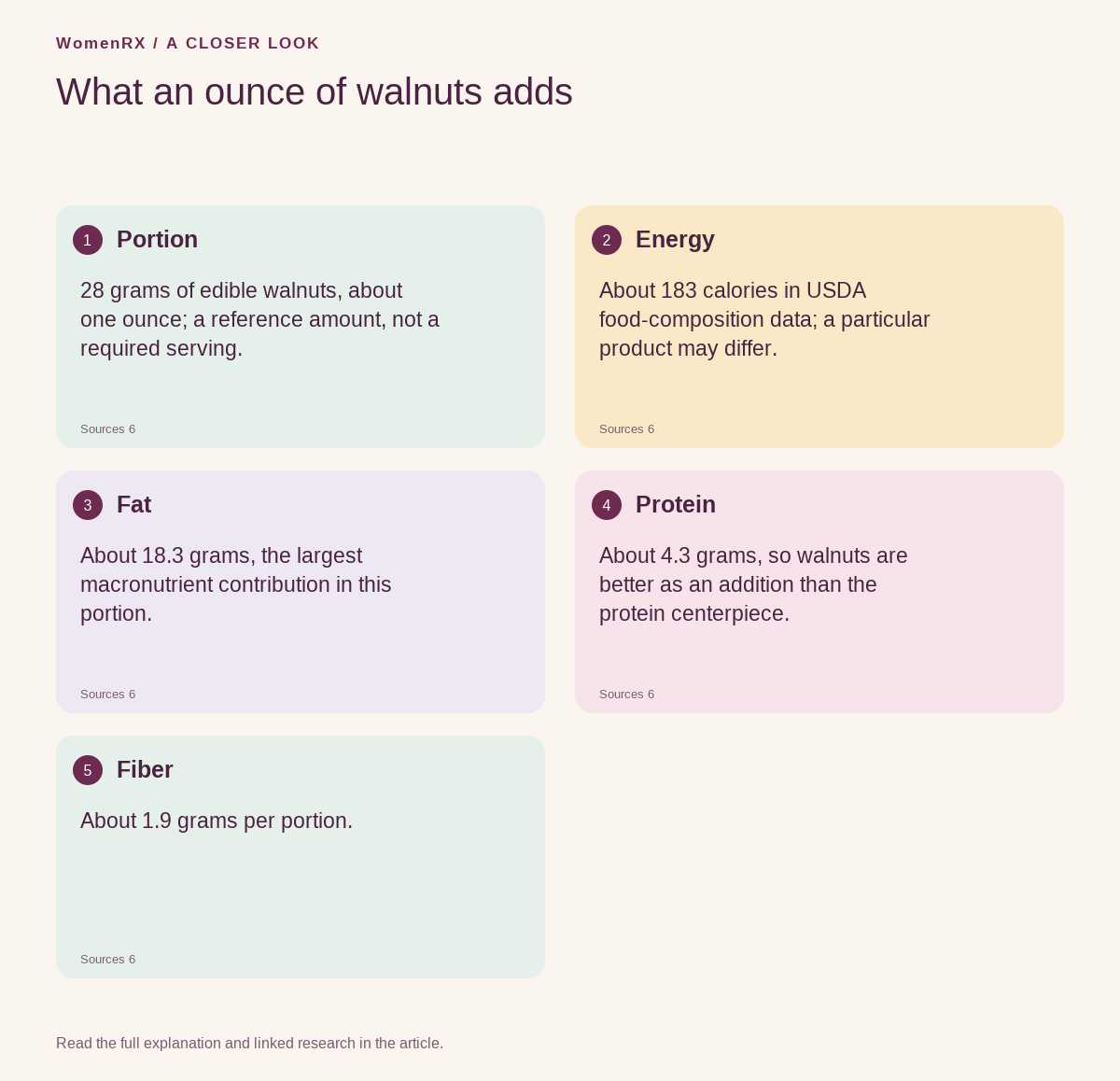
What an ounce of walnuts adds
Portion: 28 grams of edible walnuts, about one ounce; a reference amount, not a required serving.6
Energy: About 183 calories in USDA food-composition data; a particular product may differ.6
Fat: About 18.3 grams, the largest macronutrient contribution in this portion.6
Protein: About 4.3 grams, so walnuts are better as an addition than the protein centerpiece.6
Fiber: About 1.9 grams per portion.6
Read the figure as text
Reference amounts for 28 grams of edible English walnuts show where their nutritional emphasis lies.- Portion: 28 grams of edible walnuts, about one ounce; a reference amount, not a required serving.6
- Energy: About 183 calories in USDA food-composition data; a particular product may differ.6
- Fat: About 18.3 grams, the largest macronutrient contribution in this portion.6
- Protein: About 4.3 grams, so walnuts are better as an addition than the protein centerpiece.6
- Fiber: About 1.9 grams per portion.6
More questions, answered
Are walnuts a high-protein snack?
Not compared with their fat contribution. A 28-gram portion provides an estimated 4.3 grams of protein alongside 18.3 grams of fat. Choose walnuts for what they add to a snack, but don’t count on them as its main protein source. 6
Sources you can check
- Food allergy - NHSAccessed 2026-09-25Return to first citation
- Dietary Supplements and Life Stages: Pregnancy - Health Professional Fact SheetAccessed 2026-09-25Return to first citation
- Walnuts Consumed by Healthy Adults Provide Less Available Energy than Predicted by the Atwater Factors.Baer DJ, Gebauer SK, Novotny JA. · The Journal of nutrition · 2016Return to first citation
- Nuts and CVD.Ros E. · The British journal of nutrition · 2015Return to first citation
- The Metabolizable Energy and Lipid Bioaccessibility of Tree Nuts and Peanuts: A Systematic Review with Narrative Synthesis of Human and In Vitro Studies.Nikodijevic CJ, Probst YC, Tan SY, Neale EP. · Advances in nutrition (Bethesda, Md.) · 2023Return to first citation
- USDA SR Legacy: Nuts, walnuts, english (FDC 170187)Accessed 2026-09-25Return to first citation