Watermelon and Weight Management: What Does It Add to a Meal?
Whole watermelon can be a refreshing, relatively low-energy snack, but its best-supported role is as a swap for another snack, not as a weight-loss treatment.
Watermelon’s high water content gives it a lot of volume for relatively little energy: one cup of diced watermelon has about 46 calories. In a small trial, adults reported feeling fuller after whole watermelon than after an equal-calorie cookie snack. That makes it a reasonable snack swap if you enjoy it, but the study doesn’t show that watermelon causes lasting weight loss or whether its effects differ for women. 1
The useful question is what it replaces
Watermelon can fit into a weight-management routine as a sweet, juicy fruit choice. Its high water content means it has relatively low energy density, and one cup of diced watermelon contains about 46 calories. 1 That can make it easier to enjoy a generous-feeling snack without choosing a more energy-dense option.
The distinction is whether watermelon replaces something or simply gets added on top. In a four-week crossover study, 33 adults with overweight or obesity ate two cups of watermelon or an equal-calorie low-fat cookie snack each day. Compared with the cookie period, participants reported less hunger and greater fullness during the watermelon period. 1 That’s evidence for one practical tradeoff: choosing whole watermelon instead of a comparable snack may feel more satisfying. It doesn’t show that adding watermelon to your usual meals leads to weight loss.
What the study can, and can’t, tell you
At the end of the four-week periods, body weight and BMI decreased during the watermelon phase and increased during the cookie phase. 1 But this was a small, short study, not proof that watermelon reliably produces lasting weight loss. A review of watermelon and L-citrulline research likewise describes a possible role in weight control as an area that needs further study. 2
The results cited here aren’t broken out by sex, so they don’t establish whether watermelon affects weight differently for women. Its value is more straightforward: it’s a whole-fruit option that some people may find filling when used in place of a snack they’d otherwise eat.
Whole fruit isn’t the same test as juice
The study tested watermelon flesh, not watermelon juice. Its authors discuss why whole fruit may feel more filling than juice: it has more volume to chew, and chewing and the solid form may influence fullness. They also note that evidence comparing whole fruit with juice comes from other fruit research, not a watermelon-versus-watermelon-juice arm of their trial. 1
So if you’re choosing between the forms for a snack, whole watermelon is the format with direct satiety evidence in this study. That doesn’t establish that juice is harmful or that it prevents weight management. It means you shouldn’t assume a glass of juice will feel as filling as eating the fruit. The study didn’t compare their effects or establish an equivalent serving size.
A simple way to decide
If you like watermelon, try it as the snack you were already planning to have, rather than treating it as a detox, fat burner, or special remedy. If you have it alongside your usual snack rather than swapping it for that snack, you’re making a different choice from the one tested in the study. And if watermelon doesn’t keep you satisfied, there’s no need to force it: the useful snack is one that fits your appetite and routine.
In short, watermelon’s sweetness doesn’t cancel out its place as fruit, and its water content can make it a relatively low-energy, high-volume choice. The evidence supports a sensible swap, not a special weight-loss effect.
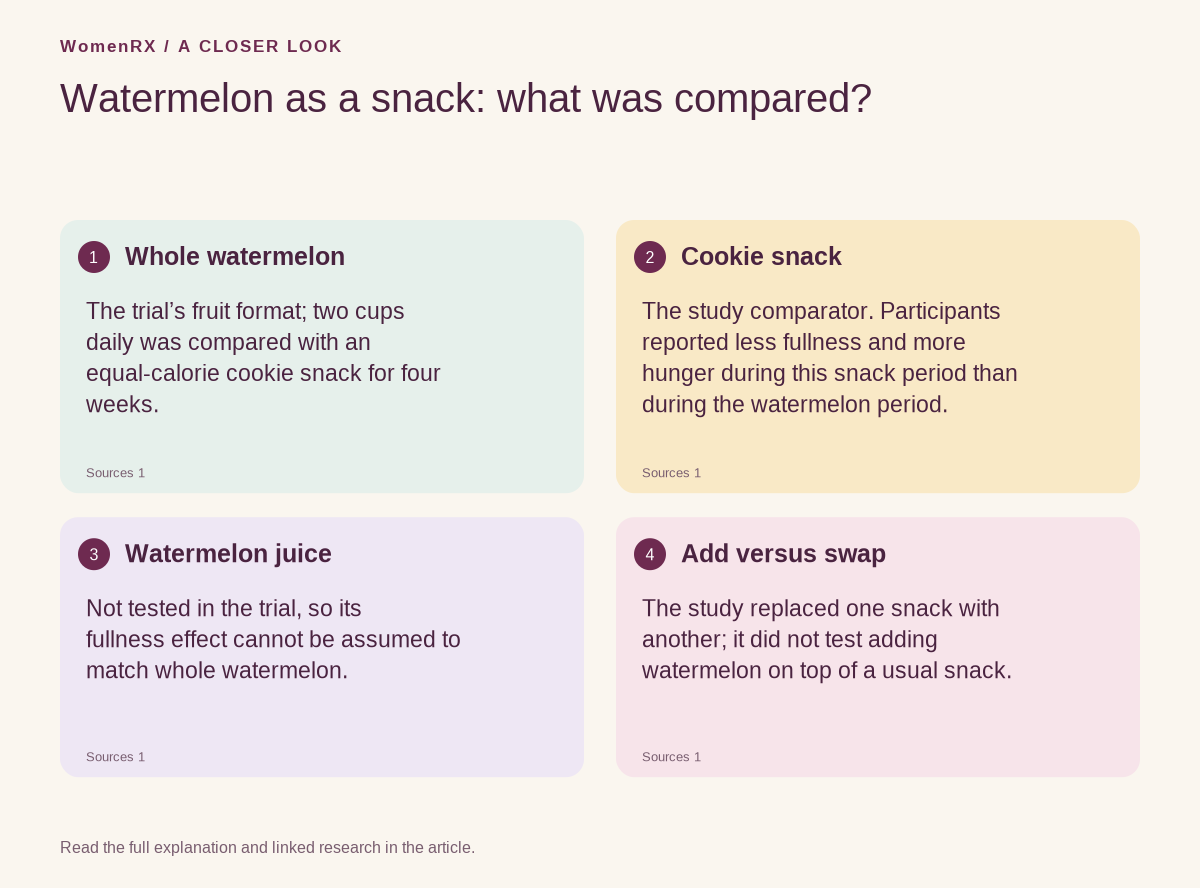
Watermelon as a snack: what was compared?
Whole watermelon: The trial’s fruit format; two cups daily was compared with an equal-calorie cookie snack for four weeks.1
Cookie snack: The study comparator. Participants reported less fullness and more hunger during this snack period than during the watermelon period.1
Watermelon juice: Not tested in the trial, so its fullness effect cannot be assumed to match whole watermelon.1
Add versus swap: The study replaced one snack with another; it did not test adding watermelon on top of a usual snack.1
Read the figure as text
The human trial supports a specific comparison: whole watermelon instead of an equal-calorie cookie snack. Juice was not tested.- Whole watermelon: The trial’s fruit format; two cups daily was compared with an equal-calorie cookie snack for four weeks.1
- Cookie snack: The study comparator. Participants reported less fullness and more hunger during this snack period than during the watermelon period.1
- Watermelon juice: Not tested in the trial, so its fullness effect cannot be assumed to match whole watermelon.1
- Add versus swap: The study replaced one snack with another; it did not test adding watermelon on top of a usual snack.1
More questions, answered
Does watermelon burn fat or detox the body?
This human study tested fullness and changes during a snack comparison; it did not test fat-burning or detox effects. Watermelon is best understood as a fruit you can choose as part of a meal or snack, not a treatment. 1
Sources you can check
- Effects of Fresh Watermelon Consumption on the Acute Satiety Response and Cardiometabolic Risk Factors in Overweight and Obese Adults.Lum T, Connolly M, Marx A, Beidler J, Hooshmand S, Kern M, Liu C, Hong MY. · Nutrients · 2019Return to first citation
- Watermelon and L-Citrulline in Cardio-Metabolic Health: Review of the Evidence 2000-2020.Burton-Freeman B, Freeman M, Zhang X, Sandhu A, Edirisinghe I. · Current atherosclerosis reports · 2021Return to first citation