Can Volumetrics Help With Weight Management After 40?
Choosing foods with more water and fiber can make a satisfying plate less energy-dense, but the rest of the meal still matters.
Volumetrics focuses on lowering a meal’s energy density, or calories per gram, rather than simply making portions smaller. In experiments, serving less energy-dense foods reduced daily calorie intake, though the evidence for greater weight loss is less certain. You can try the idea after 40 by swapping some energy-dense ingredients for vegetables or fruit while keeping protein and fiber in the meal. Results specific to midlife women aren’t clear. 46
A full plate and a lower-energy-density plate aren’t the same thing
Energy density means the calories in a given weight of food, usually expressed as calories per gram. Water adds weight without adding calories, so adding vegetables to a dish or water to a food such as porridge can lower its energy density. Volumetrics is an eating approach built around that distinction. It isn’t a rule that you must eat the largest possible portion. 46
Picture two similarly filled pasta bowls. One contains mostly pasta with a rich sauce and cheese. In the other, some of the pasta and sauce have been replaced with tomatoes, zucchini and beans. The second bowl can be less energy-dense if those ingredients replace more calorie-dense ones. The beans also contribute protein and fiber; the vegetables contribute fiber. But the size of the bowl alone tells you neither its calories nor whether it has enough protein to make a useful meal. These are illustrative meals, not a tested head-to-head comparison. 1236
That’s the distinction worth keeping: portion size is how much food you serve; energy density is how much energy that food contains for its weight. You can change one without necessarily changing the other. Researchers have examined them as separate influences on how much people eat. 48
What the research suggests, and what it doesn’t
A 2022 review pooled experiments in which researchers served people higher- or lower-energy-density versions of foods and measured intake for at least a day. Across 31 studies, including 27 in adults and four in children, the lower-density foods were associated with lower daily energy intake. Eating more at other meals generally did not make up for the difference in these experiments. That supports the practical idea behind a food swap, but it doesn’t mean every swap will leave you feeling equally satisfied. 6
Weight is a longer-term question. In the same review, the pooled result from five studies leaned toward more weight loss with lower-energy-density foods, but the difference was not statistically significant. An earlier systematic review of adult diet studies concluded that relatively low-energy-density patterns could help with weight loss and maintenance. Taken together, the findings make this a reasonable strategy to try, not a predictable weight-loss result. 67
One small randomized trial tested a Volumetrics-style diet more directly. Thirty-seven physically active, middle-aged participants followed either that approach or time-restricted eating for 12 weeks. Both groups lost weight and fat mass, with no significant difference between them; both maintained lean body mass. Participants logged their food and had nutrition-coach support, so the result doesn’t show what happens when someone casually changes a few meals on her own. The reported results also don’t tell us whether women over 40, or women at a particular menopause stage, responded differently. 4
Make the swap serve the whole meal
Start with a meal you actually enjoy, then ask what an addition would replace. Adding vegetables to your usual pasta and sauce may make dinner bigger, but it won’t necessarily lower the meal’s total calories. Replacing some of the pasta or rich sauce with vegetables changes the balance. Keeping beans, tofu or another protein food in the bowl helps avoid turning dinner into little more than vegetables. Protein is needed to maintain body tissues, including muscle; beans and lentils are also fiber-containing plant foods. 1236
The same thinking works at snack time. As an example, a bowl of whole fruit with yogurt offers a different mix of water, fiber and protein from a similarly sized bowl of a drier, more energy-dense snack. Whole fruit has been studied separately from complete Volumetrics meals: a systematic review found that increasing it tended to support weight maintenance or modest loss in trials lasting 3 to 24 weeks. That finding doesn’t prove this particular snack swap will change your weight. 1235
There’s room for foods that are energy-dense, too. Nuts and seeds are plant-based protein choices, even though their role in a meal differs from that of water-rich produce. You don’t need to remove them to make Volumetrics useful. Instead, notice whether a lower-density swap still leaves you with a meal you like and enough variety across the day. Fiber can help you feel full, but increasing it quickly may cause gas or bloating, so a sudden all-vegetable overhaul isn’t necessary. 12
After 40, the most useful question isn’t “How much food can I fit on this plate?” It’s “What did I replace, and what did I keep?” That lets you use food volume as one tool while still paying attention to protein, fiber and the satisfaction that makes a meal worth repeating. 1236
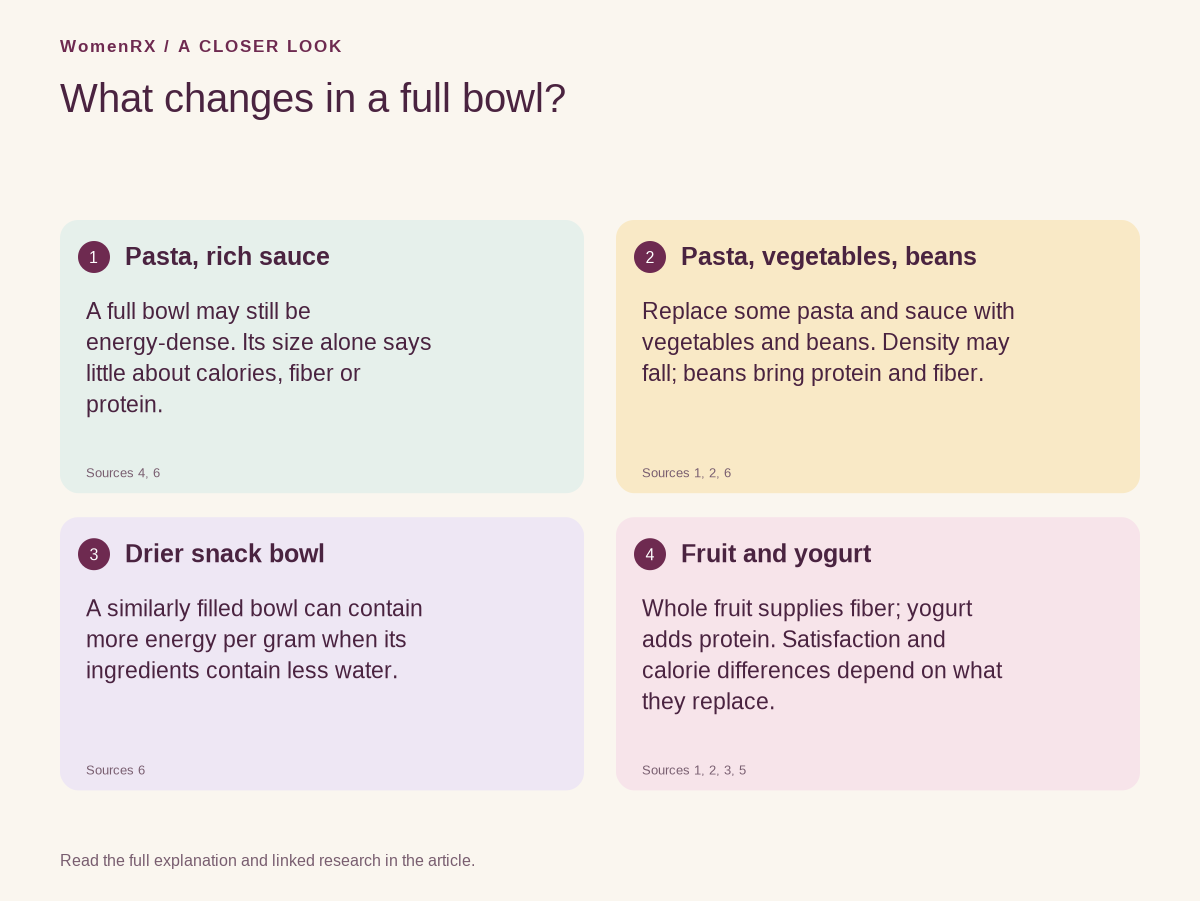
What changes in a full bowl?
Pasta, rich sauce: A full bowl may still be energy-dense. Its size alone says little about calories, fiber or protein.46
Pasta, vegetables, beans: Replace some pasta and sauce with vegetables and beans. Density may fall; beans bring protein and fiber.126
Drier snack bowl: A similarly filled bowl can contain more energy per gram when its ingredients contain less water.6
Fruit and yogurt: Whole fruit supplies fiber; yogurt adds protein. Satisfaction and calorie differences depend on what they replace.1235
Read the figure as text
These illustrative swaps compare similarly filled bowls, not measured equal portions. What gets replaced matters more than how full the bowl looks.- Pasta, rich sauce: A full bowl may still be energy-dense. Its size alone says little about calories, fiber or protein.46
- Pasta, vegetables, beans: Replace some pasta and sauce with vegetables and beans. Density may fall; beans bring protein and fiber.126
- Drier snack bowl: A similarly filled bowl can contain more energy per gram when its ingredients contain less water.6
- Fruit and yogurt: Whole fruit supplies fiber; yogurt adds protein. Satisfaction and calorie differences depend on what they replace.1235
More questions, answered
Do I need to count calories per gram to try Volumetrics?
No. Energy density explains why a substitution may change a meal’s calories; you can apply the idea by replacing some energy-dense ingredients with water-rich foods, then checking that the meal still includes protein and foods you enjoy. The exact calorie difference depends on the ingredients and amounts used. 146
Sources you can check
- MedlinePlus: Managing weight with healthy eatingAccessed 2026-09-25Return to first citation
- Dietary Fiber: MedlinePlusAccessed 2026-09-25Return to first citation
- Dietary Proteins: MedlinePlusAccessed 2026-09-25Return to first citation
- Similar body composition outcomes following volumetric diet and time-restricted eating in middle-aged individuals: a 12-week randomized controlled trial.Cloos A, Geisler S, Isenmann E. · Nutrition journal · 2025Return to first citation
- Impact of Whole, Fresh Fruit Consumption on Energy Intake and Adiposity: A Systematic Review.Guyenet SJ. · Frontiers in nutrition · 2019Return to first citation
- Calorie reformulation: a systematic review and meta-analysis examining the effect of manipulating food energy density on daily energy intake.Robinson E, Khuttan M, McFarland-Lesser I, Patel Z, Jones A. · The international journal of behavioral nutrition and physical activity · 2022Return to first citation
- Dietary energy density and body weight in adults and children: a systematic review.Pérez-Escamilla R, Obbagy JE, Altman JM, Essery EV, McGrane MM, Wong YP, Spahn JM, Williams CL. · Journal of the Academy of Nutrition and Dietetics · 2012Return to first citation
- "The Big Three" properties of food that drive intake.Rolls BJ, Cunningham PM, Zuraikat FM. · Physiology & behavior · 2025Return to first citation