What an Anti-Inflammatory Diet Can, and Can’t, Do
It’s a broad label for eating patterns, not one proven plan, and lower inflammation markers don’t automatically mean weight loss or symptom relief.
An anti-inflammatory diet usually means emphasizing fiber-rich foods and sources of unsaturated fats, while limiting some foods associated with a more inflammatory dietary score. There’s no single standardized version. Studies in older adults found changes in diet scores and intake; separate research in women with lipedema examined blood markers. Those findings don’t establish general benefits for weight, symptoms, or disease outcomes in women over 40. 1 2 3 4 5
First, the name doesn’t describe one set menu
“Anti-inflammatory diet” is an umbrella term, not a single standardized eating plan. Researchers use different ways to describe it, including the Dietary Inflammatory Index, which scores the inflammatory potential of a person’s overall diet. Reviews also group together studies of different foods, dietary patterns, and outcomes, making it hard to treat every plan with this label as equivalent. 1 2
In practice, the pattern can mean making fiber-rich foods such as mushrooms, along with fruits and vegetables, regular parts of meals, and including sources of unsaturated fats such as nuts, seeds, and fish. But a food list is not proof that a specific plan prevents disease or eases symptoms. The studies don’t establish that every woman over 40 needs to follow one. 1 2
A useful way to evaluate a plan is to ask: What does it ask me to eat, what outcome has actually been measured, and in whom? That keeps a change in a laboratory marker separate from a promise about how you’ll feel.
What the studies measured
Some research in older adults has measured a diet score rather than a health outcome. In a two-year randomized trial of 319 healthy adults ages 63 to 79, 66% of whom were women, the group assigned to a walnut-rich diet had a lower average Dietary Inflammatory Index score than the control group. That supports a change in the measured inflammatory potential of the diet. It does not, by itself, show that participants had fewer symptoms or less disease, and the reported result wasn’t a women-specific effect. 5
Another study involved community-dwelling older adults with a mean age of 73.7; 80% of participants were women. After six workshops focused on practical dietary changes, participants’ diet scores decreased and fiber intake increased. Those are changes in eating behavior and a diet score, not evidence that the workshops prevented frailty or improved participants’ health. 2
Studies that measure blood markers answer a different question. In a cross-sectional study of 60 women with lipedema, a higher inflammatory diet score was associated with higher levels of two blood markers, TNF-α and IL-6. The scores were not significantly associated with reported pain or quality of life. Because the study looked at associations at one point in time, it cannot show that changing the diet would lower the markers or improve how women felt. And results in women with lipedema don’t automatically apply to all women in midlife. 4
Biomarkers, symptoms, and weight aren’t interchangeable
Inflammation markers such as CRP, IL-6, or TNF-α are measurements, not a complete account of someone’s health. A change in a marker may be scientifically interesting, but it does not prove that a diet reduces pain, changes body weight, or prevents a particular disease. Those outcomes need to be measured directly.
That distinction matters in midlife, when a diet may be promoted as an answer to several different concerns at once. The women-specific studies described here do not establish that an anti-inflammatory eating pattern relieves common midlife symptoms, and they do not report whether results differ between perimenopause and postmenopause. If a plan claims benefits for sleep, hot flashes, joint pain, or weight, look for evidence measuring that particular outcome in a relevant group of women, not just a change in a blood test.
There are small, condition-specific studies too. A seven-month Mediterranean-style ketogenic diet study included 24 women with lipedema and a control group of 24 people with overweight or obesity. It reported reductions in body weight, fat, leg circumferences, and visceral fat, and lower CRP and IL-6 specifically in the lipedema group. These findings concern this particular intervention and its studied groups; they don’t establish a general weight-loss or inflammation effect for women in midlife. 3
A practical way to judge a proposed plan
Before adopting a plan, check its claims against its actual design:
- Look at the pattern, not the label. Does it describe a recognizable eating pattern, or mainly sell a special product, supplement, or set of forbidden foods?
- Match the evidence to the promise. A lower diet score or blood marker is not the same as weight loss, symptom improvement, or disease prevention.
- Check who was studied. Older-adult studies may include women without reporting a separate result for them. A study in people with a specific condition may not apply to you.
- Notice what wasn’t measured. If you want help with a particular symptom, research needs to measure that symptom. A marker alone can’t answer the question.
A flexible approach built around fiber-rich foods and varied sources of unsaturated fats is closer to the patterns studied than a rigid plan with sweeping promises. Whether it’s a good fit for you depends on your health needs, preferences, and the outcome you care about. The evidence above shows shifts in diet scores and certain inflammation markers, but it does not establish broader clinical benefits for women over 40.
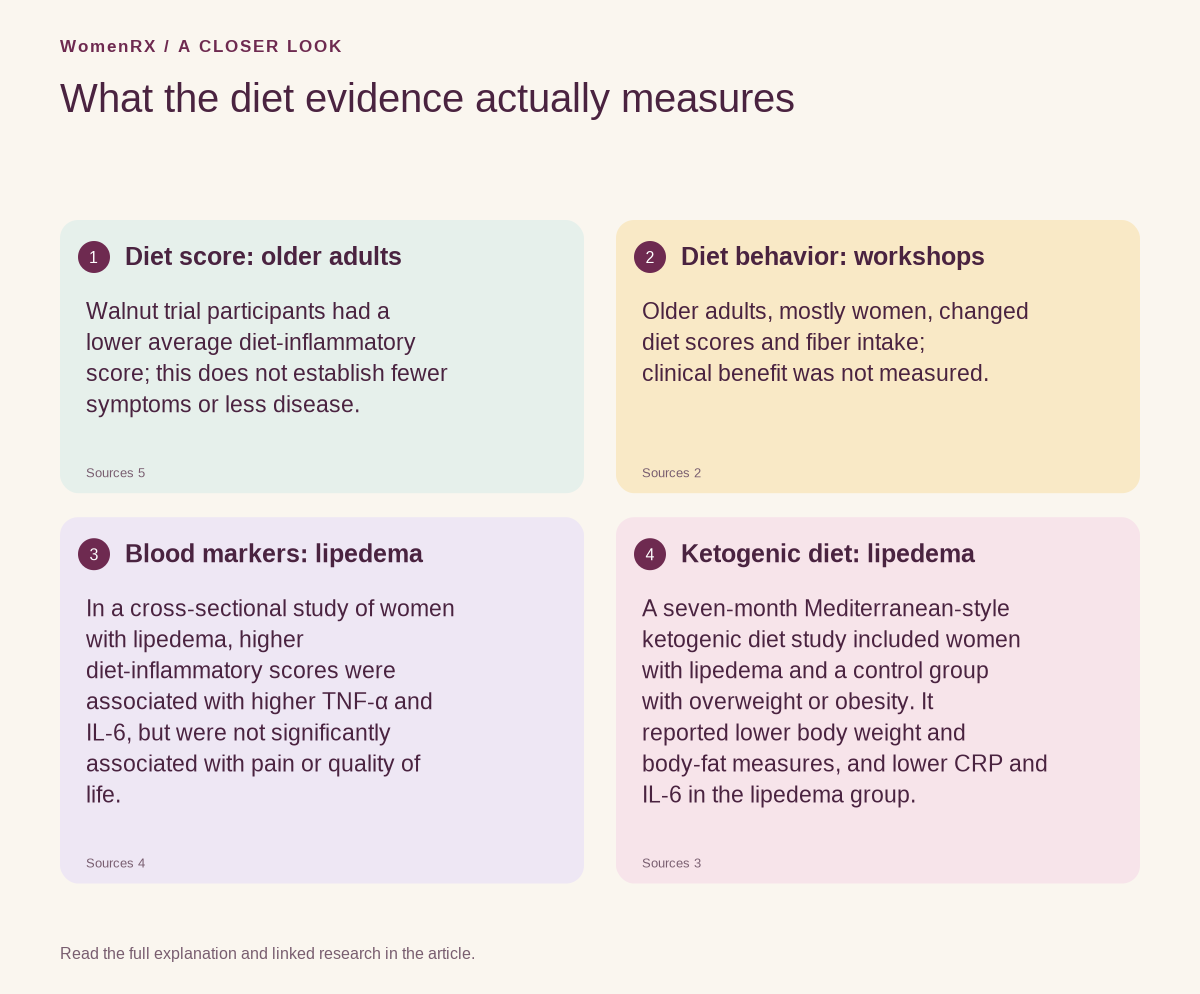
What the diet evidence actually measures
Diet score: older adults: Walnut trial participants had a lower average diet-inflammatory score; this does not establish fewer symptoms or less disease.5
Diet behavior: workshops: Older adults, mostly women, changed diet scores and fiber intake; clinical benefit was not measured.2
Blood markers: lipedema: In a cross-sectional study of women with lipedema, higher diet-inflammatory scores were associated with higher TNF-α and IL-6, but were not significantly associated with pain or quality of life.4
Ketogenic diet: lipedema: A seven-month Mediterranean-style ketogenic diet study included women with lipedema and a control group with overweight or obesity. It reported lower body weight and body-fat measures, and lower CRP and IL-6 in the lipedema group.3
Read the figure as text
The same anti-inflammatory label can refer to different patterns and different endpoints. This map separates diet-score findings, blood-marker associations, and patient-reported outcomes.- Diet score: older adults: Walnut trial participants had a lower average diet-inflammatory score; this does not establish fewer symptoms or less disease.5
- Diet behavior: workshops: Older adults, mostly women, changed diet scores and fiber intake; clinical benefit was not measured.2
- Blood markers: lipedema: In a cross-sectional study of women with lipedema, higher diet-inflammatory scores were associated with higher TNF-α and IL-6, but were not significantly associated with pain or quality of life.4
- Ketogenic diet: lipedema: A seven-month Mediterranean-style ketogenic diet study included women with lipedema and a control group with overweight or obesity. It reported lower body weight and body-fat measures, and lower CRP and IL-6 in the lipedema group.3
More questions, answered
Is an anti-inflammatory diet the same as a Mediterranean diet?
The terms aren’t interchangeable. Research uses “anti-inflammatory diet” across different patterns and measures, while other studies identify a Mediterranean-style diet or use a Mediterranean Diet Score. The label alone doesn’t prove a particular health benefit. 1 3 4
Does lowering an inflammation marker mean I’ll feel better?
Not necessarily. In a study of women with lipedema, diet scores were associated with blood markers, but the scores weren’t significantly associated with pain or quality-of-life ratings. Marker changes and symptom changes are separate outcomes, and one doesn’t establish the other. 4
Sources you can check
- Harnessing diet to modulate inflammation and symptom progression in endometriosis.Thompson T, McAllister V, Strong A, Andrisse S. · Frontiers in nutrition · 2026Return to first citation
- Co-Production of Behavior Change Intervention Promoting an Anti-Inflammatory Diet for Frailty Prevention in Community-Dwelling Older Adults.Lyu W, Masuda M, Kubo K, Isomoto H, Tamii Y, Nakamae Y, Okitsu Y, Arai A, Ueno M, Akishita M, Iijima K, Son BK. · Nutrients · 2026Return to first citation
- Exploring the Anti-Inflammatory Potential of a Mediterranean-Style Ketogenic Diet in Women with Lipedema.Jeziorek M, Chachaj A, Szuba A, Różańska D, Prescha A. · Nutrients · 2025Return to first citation
- Dietary Inflammatory Index and Mediterranean Diet Score are associated with systemic inflammation in women with lipedema.Tel Adıgüzel K, Yaman A, Kürklü NS, Adıgüzel E. · International journal of obesity (2005) · 2026Return to first citation
- The Dietary Inflammatory Index is Lower Among Healthy Older Adults Consuming a Walnut-Supplemented Diet. Ancillary Results from the Walnuts and Healthy Aging Randomized Controlled Trial.Stern LH, Brisco J, Jaceldo-Siegl K, Shavlik D, Sabate J, Serra-Mir M, Cofán M, Sala-Vila A, Ros E, Wirth MD, Hebert JR, Rajaram S. · Journal of the Academy of Nutrition and Dietetics · 2026Return to first citation