The Nordic Diet After 40: What It Can and Cannot Do
A Nordic-style pattern can support weight loss and improve some heart-health measures, but the evidence does not show that it works differently after menopause.
A Nordic-style diet is a flexible way to eat more vegetables, fruit and berries, whole grains, beans, nuts, and fish, while limiting excess salt, added sugar, and saturated fat. Trials suggest it can help with weight and some heart-risk measures, but the weight-loss benefit is not unique to Nordic foods, and menopause-specific effects have not been established. You can adapt the pattern to familiar, affordable foods. 1 2 3
What the pattern looks like in practice
“Nordic diet” describes a broad eating pattern, not a menu that requires imported or traditional Scandinavian foods. In a clinical trial, the pattern emphasized high-fiber plant foods, fruit, berries, vegetables, whole grains, rapeseed oil, nuts, fish, and low-fat milk products, with less salt, added sugar, and saturated fat. 3
The useful idea is the overall combination. Oats or whole-grain bread, beans, vegetables, fruit, nuts, and fish can make up the pattern using foods you already enjoy and can find. A particular berry, fish, or grain is not a weight-loss shortcut on its own.
What weight-loss studies actually show
A systematic review and meta-analysis of seven randomized trials, including 774 participants, found that people following a Nordic diet lost an average of 1.83 kg more than comparison groups. The review found too little evidence to draw firm conclusions about other measures such as waist size or body fat. 1
One 26-week trial helps put that result in context. It enrolled 181 adults with increased waist circumference, including men and women ages 20 to 66, and compared a New Nordic Diet with an average Danish diet. Among those who completed the study, the average weight change was a loss of 4.7 kg with the Nordic diet and 1.5 kg with the comparison diet. The difference was 3.2 kg; an analysis that included all randomized participants found a 3.0 kg difference. Participants could eat freely, but the study supplied the food and cookbooks, so the results may not reflect how easy it is to follow the pattern in everyday life. 2
Those findings support the pattern as one possible approach, not as a guarantee or a special effect of Nordic ingredients. In a later analysis of people following the New Nordic Diet, weight outcomes varied: some lost at least 5% of their weight, while others lost less than 2%. The analysis described participants of both sexes, not menopause-specific results. 4
What heart-health results mean
Studies have measured risk markers, not whether the diet prevents heart attacks or extends life. In a six-week trial of 88 mildly hypercholesterolemic adults, the Nordic diet improved several blood lipid measures compared with the participants’ usual Western diet, including a 21% reduction in LDL cholesterol. Systolic blood pressure also fell, while diastolic pressure and triglycerides did not differ significantly. HDL cholesterol decreased too, a reminder that no single lab result tells the whole story. 3
In the 26-week trial of adults with increased waist circumference, blood pressure was lower with the Nordic diet than with the comparison diet: the adjusted differences were 5.1 mm Hg for systolic and 3.2 mm Hg for diastolic pressure. 2 These are encouraging changes in measured risk factors, but they are not proof of fewer cardiovascular events.
Does menopause change the answer?
The available findings do not establish a menopause-specific benefit. The 26-week trial included adults across a wide age range and both men and women, but did not report a menopause-specific result. The weight-loss review likewise does not provide a menopause-specific conclusion. So there is no basis here to say that the diet works better or worse because you are in perimenopause or postmenopause. 1 2
That does not make the pattern unsuitable after 40. It means the evidence supports considering it as one generally healthful option, rather than treating it as a menopause diet. Your preferences, health needs, budget, and ability to keep eating this way matter.
A flexible sample day
This is an example, not a prescribed plan:
- Breakfast: Oatmeal topped with berries and nuts, with plain yogurt or a fortified alternative.
- Lunch: Whole-grain bread with beans or fish, plus a generous serving of vegetables.
- Snack: Fruit, or vegetables with a bean dip.
- Dinner: Fish, or beans and lentils, with roasted root vegetables and cabbage or another vegetable. Add barley or another whole grain if you like.
The point is the mix of plant foods, whole grains, and satisfying protein, not exact Nordic ingredients or portions. The foods emphasized in Nordic diet trials include plant foods, whole grains, nuts, and fish. 3
Swaps that make the pattern yours
- If you eat vegetarian: Use beans, lentils, or another protein you enjoy in place of fish. Keep the vegetables, fruit, whole grains, and nuts as the foundation.
- If you avoid gluten: Choose a gluten-free whole grain you like, such as brown rice or quinoa, rather than rye or barley.
- If cost or time is tight: Frozen vegetables, canned beans, oats, and canned fish can stand in for fresh or more elaborate options. These are practical substitutions, not foods that have been individually tested as weight-loss treatments.
A good test is whether the meals feel satisfying and workable enough to repeat. If you want weight loss, the Nordic pattern can be a structure for changing what you eat, but the trials do not show that particular Nordic foods cause weight loss by themselves. If heart health is your main goal, the evidence offers encouraging changes in some cholesterol and blood-pressure measures, not a promise about future heart disease.
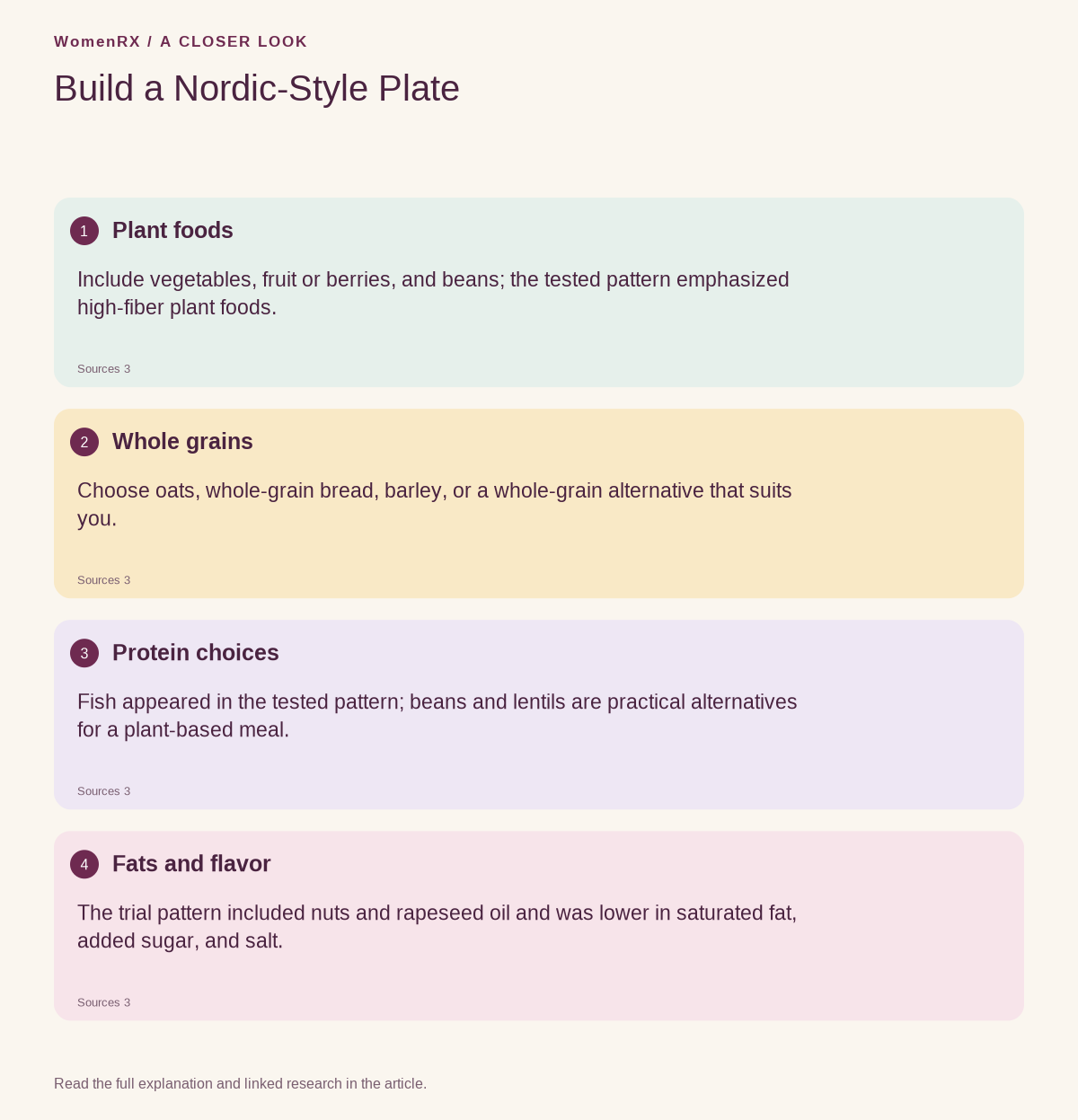
Build a Nordic-Style Plate
Plant foods: Include vegetables, fruit or berries, and beans; the tested pattern emphasized high-fiber plant foods.3
Whole grains: Choose oats, whole-grain bread, barley, or a whole-grain alternative that suits you.3
Protein choices: Fish appeared in the tested pattern; beans and lentils are practical alternatives for a plant-based meal.3
Fats and flavor: The trial pattern included nuts and rapeseed oil and was lower in saturated fat, added sugar, and salt.3
Read the figure as text
Use this checklist to see the pattern’s main food groups and adapt them to your preferences. It is a practical guide, not a validated score or weight-loss prescription.- Plant foods: Include vegetables, fruit or berries, and beans; the tested pattern emphasized high-fiber plant foods.3
- Whole grains: Choose oats, whole-grain bread, barley, or a whole-grain alternative that suits you.3
- Protein choices: Fish appeared in the tested pattern; beans and lentils are practical alternatives for a plant-based meal.3
- Fats and flavor: The trial pattern included nuts and rapeseed oil and was lower in saturated fat, added sugar, and salt.3
Sources you can check
- Effects of a healthy Nordic diet on weight loss in adults: a systematic review and meta-analysis of randomized controlled clinical trials.Ramezani-Jolfaie N, Mohammadi M, Salehi-Abargouei A. · Eating and weight disorders : EWD · 2020Return to first citation
- Health effect of the New Nordic Diet in adults with increased waist circumference: a 6-mo randomized controlled trial.Poulsen SK, Due A, Jordy AB, Kiens B, Stark KD, Stender S, Holst C, Astrup A, Larsen TM. · The American journal of clinical nutrition · 2014Return to first citation
- Effects of a healthy Nordic diet on cardiovascular risk factors in hypercholesterolaemic subjects: a randomized controlled trial (NORDIET).Adamsson V, Reumark A, Fredriksson IB, Hammarström E, Vessby B, Johansson G, Risérus U. · Journal of internal medicine · 2011Return to first citation
- Predicting weight loss success on a new Nordic diet: an untargeted multi-platform metabolomics and machine learning approach.Pigsborg K, Stentoft-Larsen V, Demharter S, Aldubayan MA, Trimigno A, Khakimov B, Engelsen SB, Astrup A, Hjorth MF, Dragsted LO, Magkos F. · Frontiers in nutrition · 2023Return to first citation