The Nordic Diet, With Foods You Can Find Locally
Nordic-style eating is a flexible pattern built around whole grains, produce, fish, and plant oils, not a list of specialty foods you have to track down.
A healthy Nordic-style pattern emphasizes whole grains, fruits and vegetables, berries, vegetable oils, fish, and lower-fat dairy and meat. You can choose familiar local foods that keep those broad features: whole-wheat bread instead of a Nordic whole-grain loaf, for example, or frozen blueberries instead of bilberries. These are practical swaps, not foods proven to produce identical health effects. 5 6
The pattern matters more than the passport
The healthy Nordic diets studied in adults weren’t defined by requiring every meal to come from a particular country. They emphasized whole grains, fruits and vegetables, berries, vegetable oils, fish, and lower-fat milk products and meat. That gives you a useful starting point: build meals around those food groups, then choose versions you can actually buy and enjoy. 5 6
In one multicenter randomized trial called SYSDIET, 200 adults with features of metabolic syndrome were assigned to a healthy Nordic diet or a control diet for 18 or 24 weeks. The study’s Nordic pattern included whole grains, produce, berries, vegetable oils and margarines, fish, and lower-fat milk products and meat. Participants were men and women, with a mean age of 55; the reported findings did not separate results by women’s life stage. Several published analyses of this diet draw on that same trial, not on separate groups of participants. 4 5 6
That trial and its related analyses examined cardiometabolic measures in adults with metabolic syndrome. They don’t show that a Nordic-style pattern is superior for every person, or that a particular swap will reproduce a trial result. 4 5 6
Make the foods familiar
Use these studied-food-to-local-choice pairs as practical starting points, not as claims that two foods are nutritionally or medically identical:
- Nordic whole-grain products → supermarket whole-wheat bread or oatmeal. The feature to keep is a whole-grain food, not a particular national recipe. Whole-grain products were part of the SYSDIET pattern; oat-bran porridge and whole-grain bread appeared in a separate breakfast trial. 2 5 6
- Lingonberries or bilberries → fresh or frozen blueberries. This keeps berries in the meal without requiring a specialty jam. Lingonberry and bilberry jam appeared in the breakfast trial, while blueberries appeared in a separate multifunctional-diet study; neither study tested this exact swap. 2 3
- Vegetable oils → canola oil, for example. Canola oil was identified as a component of the Nordic pattern in a SYSDIET analysis, and vegetable oils were included in the trial diet. Choosing another plant oil keeps the broad plant-oil feature, but the studies don’t show that different oils have identical effects. 4 6
- Fish → canned fish as a convenient option. This keeps fish on the menu in a convenient form. Fish was part of the SYSDIET pattern, and canned fish was provided in a separate multifunctional-diet study; those findings don’t establish identical effects across fish choices. 3 5 6
- Lower-fat milk → plain lower-fat yogurt if that’s easier to use. Both are lower-fat dairy choices, rather than a reason to search for a regional milk product. Milk or yogurt appeared in the breakfast trial, and lower-fat milk products were part of the SYSDIET pattern. 2 6
Beans and lentils can be useful familiar plant foods, too. They’re included among foods encouraged in the dietary recommendations discussed in a type 2 diabetes trial, but they shouldn’t be presented as a tested one-for-one substitute for fish in the Nordic-diet trial. 1
A simple way to put it together
For example, you might make oatmeal with berries for breakfast; choose a whole-grain sandwich with fish and vegetables for lunch; and serve a grain, vegetables, and fish or lower-fat meat at dinner, using a plant oil in cooking. These are illustrations, not a required menu. If you don’t eat fish or dairy, you can still use the pattern’s other familiar features, but the cited Nordic trial doesn’t establish that any specific alternative creates the same effects.
A small randomized trial offers a useful reminder not to overpromise from one meal: among 79 overweight adults with elevated LDL cholesterol, a Nordic-style high-fiber breakfast for 12 weeks did not change LDL cholesterol, other blood lipids, body weight, or glucose metabolism compared with usual breakfast, although some inflammation and abdominal-fat markers changed. That’s not a test of the full Nordic pattern, and it isn’t evidence that breakfast alone will deliver broad health benefits. The reported abstract does not give a sex breakdown for this breakfast study. 2
What the evidence can, and can’t, tell you
SYSDIET included men and women with features of metabolic syndrome, but its reported analyses don’t establish different results for women at different ages or during pregnancy, breastfeeding, or menopause. The separate breakfast study doesn’t report participants’ sex in its abstract. These studies also don’t provide a pregnancy- or lactation-specific meal plan or guidance for meeting nutrient needs during those stages. If you’re pregnant or breastfeeding, treat this as a broad food-pattern idea, not a complete guide to your individual nutrition needs. 2 5 6
For a beginner, a reasonable first move is simply to make one or two pattern features easier: choose a whole grain you like, keep frozen berries on hand, or use a plant oil you already have. There’s no need to buy specialty foods or copy a regional menu exactly.
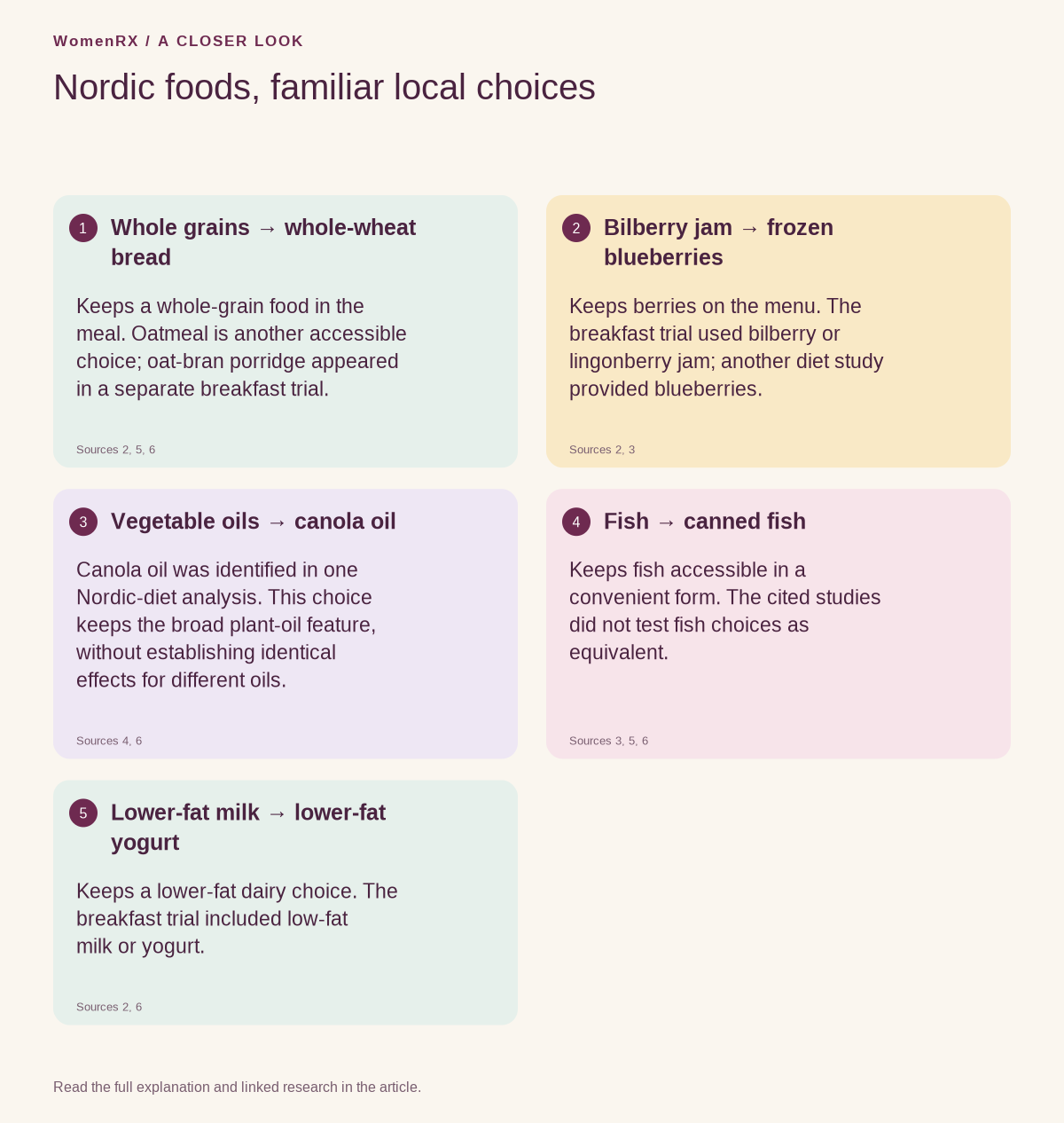
Nordic foods, familiar local choices
Whole grains → whole-wheat bread: Keeps a whole-grain food in the meal. Oatmeal is another accessible choice; oat-bran porridge appeared in a separate breakfast trial.256
Bilberry jam → frozen blueberries: Keeps berries on the menu. The breakfast trial used bilberry or lingonberry jam; another diet study provided blueberries.23
Vegetable oils → canola oil: Canola oil was identified in one Nordic-diet analysis. This choice keeps the broad plant-oil feature, without establishing identical effects for different oils.46
Fish → canned fish: Keeps fish accessible in a convenient form. The cited studies did not test fish choices as equivalent.356
Lower-fat milk → lower-fat yogurt: Keeps a lower-fat dairy choice. The breakfast trial included low-fat milk or yogurt.26
Read the figure as text
Each pair shows a studied food or food group, an accessible choice, and the broad feature the choice keeps. It does not imply proven equivalent health effects.- Whole grains → whole-wheat bread: Keeps a whole-grain food in the meal. Oatmeal is another accessible choice; oat-bran porridge appeared in a separate breakfast trial.256
- Bilberry jam → frozen blueberries: Keeps berries on the menu. The breakfast trial used bilberry or lingonberry jam; another diet study provided blueberries.23
- Vegetable oils → canola oil: Canola oil was identified in one Nordic-diet analysis. This choice keeps the broad plant-oil feature, without establishing identical effects for different oils.46
- Fish → canned fish: Keeps fish accessible in a convenient form. The cited studies did not test fish choices as equivalent.356
- Lower-fat milk → lower-fat yogurt: Keeps a lower-fat dairy choice. The breakfast trial included low-fat milk or yogurt.26
More questions, answered
Do you need traditional Nordic foods to follow the pattern?
No. The studied pattern is described through food groups, including whole grains, produce, berries, plant oils, fish, and lower-fat dairy. Familiar local choices can help you include those features, though specific substitutions haven’t been shown to produce identical effects. 5 6
Has the Nordic diet been studied specifically during pregnancy or breastfeeding?
The SYSDIET trial included men and women but did not report pregnancy- or breastfeeding-specific findings. The separate breakfast trial does not report participants’ sex in its abstract. Neither provides a nutrition plan for pregnancy or lactation. 2 5 6
Sources you can check
- The effect of an app-based dietary education on dietary intake and cardiometabolic risk markers in people with type 2 diabetes: results from a randomized controlled trial.Sjöblom L, Hantikainen E, Dahlgren A, Trolle Lagerros Y, Bonn SE. · Nutrition journal · 2025Return to first citation
- Role of a prudent breakfast in improving cardiometabolic risk factors in subjects with hypercholesterolemia: a randomized controlled trial.Adamsson V, Reumark A, Marklund M, Larsson A, Risérus U. · Clinical nutrition (Edinburgh, Scotland) · 2015Return to first citation
- A randomized trial involving a multifunctional diet reveals systematic lipid remodeling and improvements in cardiometabolic risk factors in middle aged to aged adults.Arroyo CB, Ocariz MG, Rogova O, Al-Majdoub M, Björck I, Tovar J, Spégel P. · Frontiers in nutrition · 2023Return to first citation
- A dietary biomarker approach captures compliance and cardiometabolic effects of a healthy Nordic diet in individuals with metabolic syndrome.Marklund M, Magnusdottir OK, Rosqvist F, Cloetens L, Landberg R, Kolehmainen M, Brader L, Hermansen K, Poutanen KS, Herzig KH, Hukkanen J, Savolainen MJ, Dragsted LO, Schwab U, Paa... · The Journal of nutrition · 2014Return to first citation
- Analysis of the SYSDIET Healthy Nordic Diet randomized trial based on metabolic profiling reveal beneficial effects on glucose metabolism and blood lipids.Gürdeniz G, Uusitupa M, Hermansen K, Savolainen MJ, Schwab U, Kolehmainen M, Brader L, Cloetens L, Herzig KH, Hukkanen J, Rosqvist F, Ulven SM, Gunnarsdóttir I, Thorsdottir I, Ores... · Clinical nutrition (Edinburgh, Scotland) · 2022Return to first citation
- A Healthy Nordic Diet Alters the Plasma Lipidomic Profile in Adults with Features of Metabolic Syndrome in a Multicenter Randomized Dietary Intervention.Lankinen M, Schwab U, Kolehmainen M, Paananen J, Nygren H, Seppänen-Laakso T, Poutanen K, Hyötyläinen T, Risérus U, Savolainen MJ, Hukkanen J, Brader L, Marklund M, Rosqvist F, Her... · The Journal of nutrition · 2015Return to first citation