Which Eating Patterns Have the Best Heart Evidence?
DASH has strong evidence for lowering blood pressure, while cholesterol-focused swaps and Mediterranean-style eating offer other useful ways to shape a heart-healthy diet.
If blood pressure is your main concern, DASH is a well-supported place to start. It also improves cholesterol levels. For high LDL cholesterol, replacing foods high in saturated fat with nuts or unsaturated oils is a more targeted move. Mediterranean-style eating is another reasonable pattern, but changes in blood pressure or cholesterol aren’t the same as proof that a diet prevents heart attacks. 568
Start with the number you want to change
A heart-healthy diet isn’t a contest to find the single best food. The more useful question is what your eating pattern could change: blood pressure, LDL cholesterol, or your longer-term chance of a cardiovascular event. Those are related, but they aren’t interchangeable outcomes.
DASH, short for Dietary Approaches to Stop Hypertension, has particularly clear support for blood pressure. It emphasizes vegetables, fruit and whole grains; includes beans, nuts, fish, poultry, vegetable oils and lower-fat dairy; and limits foods high in saturated fat, sweets and sugar-sweetened drinks. Research underlying the plan found improvements in blood pressure and cholesterol levels. 5
That gives you room to work with meals you already eat. For example, you could build a familiar dinner around beans and vegetables more often, rather than treating one newly added “superfood” as the intervention. The pattern matters more than a single ingredient. 5
DASH and Mediterranean-style eating: what can we compare?
These patterns overlap in their emphasis on plant foods, but they aren’t identical. 510 In a three-month randomized trial of adults who had high-normal blood pressure or grade 1 hypertension and had never been treated with blood-pressure medicine, researchers compared salt restriction alone, DASH plus salt restriction, Mediterranean-style eating plus salt restriction, and minimal intervention. All three dietary intervention groups had lower blood pressure and lower total and LDL cholesterol than the minimal-intervention group. Mediterranean-style eating with salt restriction produced a greater blood-pressure reduction than DASH with salt restriction in this trial. 8
That’s useful, but it isn’t a universal winner’s podium. The study measured risk factors over three months, not heart attacks or strokes years later. Both named patterns were paired with salt restriction, so its results don’t tell us how either would perform without that component. The reported results also don’t establish that one pattern works better specifically for women. 8
If you already enjoy meals built around vegetables, legumes, nuts and olive oil, a Mediterranean-style pattern may feel like a natural fit. 10 If you want a clearly described plan aimed at blood pressure, DASH offers one. The practical choice is a pattern you can make part of ordinary eating, while keeping your own blood-pressure and cholesterol results in view. 568
For LDL cholesterol, pay attention to what replaces what
When LDL cholesterol is the concern, the fat swap is more specific than a general instruction to “eat healthy.” Saturated fat raises LDL cholesterol. MedlinePlus recommends choosing foods with healthier fats, including nuts and unsaturated oils such as olive, canola or safflower oil, in place of sources of saturated fat. It identifies some meats, dairy products, baked goods, and deep-fried or processed foods as potential sources. 6
Consider two examples: using an unsaturated oil instead of a fat high in saturated fat when cooking, or choosing nuts in place of a snack that’s high in saturated fat. These are examples of substitutions, not promises that either food on its own will prevent heart disease. A label can help you compare saturated fat across the particular products you buy. 6
Sodium is a different lever. Reducing it can help lower blood pressure, but it isn’t a way to lower cholesterol. That distinction can save you from judging a food by one claim on its package: “low sodium” doesn’t tell you whether it fits your LDL goal, and an unsaturated-fat swap doesn’t address all the sodium in a meal. 6
A small eight-week randomized trial adds another reason not to assume every favorable swap changes every marker. Among 90 adults with obesity and metabolic syndrome, a plant-protein DASH diet produced a greater reduction in systolic blood pressure than an animal-protein DASH diet, after accounting for weight change. The groups did not differ significantly in LDL or HDL cholesterol changes. That finding supports a blood-pressure distinction in this study population, not an LDL claim for the protein swap. 9
What do we know about heart attacks and strokes?
Blood pressure and LDL cholesterol are worth addressing, but a change in either is not itself a measured reduction in heart attacks or strokes. In an observational UK Biobank study of 83,248 adults with untreated or uncontrolled high blood pressure and no prior cardiovascular disease, those with the highest DASH diet-quality scores had a lower rate of a combined outcome of nonfatal cardiovascular events and cardiovascular death than those with the lowest scores. This was an association, not a trial showing that assigning people to DASH prevented events. In this population, the study did not find a statistically significant association between its Mediterranean diet score and that cardiovascular outcome. 3
That result shouldn’t be stretched into “Mediterranean eating doesn’t help.” It tells us what these diet scores were associated with in one particular high-blood-pressure population. Meanwhile, a US cross-sectional study of adults who already had hypertension found no significant association between its measure of DASH adherence and having controlled blood pressure. Because it measured diet and blood-pressure control at the same time, it can’t overturn dietary trials or show what would happen if someone changed her eating pattern. 4
What changes for women?
The cited dietary comparisons do not report a clear women-specific advantage for DASH or Mediterranean-style eating, so there’s no sound basis here for a separate ranking for women. 89 Your health history may still change how closely you watch risk factors: heart-disease risk rises after menopause, and a history of gestational hypertension raises the chance of high blood pressure later. 27
If you had high blood pressure during pregnancy, mention that history when your cardiovascular risk is assessed. And don’t rely on how you feel to judge whether a food change is enough: high blood pressure usually has no symptoms and is identified by measurement. Diet can be part of managing it, but some people also need medicine. 71
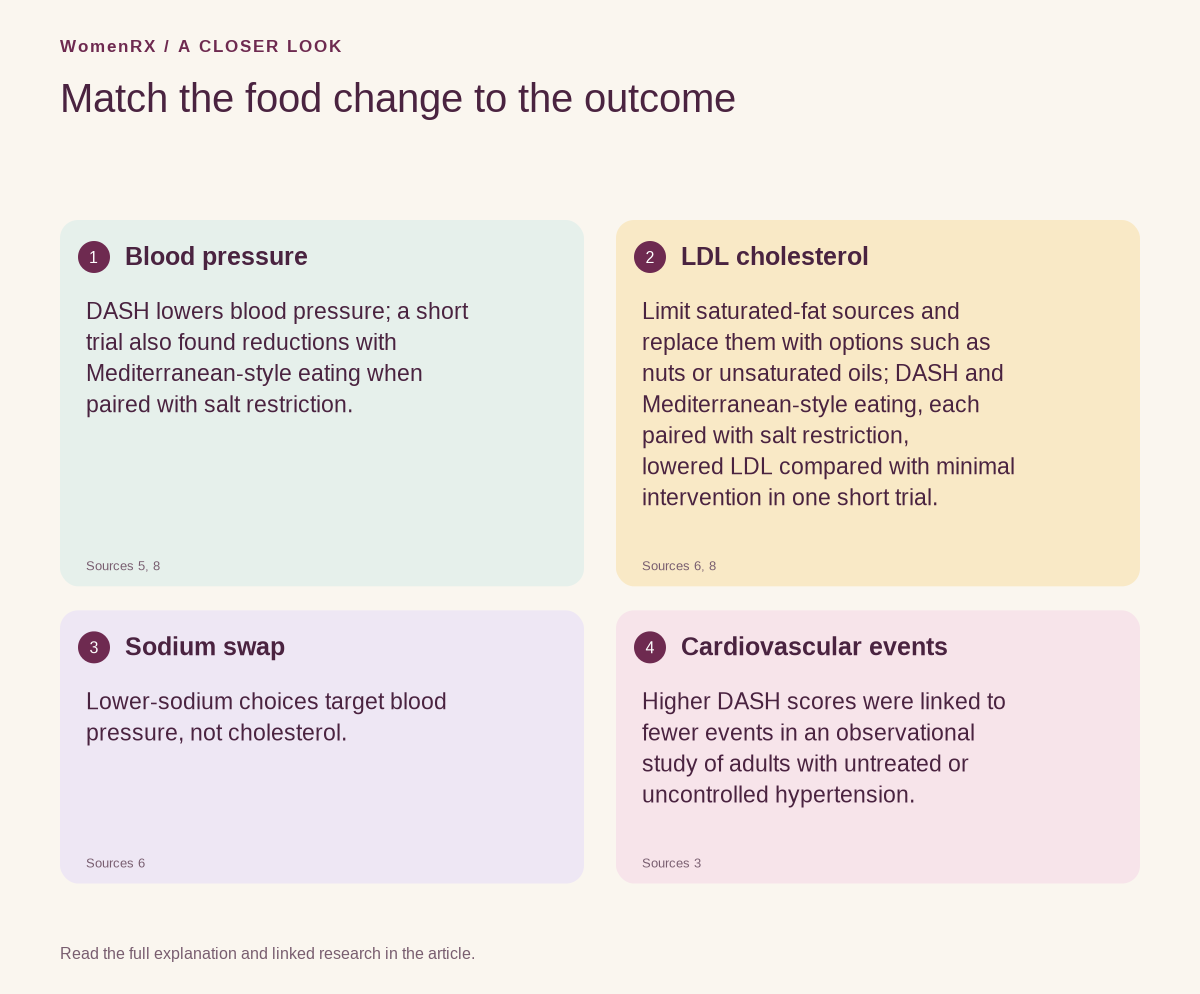
Match the food change to the outcome
Blood pressure: DASH lowers blood pressure; a short trial also found reductions with Mediterranean-style eating when paired with salt restriction.58
LDL cholesterol: Limit saturated-fat sources and replace them with options such as nuts or unsaturated oils; DASH and Mediterranean-style eating, each paired with salt restriction, lowered LDL compared with minimal intervention in one short trial.68
Sodium swap: Lower-sodium choices target blood pressure, not cholesterol.6
Cardiovascular events: Higher DASH scores were linked to fewer events in an observational study of adults with untreated or uncontrolled hypertension.3
Read the figure as text
The strongest takeaway depends on whether you mean blood pressure, LDL cholesterol or measured cardiovascular events.- Blood pressure: DASH lowers blood pressure; a short trial also found reductions with Mediterranean-style eating when paired with salt restriction.58
- LDL cholesterol: Limit saturated-fat sources and replace them with options such as nuts or unsaturated oils; DASH and Mediterranean-style eating, each paired with salt restriction, lowered LDL compared with minimal intervention in one short trial.68
- Sodium swap: Lower-sodium choices target blood pressure, not cholesterol.6
- Cardiovascular events: Higher DASH scores were linked to fewer events in an observational study of adults with untreated or uncontrolled hypertension.3
Sources you can check
- High Blood Pressure | Hypertension | MedlinePlusAccessed 2026-09-25Return to first citation
- Heart Disease in Women | MedlinePlusAccessed 2026-09-25Return to first citation
- Dietary Patterns and Risk of Cardiovascular Disease and All-Cause Mortality in Adults with Untreated or Uncontrolled Hypertension.Chen SH, Liu B, Cheng HM, Liang L, Hu FB. · The Journal of nutrition · 2026Return to first citation
- Association Between Dietary Pattern Adherence and Blood Pressure Control Among U.S. Adults: A Descriptive Analysis of National Health and Nutrition Examination Survey (NHANES) 2017-2020 Data.Akinboboye AC, Manafa CC, Odukale-Okuneye AO, Ariahu N, Adesoye I. · Cureus · 2026Return to first citation
- DASH Eating Plan: MedlinePlusAccessed 2026-09-25Return to first citation
- How to Lower Cholesterol with Diet: MedlinePlusAccessed 2026-09-25Return to first citation
- High Blood Pressure in Pregnancy | Preeclampsia | MedlinePlusAccessed 2026-09-25Return to first citation
- Effect of DASH vs. mediterranean diet accompanied by a salt restriction on metabolic syndrome and cardiometabolic risk factors in adults with high normal blood pressure or grade 1 hypertension: secondary analyses of a randomized controlled trial.Filippou CD, Thomopoulos CG, Konstantinidis DG, Dimitriadis KS, Chrysochoou CA, Tatakis FA, Siafi EP, Tousoulis DM, Nihoyannopoulos PI, Panagiotakos DB, Tsioufis KP. · Hellenic journal of cardiology : HJC = Hellenike kardiologike epitheorese · 2025Return to first citation
- Effect of dietary approaches to stop hypertension (DASH) diet, high in animal or plant protein on cardiometabolic risk factors in obese metabolic syndrome patients: A randomized clinical trial.Vasei MH, Hosseinpour-Niazi S, Ainy E, Mirmiran P. · Primary care diabetes · 2022Return to first citation
- Placental lipid handling, growth and inflammatory pathways are modified by a maternal Mediterranean diet.Lopez-Tello J, Youssef L, Bermejo-Poza R, Cabezas A, De la Fuente J, Crovetto F, Gratacos E, Crispi F, Sferruzzi-Perri AN. · Scientific reports · 2026Return to first citation