The MIND Diet: What It May Mean for Brain Health
The MIND diet offers a practical pattern of brain-focused food choices, but current evidence doesn’t show that following it prevents dementia.
The MIND diet combines elements of Mediterranean and DASH-style eating, emphasizing leafy greens, berries, nuts, beans, whole grains, olive oil, seafood, and poultry while limiting foods high in saturated fat. Studies often link closer adherence with better cognitive outcomes, but much of that evidence is observational. A major trial did not find a significant cognitive advantage over another calorie-restricted diet after three years. 1 3
A food pattern, not a promise
MIND stands for Mediterranean-DASH Intervention for Neurodegenerative Delay. It combines parts of Mediterranean and DASH-style eating, with particular emphasis on green leafy vegetables and berries. The pattern also includes nuts, legumes, whole grains, olive oil, seafood, and poultry, and encourages limiting foods high in saturated fat. 3
The idea is to make a set of food choices that may support brain health, not to follow a proven dementia-prevention treatment. That distinction matters: long-term studies often find that people who score higher on MIND-diet adherence have better cognitive outcomes, but those studies can show an association, not that the diet itself caused the difference. 1
What the score can, and can’t, tell you
Researchers generally estimate adherence from reported eating habits, then compare people with higher and lower diet scores. The score is a way to describe a pattern across food categories, not a test of your brain health. Studies have used different assessment and scoring methods, and a systematic review found that this variation makes it difficult to identify one optimal MIND score. 1
That means you don’t need to treat the score as a pass-or-fail target. A useful beginner approach is to look at what you already eat and choose a realistic swap that moves a meal toward the pattern. For example, you might add leafy greens to a lunch you already like, choose berries with breakfast, or use beans in a meal that often relies on meat. These are examples of applying the food categories, not a guarantee of a particular score or cognitive benefit.
The evidence is encouraging in places, but not conclusive. In the systematic review, most of the included observational studies reported favorable associations with global cognition, specific cognitive skills, or dementia risk. The review also found mixed results among randomized trials, which are better suited to testing whether changing a diet causes an outcome. 1
One important trial compared a MIND diet with a control diet over three years in adults aged 65 and older who were overweight, cognitively unimpaired, had a family history of dementia, and had a suboptimal diet. Both groups were assigned calorie-restricted diets. The trial’s primary analysis found no significant difference in cognitive change between the groups after three years. 3
So the honest takeaway is not that the MIND diet has no value, or that it prevents dementia. It’s that observational associations have not yet become clear proof that adopting this specific diet slows cognitive decline.
What’s known about women
The evidence does not establish a special MIND-diet benefit for women. Some research includes women: the three-year trial enrolled men and women aged 65 and older, and its assignment process accounted for sex. But the reported trial findings don’t include a separate result for women, so they can’t tell us whether the diet affected women differently. 3
A large population study reported similar associations across subgroups defined by sex, among other characteristics. That is useful context, but it is still observational evidence and does not prove that the diet works equally well, or prevents dementia, in women. 2 The systematic review covers studies in middle-aged and older adults overall; it does not establish a specific benefit for older women or a distinct result for women during perimenopause or after menopause. 1
Make the pattern fit your life
Think in food categories rather than a perfect daily menu. If you want to try the pattern, you could:
- Add a leafy green to a familiar meal.
- Choose berries alongside a snack or breakfast.
- Use beans, nuts, or whole grains in meals where they fit your tastes.
- Choose seafood or poultry sometimes in place of a food high in saturated fat.
- Use olive oil in place of another cooking fat when it works for the dish.
These examples reflect the foods emphasized in the MIND pattern; they don’t specify a validated amount or promise a change in memory. The MIND diet includes wine in some descriptions, but you don’t need to start drinking to try the pattern. In the trial described here, researchers made no wine recommendation. 3
If a change feels too restrictive, too costly, or difficult to maintain, it may not be a good fit. A sustainable shift toward foods you enjoy is a more realistic starting point than trying to achieve a perfect score. The evidence supports treating MIND as one possible way to organize healthy food choices, not as a substitute for a guarantee about your future brain health.
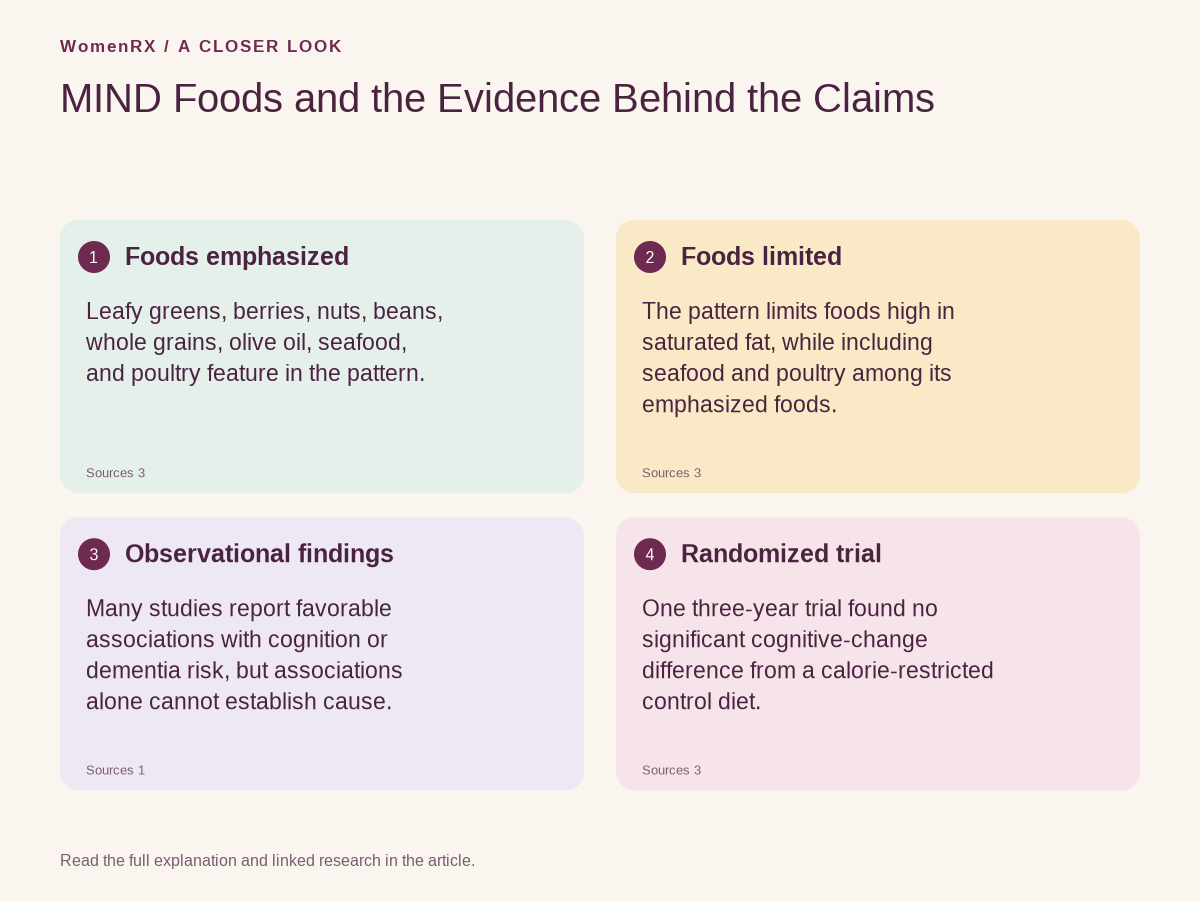
MIND Foods and the Evidence Behind the Claims
Foods emphasized: Leafy greens, berries, nuts, beans, whole grains, olive oil, seafood, and poultry feature in the pattern.3
Foods limited: The pattern limits foods high in saturated fat, while including seafood and poultry among its emphasized foods.3
Observational findings: Many studies report favorable associations with cognition or dementia risk, but associations alone cannot establish cause.1
Randomized trial: One three-year trial found no significant cognitive-change difference from a calorie-restricted control diet.3
Read the figure as text
The food pattern is straightforward to describe; the harder question is whether following it causes better cognitive outcomes.- Foods emphasized: Leafy greens, berries, nuts, beans, whole grains, olive oil, seafood, and poultry feature in the pattern.3
- Foods limited: The pattern limits foods high in saturated fat, while including seafood and poultry among its emphasized foods.3
- Observational findings: Many studies report favorable associations with cognition or dementia risk, but associations alone cannot establish cause.1
- Randomized trial: One three-year trial found no significant cognitive-change difference from a calorie-restricted control diet.3
More questions, answered
Does following the MIND diet prevent dementia?
Dementia prevention hasn’t been established. Observational studies often link higher MIND-diet adherence with more favorable cognitive outcomes, but that doesn’t prove the diet caused them. A three-year randomized trial measured cognitive change, not dementia prevention, and found no significant advantage over a calorie-restricted control diet. 1 3
Do women get a different benefit from the MIND diet?
Current findings don’t establish a women-specific benefit. Some studies include women or examine results across sex subgroups, but the reported trial results don’t give a separate randomized-trial result for women. 2 3
Sources you can check
- The association between the MIND diet and cognitive health in middle-aged and older adults: A systematic review.Tse JHW, Law QPS, Tsang JTY, Suen LKP, Tyrovolas S, Kwan RYC. · The journal of nutrition, health & aging · 2025Return to first citation
- Circulating metabolomic profile of the MIND diet and its relation to cognition in middle-aged and older adults.Chen H, Shen J, Tao Y, Zhang Y, Gao M, Ma Y, Zheng Y, Zong G, Lin Q, Tong L, Yuan C. · iMetaOmics · 2025Return to first citation
- Genetic Variation in Response to the Mediterranean-DASH Intervention for Neurodegenerative Delay (MIND): A Randomized Controlled Trial.Cornelis MC, Barnes LL. · Nutrients · 2026Return to first citation