The MIND Diet: What Women Over 40 Should Know
The MIND diet has encouraging but mixed evidence for cognitive health, and the studies don’t establish that it prevents dementia or causes weight loss.
The MIND diet combines elements of Mediterranean and DASH eating patterns: it emphasizes foods such as leafy greens, whole grains, beans, nuts, fish and olive oil, while limiting foods such as red meat, butter, sweets and fried foods. Studies in women and mixed-sex groups offer some promising cognitive findings, but observational associations don’t prove cause and effect. A small trial in women is encouraging, not conclusive. 1 2 3 4
What the MIND diet looks like
MIND stands for Mediterranean-DASH Intervention for Neurodegenerative Delay. It blends parts of the Mediterranean diet and DASH, a pattern developed to address blood pressure. Its scoring system includes 10 food groups to favor and five to limit. Examples of foods emphasized include leafy green vegetables, nuts, beans and other legumes, whole grains, fish, poultry and olive oil. Foods the pattern limits include red meat, butter, cheese, sweets and fried foods. 2
That’s a food-pattern framework, not a guarantee that a particular meal or ingredient protects memory. The useful everyday takeaway is to think about the overall mix of foods you eat, rather than treating one food as a brain-health fix.
What studies in women actually show
There are studies involving women, but they don’t answer the same question or represent the same stage of life.
In a prospective study of 16,058 women aged 70 and older, greater long-term MIND-diet adherence was associated with a slightly better average verbal-memory score. It was not associated with less decline over six years in verbal memory, global cognition or the study’s overall cognitive test score. Because this was an observational study, it can show an association, not that the diet caused the difference. 4
A small randomized trial offers a different kind of evidence. It enrolled women with obesity whose average age was 48, assigning them to a calorie-restricted MIND diet or a calorie-restricted control diet. Among the 37 participants who completed the three-month study, some cognitive test results improved more in the MIND group than in the control group. The researchers also reported differences in some brain-imaging measures. The trial is relevant to midlife women, but its small size, short duration and specific participant group limit how broadly its findings can be applied. The reported findings do not establish a menopause-specific effect. 1
Together, these studies make a midlife benefit plausible enough to investigate, but they don’t show that all women over 40 will experience better cognition from eating this way. Nor do they show that a benefit is tied to menopause status.
Why the overall evidence remains mixed
A large UK Biobank analysis examined MIND adherence in relation to cognitive-test performance and, separately, followed dementia diagnoses in a subset aged 55 and older. Higher adherence was associated with slightly worse performance on five of the seven cognitive tests. In the dementia analysis, MIND adherence was not associated with incident dementia overall; a lower dementia risk appeared in a women-only analysis, but not among men. That finding is observational, not proof that MIND prevents dementia in women. The study also found similar patterns for another healthy-eating score, so it doesn’t establish a unique effect of the MIND pattern. 3
A 2025 systematic review of older-adult research found that several observational studies reported better cognitive outcomes with greater MIND adherence, while one cohort study and the single randomized trial included in its review found no effect. The authors also noted that the review did not assess the quality of the included studies. The mix of positive associations and null results is a reason for measured expectations, not a settled verdict. 2
Don’t confuse cognition evidence with weight-loss evidence
A diet can be studied for one outcome without being proven to affect another. The small trial in women with obesity tested a calorie-restricted MIND pattern against a calorie-restricted control diet, and its primary outcome was cognitive performance. That design cannot isolate whether MIND itself causes weight loss, and the cognitive findings should not be presented as proof of a weight-loss effect. 1
If you’re considering this pattern, you can use its food priorities as a way to shape meals without treating strict adherence as a promise of better memory or a particular change on the scale. The evidence supports interest in the pattern, but not a prevention claim or a guaranteed result.
MIND Foods and the Evidence Behind the Claims
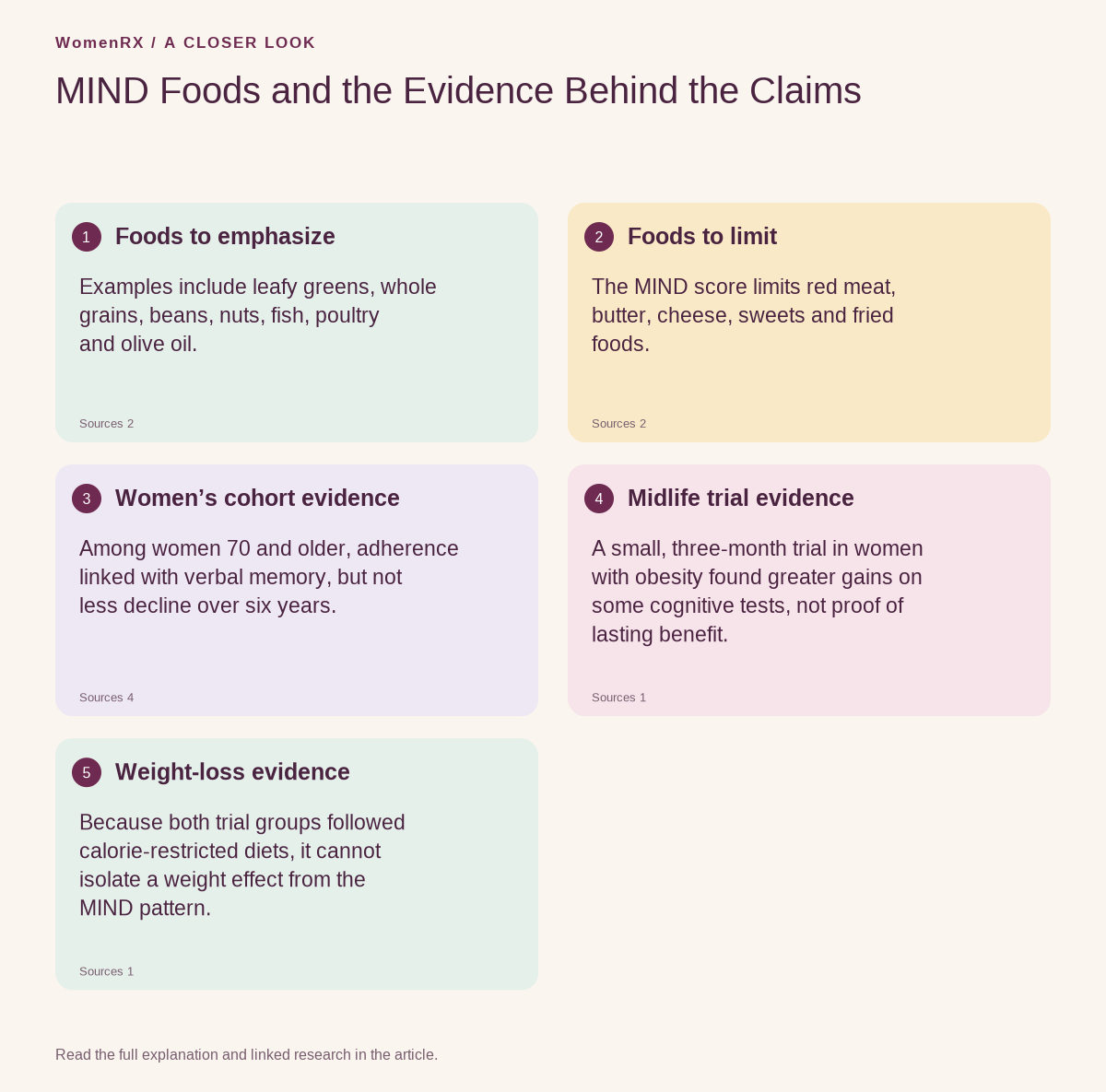
Foods to emphasize: Examples include leafy greens, whole grains, beans, nuts, fish, poultry and olive oil.2
Foods to limit: The MIND score limits red meat, butter, cheese, sweets and fried foods.2
Women’s cohort evidence: Among women 70 and older, adherence linked with verbal memory, but not less decline over six years.4
Midlife trial evidence: A small, three-month trial in women with obesity found greater gains on some cognitive tests, not proof of lasting benefit.1
Weight-loss evidence: Because both trial groups followed calorie-restricted diets, it cannot isolate a weight effect from the MIND pattern.1
Read the figure as text
The pattern’s food priorities are distinct from the still-evolving evidence about cognition and weight.- Foods to emphasize: Examples include leafy greens, whole grains, beans, nuts, fish, poultry and olive oil.2
- Foods to limit: The MIND score limits red meat, butter, cheese, sweets and fried foods.2
- Women’s cohort evidence: Among women 70 and older, adherence linked with verbal memory, but not less decline over six years.4
- Midlife trial evidence: A small, three-month trial in women with obesity found greater gains on some cognitive tests, not proof of lasting benefit.1
- Weight-loss evidence: Because both trial groups followed calorie-restricted diets, it cannot isolate a weight effect from the MIND pattern.1
Sources you can check
- Effect of MIND diet intervention on cognitive performance and brain structure in healthy obese women: a randomized controlled trial.Arjmand G, Abbas-Zadeh M, Eftekhari MH. · Scientific reports · 2022Return to first citation
- Effects of the MIND Diet on the Cognitive Function of Older Adults: A Systematic Review.Kim S, Jang EH, Lee S. · Clinical nutrition research · 2025Return to first citation
- MIND Dietary Pattern and Its Association with Cognition and Incident Dementia in the UK Biobank.Cornelis MC, Agarwal P, Holland TM, van Dam RM. · Nutrients · 2022Return to first citation
- Association of Long-Term Adherence to the MIND Diet with Cognitive Function and Cognitive Decline in American Women.Berendsen AM, Kang JH, Feskens EJM, de Groot CPGM, Grodstein F, van de Rest O. · The journal of nutrition, health & aging · 2018Return to first citation